
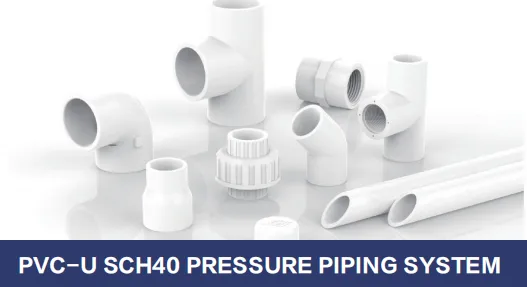
Think of PVC-U SCH40 as a skeleton - it provides structure but needs joints to function. Accessories are these critical connection points that determine system integrity. Choose poorly, and you risk leaks, pressure drops, or catastrophic failures. Choose wisely, and you create systems that flow smoothly for decades. Understanding fittings is particularly crucial for industrial pvc pressure pipes installations where downtime means significant financial losses.
The traffic directors of piping systems, these fittings navigate corners and obstacles. The 45° elbow provides gentler flow redirection, reducing turbulence and preserving pressure - perfect for precision irrigation systems. The 90° version handles sharp directional changes where space is limited, common in basement plumbing configurations.
These three-way connectors serve as distribution hubs. Standard tees split flow evenly, while reducing tees manage branch lines with different diameters. Chemical processing plants rely on tees for reagent distribution lines, ensuring precise volumetric flow to multiple reaction chambers through a single inlet.
The unsung repair heroes. Full couplings join identical pipe ends during initial installation while repair couplings save the day when fixing damaged sections without complete disassembly. Municipal water departments keep these stocked for emergency main breaks where quick repairs minimize service interruptions.
Designed for practical convenience, unions feature threaded collars that allow disconnection without pipe rotation. Essential for pump stations, they enable quick impeller replacements. Water treatment facilities install unions before and after critical components for scheduled maintenance access without draining entire systems.
More than just endpoints, caps provide secure system termination and future expansion points. Threaded caps allow temporary sealing during phased construction, while solvent-weld versions create permanent closures. Fire sprinkler contractors use caps to seal test points after system certification.
Where caps cover pipe ends, plugs seal accessory openings. Cleanout plugs in waste systems offer maintenance access. Expansion tank fittings feature pressure-test plugs that verify integrity before commissioning. Industrial applications use brass-core plugs at sample points for fluid testing.
The diameter transition specialists. Hex bushings provide wrench surfaces for solid connections when adapting larger equipment ports to standard piping. Slip bushings offer flush transitions in tight spaces. Common in aquaculture systems where pipe sizes change between filtration stages and fish tanks.
The universal translators between different connection types. Male adapters transition from solvent-weld to threaded connections, allowing valve integration. Female adapters create threaded receivers. Essential in retrofits where modern PVC systems connect to legacy iron pipe infrastructure.
Four-way flow distributors that create complex manifolds. Industrial cooling systems use crosses for equal distribution across multiple heat exchangers. In stormwater management, crosses help balance flow between retention chambers. Their symmetrical design prevents flow biases common with multiple tees.
The heavy-duty connectors for equipment interfacing. Vanstone flanges compensate for minor misalignment during pump or tank installations. Blind flanges create expansion-ready system ends. Water treatment plants use flanged connections for rapid filter replacement during maintenance cycles.
With their 45° branch angle, wyes reduce turbulence where flows combine. Essential in vent stacks to prevent vapor lock. Agricultural drainage systems use wyes to merge collection lines into mains with minimal sediment accumulation at junctions.
More than simple drain components, modern traps feature cleanout ports and removable tops for deep cleaning. Commercial kitchen grease traps intercept fats before they enter municipal systems. Lab sink traps prevent chemical contamination of waste streams through internal cartridge filters.
Strategic access points transform maintenance nightmares into routine operations. Angled cleanouts serve tight spaces like under sinks. Extended reach models navigate deep soil penetration. Cities mandate cleanout placement every 50 feet in sewer laterals to enable hydro-jetting without property excavation.
Control systems demand proper valving. Ball valves provide bubble-tight shutoff for repairs and section isolation. Gate valves offer precise flow throttling in distribution networks. Check valves prevent backflow during pump cycling. Chemical plants use specialized valves that resist solvents.
Imagine a commercial greenhouse irrigation system: 90° elbows navigate structural columns, tees distribute water to different plant zones, unions connect to drip emitters for seasonal reconfiguration. Bushings adapt filters to pump diameters, while strategically placed cleanouts allow quick flushing of organic buildup. The entire system exemplifies how accessories transform pipes into functional infrastructure.
Material compatibility is just the starting point. Consider:
PVC-U SCH40 accessories form the critical connections that transform pipe segments into living systems. Beyond avoiding leaks, the right accessories optimize flow efficiency, simplify maintenance, reduce life-cycle costs, and prevent failures. For professionals, mastery of these components separates basic pipe-layers from true systems engineers. Whether in residential plumbing or industrial processing plants, thoughtful accessory selection ensures your piping system functions as a seamless, reliable whole.
Recommend Products












