


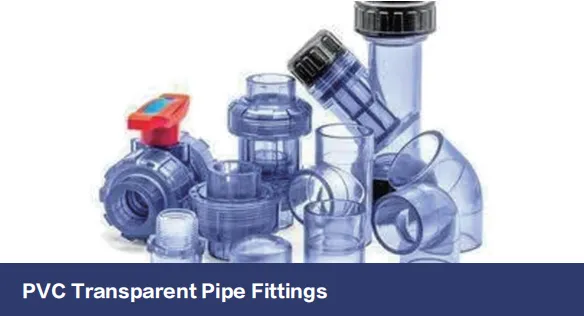
Ever grabbed a "1-inch PVC pipe" only to discover it's actually 1.315 inches wide? You're not alone! This comprehensive guide pulls back the curtain on PVC sizing mysteries and how they impact clear PVC fittings . We'll decode how manufacturers label pipes versus their actual dimensions—because nobody likes unexpected surprises mid-project!
Why Nominal ≠ Actual
Picture this: You're building a custom aquarium system with transparent pipes to monitor water flow. You order "¾-inch PVC," but your fittings don't seat properly. Why? PVC sizes work like clothing tags—they're approximate, not literal.
Transparent Pipe Size Cheat Sheet
These dimensions apply to both white and clear PVC—critical knowledge when planning visible installations:
Schedule 40 Clear PVC Dimensions
| Nominal Size (in) | Outer Diameter (in) | Inner Diameter (in) | Wall Thickness (in) | Max Pressure (PSI) |
|---|---|---|---|---|
| 1/8" | 0.405 | 0.249 | 0.068 | 810 |
| 1/4" | 0.540 | 0.344 | 0.088 | 780 |
| 3/8" | 0.675 | 0.473 | 0.091 | 620 |
| 1/2" | 0.840 | 0.602 | 0.109 | 600 |
| 3/4" | 1.050 | 0.804 | 0.113 | 480 |
| 1" | 1.315 | 1.029 | 0.133 | 450 |
| 1-1/4" | 1.660 | 1.360 | 0.140 | 370 |
| 1-1/2" | 1.900 | 1.590 | 0.145 | 330 |
| 2" | 2.375 | 2.047 | 0.154 | 280 |
Schedule 80 Clear PVC Dimensions
| Nominal Size (in) | Outer Diameter (in) | Inner Diameter (in) | Wall Thickness (in) | Max Pressure (PSI) |
|---|---|---|---|---|
| 1/8" | 0.405 | 0.195 | 0.095 | 1230 |
| 1/4" | 0.540 | 0.282 | 0.119 | 1130 |
| 3/8" | 0.675 | 0.403 | 0.126 | 920 |
| 1/2" | 0.840 | 0.526 | 0.147 | 850 |
| 3/4" | 1.050 | 0.722 | 0.154 | 690 |
| 1" | 1.315 | 0.936 | 0.179 | 630 |
| 1-1/4" | 1.660 | 1.255 | 0.191 | 520 |
| 1-1/2" | 1.900 | 1.476 | 0.200 | 470 |
| 2" | 2.375 | 1.913 | 0.218 | 400 |
Choosing Your Clear PVC Wisely
Why wall thickness matters for see-through pipes
Notice how Schedule 80 walls are thicker? That's not just about strength—it affects clarity too! Thicker walls reduce light distortion in transparent pipes, giving you truer fluid visibility. Perfect for:
- Home brewing setups monitoring sediment
- Laboratory fluid transfer systems
- Artistic installations with colored liquids
The pressure-temperature dance
Those PSI ratings? They assume water at 68°F (20°C). Heat softens PVC, dropping its pressure tolerance faster than an ice cube in summer! For hot applications like solar water systems:
Subtract 25% pressure capacity for every 15°F above room temperature
Consider CPVC instead for sustained 140°F+ environments
The Secret Sauce: Connecting Clear Pieces
Ever wondered why solvent welding works so well with PVC? That apparent "over-sizing" is intentional magic. When a 1" fitting (1.315" opening) meets a 1" pipe (1.315" OD) , they create an interference fit—like puzzle pieces clicking together.
Here's why this matters for transparent systems:
- Glue isn't glue – It's solvent that temporarily melts the joint
- Curing creates clarity – Properly welded joints become optically continuous
- Avoid cloudiness – Excess primer causes hazing in see-through pipes
Pro Tip: For crystal-clear joints, use clear cement instead of purple primer!
Beyond the Tape Measure
Whether you're building a hydroponic garden or chemical processor, understanding PVC's true dimensions transforms frustration into flawless execution. Remember:
- ️ Nominal is just a nickname – Always verify OD/ID
- ️ Clarity demands thickness – Schedule 80 offers superior optical performance
- Welding is science – Not all solvent cements play nice with transparent formulas
So next time you handle those crystal-clear pipes, you'll see more than fluid flowing—you'll see precision engineering in action!










