
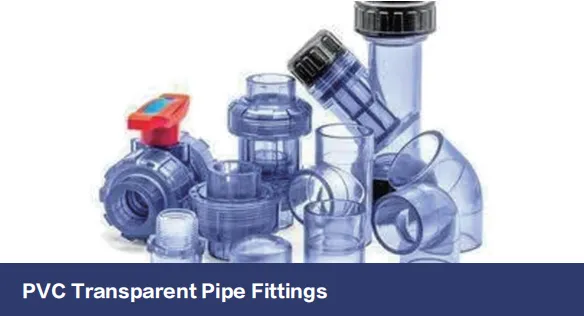
You know that moment when you're fixing a plumbing system and wish you could actually see what's happening inside the pipes? That's where PVC transparent fittings become game-changers. As someone who's spent years in industrial supply chains, I'm constantly amazed by how these crystal-clear connectors transform maintenance and monitoring.
Remember old-school metal pipes? You'd never know if corrosion was building up or debris was accumulating until the system failed. Transparent PVC fittings solve that with three killer advantages:
Walk into any modern water treatment plant and you'll notice them immediately – sections of piping where technicians can visually track flow rates, spot contamination, or catch leaks the moment they happen. It's like having X-ray vision for your infrastructure.
Unlike metal alternatives, these fittings won't corrode when handling acids or alkalis. I've seen installations in chemical plants still going strong after 8+ years where metal pipes would've needed replacement twice over.
New apprentices love working with these because they're significantly lighter than metal alternatives. Glue connections mean no welding gear, no threading tools – just quick, secure joins that even beginners get right.
This transparency revolution started in labs and pharmaceutical facilities but has exploded into mainstream use across 20+ industries, from municipal water systems to craft breweries where visual quality control matters.
Chinese factories have standardized what used to be specialty items into reliable, accessible components. Here's what really moves the needle:
The workhorses of directional change. What most buyers don't realize: the difference between cheap and quality comes down to wall thickness consistency. Top factories like Shuiyou ensure zero thinning on the bend radius – that's why they hold pressure decade after decade.
Game-changers for maintenance crews. Imagine checking pipe conditions without disassembly! Modern versions like Tongwei's SWD series feature reinforced junctions where branches meet – no more stress cracks at weak points.
Early transparent fittings yellowed in sunlight – not anymore. The secret? Premium manufacturers now add liquid UV stabilizers during compounding, not just surface coatings. You can spot quality by the blueish tint under sunlight.
Having toured factories from Zhejiang to Hunan, I've seen what separates great producers from the pack:
Top makers use virgin PVC compounds with specialized plasticizers that maintain clarity without brittleness. The exact formulations are closely guarded secrets, but you'll see the difference in cold weather performance – cheap versions crack below 5°C while premium withstand -15°C.
Ever wonder why some transparent fittings have bubbles or streaks? It comes down to mold temperature control during injection. Tier-1 factories maintain ±1°C accuracy throughout cycles – anything looser creates imperfections that weaken structures.
Export-focused manufacturers don't just meet DIN/ANSI standards – they exceed them. At Salvador Piping's facility, I witnessed fittings undergo 2x pressure tests: first right after molding, then again after 48-hour thermal cycling. That dual-check approach catches 99.6% of potential defects.
Pro Tip: Ask factories for their internal pressure test protocols. Reputable ones will share videos showing fittings under sustained pressure – if they hesitate, look elsewhere.
Water flow visibility is survival-critical for fry nurseries. Forward-thinking farms now use transparent upvc pipe fittings throughout their oxygenation systems. The ability to instantly spot blocked lines has reduced juvenile mortality rates by 18% in Guangdong aquaculture hubs.
Microbreweries love these for transfer lines between tanks. I watched a Beijing craft brewery head save thousands by catching hop debris accumulation before it reached conditioning tanks – visible through clear 90° elbows.
In sterile processing, being able to visually confirm no biofilm buildup is non-negotiable. Modern designs have ultra-smooth internal finishes (Ra ≤ 0.8 μm) that prevent microorganism adhesion – critical for WHO-GMP compliance.
After reviewing hundreds of installations worldwide, here's what's undeniable: Visibility in fluid systems isn't just convenient – it's becoming essential for reliability and safety. Chinese manufacturers transformed these from niche lab items into industrial staples through continuous refinement.
What started with simple monitoring applications now extends to specialized roles like:
The factories that will lead tomorrow are those investing in three areas right now: proprietary co-polymers for enhanced clarity, automated optical inspection systems that catch microscopic defects, and supply chain transparency proving ethical sourcing. Because these days, seeing clearly isn't just about the pipes—it's about the process too.
Recommend Products












