
In the bustling world of construction, where every decision impacts durability, cost, and functionality, few choices spark as much debate among suppliers as the selection between PVC DWV and ABS pipes. For a building material supplier, recommending the right drainage solution isn't just about checking boxes—it's about understanding project nuances, climate demands, and client priorities. As a one-stop architectural solution provider, balancing technical performance with real-world practicality becomes the cornerstone of trust. So why does a pvc dwv pipe supplier swear by their product in some regions, while an ABS advocate argues for its superiority elsewhere? Let's unpack this rivalry, exploring the factors that shape supplier preferences, from job sites in Riyadh to luxury hotels in Zurich, and everything in between.
Before diving into supplier preferences, let's establish what makes these two materials unique. Both serve the same core purpose—draining wastewater and venting sewer gases—but their compositions and characteristics set them worlds apart.
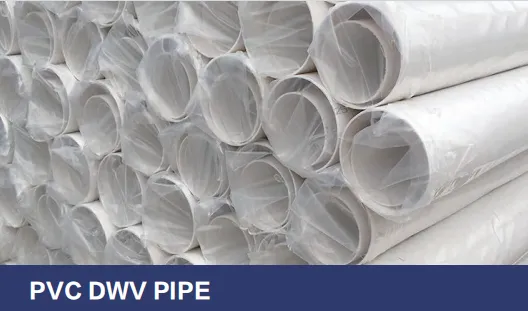
PVC DWV (Polyvinyl Chloride Drain-Waste-Vent) has become synonymous with residential and commercial plumbing since its mainstream adoption in the 1960s. A pvc dwv pipe supplier will quickly highlight its origins: a rigid plastic polymer blended with additives to enhance strength and chemical resistance. Unlike pressure pipes (used for water supply), DWV pipes prioritize gravity flow, making them ideal for sinks, showers, and toilet drains.
What truly defines PVC DWV is its versatility. Available in diameters from 1.5 inches (for lavatories) to 12 inches (for main stacks), it's compatible with an array of pipes fittings—elbows, tees, traps, and cleanouts—that a pipes fittings supplier can readily source. Its lightweight nature (roughly 1/5 the weight of cast iron) reduces labor costs, while its smooth interior minimizes clogs. For a residential building materials supplier managing a housing development, these attributes translate to faster installations and tighter budgets.
ABS (Acrylonitrile Butadiene Styrene) arrived on the scene a decade later, positioning itself as the premium alternative. This black thermoplastic copolymer combines three monomers: acrylonitrile (for chemical resistance), butadiene (for impact strength), and styrene (for rigidity). The result? A pipe that feels noticeably sturdier than PVC, with a matte finish that hides scuffs—a detail not lost on luxury home builders.
ABS's claim to fame lies in its toughness. drop a PVC pipe on a cold day, and it might crack; an ABS pipe will bounce. This resilience makes it a favorite for below-grade installations or regions with harsh winters. A commercial building materials supplier working on hospitals or schools often cites ABS's ability to withstand accidental impacts from construction equipment—a critical advantage in high-traffic job sites.
Suppliers weigh dozens of factors when choosing between PVC DWV and ABS. The table below breaks down the essentials, from cost to UV resistance, to show why these materials appeal to different needs.
| Factor | PVC DWV Pipe | ABS Pipe |
|---|---|---|
| Cost Per Linear Foot | $0.50–$2.00 (30% cheaper on average) | $0.70–$2.80 (premium pricing) |
| Impact Resistance | Moderate; brittle below 0°C | Excellent; flexible down to -40°C |
| UV Stability | Good (requires paint for prolonged outdoor use) | Poor (degrades in sunlight; indoor use only) |
| Installation Time | Longer (primer + cement; 24-hour cure time) | Faster (cement only; 15-minute set time) |
| Noise Reduction | Moderate (audible water flow in thin walls) | Superior (dense material muffles sound by 40%) |
| Chemical Resistance | Excellent (resists acids, alkalis, detergents) | Good (vulnerable to strong solvents like acetone) |
| Code Acceptance | Universal (adopted by all major building codes) | Regional (restricted in some coastal U.S. states) |
For many suppliers, especially those serving mass-market projects, PVC DWV is non-negotiable. Let's explore why it dominates inventory lists from Riyadh to Rio.
In residential construction, where margins are tight and square footage adds up, a 30% cost difference per linear foot matters. A residential building materials supplier managing a 500-unit housing complex would save approximately $75,000 by choosing PVC DWV over ABS for drainage systems alone. "Our clients in Saudi Arabia prioritize value without sacrificing quality," explains a saudi arabia building materials supplier. "PVC DWV lets us deliver both, especially on government housing contracts where budget caps are strict."
Even commercial projects aren't immune to cost pressures. A school or hospital might use PVC DWV in non-critical areas (like janitorial closets) to allocate funds to higher-priority materials, such as Class A fireproof CPL inorganic boards for walls. "We balance specs strategically," notes a commercial building materials supplier. "PVC in the basement, ABS in the operating room—whatever keeps the project compliant and on budget."
Walk into any hardware store, and you'll find PVC DWV fittings lining the shelves. This ubiquity is a lifesaver for contractors facing tight deadlines. A one-stop architectural solution provider prides itself on same-day deliveries, and PVC DWV makes that possible. "Last week, a contractor needed 20 45-degree elbows at 3 p.m. for a hotel renovation," recalls a pipes fittings supplier. "We had them in his truck by 4. With ABS, he would've waited three days for a special order."
Compatibility with other systems is another win. PVC DWV integrates seamlessly with plastic valve systems, upvc pipes, and even legacy metal pipes (via transition fittings). A plastic valve system supplier notes, "We design our valves to fit standard PVC dimensions, so there's never a question of compatibility. ABS works too, but its fittings have slightly different tolerances—more room for error."
While PVC DWV struggles in the cold, it thrives in hot, humid environments. In the Middle East, where temperatures regularly exceed 40°C, PVC's stability is a selling point. "ABS softens at high temperatures, which can cause sagging in long horizontal runs," warns a supplier. "PVC holds its shape, even in direct sunlight (with proper insulation). That's why 90% of our DWV projects in Riyadh specify PVC."
Despite PVC's cost, ABS has loyal advocates—suppliers who swear by its performance in specific scenarios. Here's where it outshines the competition.
In regions like Canada or northern Europe, winter temperatures can turn PVC brittle. An ABS pipe, however, remains flexible down to -40°C, making it the go-to for outdoor installations. "We had a project in Oslo where PVC pipes cracked during a frost heave," says a European supplier. "Since switching to ABS for below-grade work, we've had zero failures. The extra cost is insurance against callbacks."
This resilience extends to freeze-thaw cycles. In areas with fluctuating temperatures, ABS pipes expand and contract without weakening—a critical feature for cabin retreats or mountain lodges. "Our clients in the Swiss Alps demand ABS," notes a supplier specializing in luxury chalets. "They don't want to worry about burst pipes during ski season."
Time is money in construction, and ABS saves both. Unlike PVC, which requires primer before cement, ABS bonds with solvent cement alone, cutting installation time by 25%. "A plumber can glue an ABS joint and move on in 15 minutes," explains a commercial building materials supplier. "With PVC, you wait for primer to dry, then apply cement, then wait 24 hours to test. On a high-rise, that delays the project by days."
The sound difference is equally notable. Water rushing through PVC creates a gurgling echo, while ABS's density dampens noise. For luxury hotels or high-end apartments, this quietude is a selling point. "Our hospitality clients refuse to use PVC in guest bathrooms," says a supplier. "Guests shouldn't hear their neighbor's shower—ABS ensures that."
So, which do suppliers really prefer? The answer depends on where they work, whom they serve, and what their clients value most.
For residential building materials suppliers, PVC DWV is often the default. "First-time homebuyers care about monthly mortgage payments, not pipe material," says a supplier in Texas. "PVC lets us keep construction costs low, which translates to lower home prices. Unless a client specifically asks for ABS, we stick with PVC."
Exceptions exist in luxury markets. In Beverly Hills or Dubai, where homes sell for millions, ABS's quiet operation and durability become selling points. "Our high-end clients view ABS as a 'premium upgrade,' like marble countertops or smart home systems," notes a luxury residential supplier. "They're willing to pay extra for the peace of mind."
Commercial building materials suppliers navigate a maze of codes and project specifics. Hospitals, for example, often require chemical-resistant pipes, making PVC DWV a natural fit (it resists harsh cleaning agents better than ABS). Schools, with their high foot traffic, might opt for ABS in corridors to withstand accidental impacts.
Climate also plays a role. A supplier in Minnesota leans heavily on ABS for outdoor installations, while one in Florida rarely specifies it. "We had a warehouse project in Fargo where ABS pipes survived a blizzard-induced roof collapse," recalls a commercial supplier. "PVC would've shattered. Now, we use ABS for all our northern commercial jobs."
One-stop architectural solution providers pride themselves on adaptability. "We don't push one material—we solve problems," says a national supplier. "If a client needs a hospital-grade system on a tight budget, we'll mix PVC DWV in patient rooms with ABS in operating theaters. If it's a ski resort in Colorado, we'll spec ABS everywhere. Our job is to make recommendations, not dogma."
The rivalry between PVC DWV and ABS isn't static. Manufacturers are constantly refining both materials, blurring the lines between them.
PVC DWV is getting tougher. New formulations with impact modifiers allow it to withstand -15°C temperatures—closing the gap with ABS. "We're testing a 'winter-grade' PVC that could replace ABS in mild cold climates," says a supplier. "If it performs, it'll revolutionize markets like the Pacific Northwest."
ABS, meanwhile, is becoming more UV-resistant. New additives let it withstand short-term outdoor exposure, expanding its use in patios and exterior vents. "We're seeing ABS pipes with 10-year UV warranties now," notes a supplier. "It's still pricier than PVC, but for clients who want ABS's durability outdoors, it's a game-changer."
Sustainability is also driving change. Both materials are now recyclable, with suppliers launching take-back programs. "We recycle 70% of our PVC scrap into new fittings," says an eco-focused supplier. "ABS recycling is growing too—clients love that their old pipes don't end up in landfills."
At the end of the day, supplier preferences boil down to your project's unique needs. If you're building affordable housing in Riyadh, a pvc dwv pipe supplier will deliver the best value. If you're constructing a luxury hotel in Zurich, ABS might be worth the splurge. And if you're working with a one-stop architectural solution provider, they'll likely recommend a hybrid approach—PVC where cost matters, ABS where performance is critical.
The real winner? You, the client. With both materials evolving and suppliers prioritizing flexibility, you're no longer forced to choose between affordability and durability. Whether it's PVC DWV, ABS, or a mix, today's building materials suppliers have the expertise to tailor a solution that fits your project, budget, and vision—one pipe at a time.
Recommend Products












