
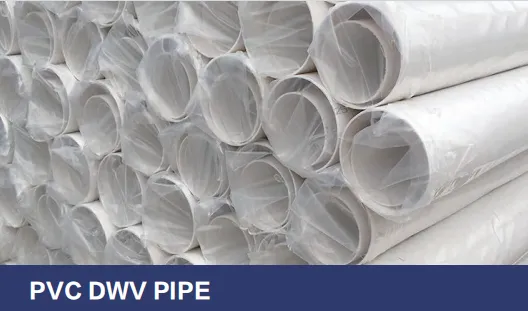
Let's face it—whether you're managing a commercial construction project, renovating a residential building, or even tackling a small plumbing upgrade, the costs can add up faster than a leaky faucet. And if there's one area where budget overruns love to hide, it's plumbing materials. Specifically, drain, waste, and vent (DWV) systems. These unsung heroes of any building's infrastructure are easy to overlook until a clogged pipe or a cracked fitting derails your timeline and sends your budget spiraling. But here's the good news: PVC DWV pipes have long been the go-to for cost-conscious builders, and with a few insider tips from experienced suppliers, you can squeeze even more savings out of every inch of pipe. In this guide, we're breaking down practical, actionable strategies to cut costs on PVC DWV pipes—without sacrificing quality, durability, or performance. Because at the end of the day, saving money shouldn't mean settling for less. Let's dive in.
Here's a truth I've learned from talking to hundreds of contractors and project managers over the years: the supplier you choose for your PVC DWV pipes isn't just a vendor—they're a partner in your project's success (and your budget's survival). A great supplier doesn't just sell you pipes; they help you avoid costly mistakes, secure better pricing, and ensure you're getting materials that will stand the test of time. So how do you pick a supplier that puts your savings first? Let's break it down.
If you're only buying a handful of pipes for a small job, you might not think twice about picking up materials from the nearest hardware store. But for larger projects—say, a multi-unit apartment complex or a commercial office building—bulk ordering from a dedicated PVC DWV pipe supplier can slash costs by 10-15% or more. Why? Because suppliers love predictable, large orders, and they're willing to reward that loyalty with volume discounts. I recently spoke with a contractor in Riyadh who was sourcing materials for a 50-unit residential complex. By switching from buying individual pipes at retail prices to placing a bulk order with a local PVC DWV pipe supplier, he saved over $8,000 on his plumbing materials alone. "It was a no-brainer," he told me. "The supplier even helped me calculate exactly how many 10-foot and 20-foot lengths I needed, so I didn't overbuy."
But bulk buying isn't just about quantity—it's about timing. Many suppliers offer seasonal discounts or end-of-quarter promotions to clear inventory. If your project timeline is flexible, ask your supplier about upcoming sales. One upvc pipe supplier I know runs a "Spring Plumbing Sale" every March, offering 12% off on all DWV orders over 500 feet. For a mid-sized project, that's hundreds (if not thousands) of dollars back in your pocket.
We've all been there: scrolling through supplier listings, tempted by the lowest price tag. But when it comes to PVC DWV pipes, "cheap" can quickly turn into "costly." I once worked with a client who opted for an overseas supplier offering PVC DWV pipes at 30% below market rate. Sounds great, right? Until the pipes arrived. Half of them were warped from poor storage, and the fittings didn't align properly with standard sizes. The result? They had to reorder from a reputable supplier, doubling their material costs and delaying the project by three weeks. "I saved $2,000 upfront and lost $10,000 in labor and delays," he groaned. "Never again."
So how do you spot a reliable supplier? Look for certifications: ISO 9001 for quality management, ASTM D2665 compliance (the standard for PVC DWV pipes), and local industry certifications (like SASO in Saudi Arabia). A good supplier will also provide samples upon request, so you can test the pipe's thickness, flexibility, and durability before committing. And don't underestimate the value of customer service—suppliers who offer technical support (like helping you choose the right pipe thickness for your project) can save you from costly sizing mistakes down the line.
Let's start with the basics: PVC DWV pipes are already one of the most cost-effective plumbing materials on the market. Compared to traditional options like cast iron or copper, PVC is lighter (reducing shipping and labor costs), easier to install (no heavy lifting or specialized tools), and resistant to corrosion (meaning fewer replacements down the line). But even within the world of PVC DWV, there are ways to optimize your material choices for maximum savings. Let's break down what to look for.
PVC DWV pipes come in different schedules, which refer to wall thickness. Schedule 40 is the standard for most residential and light commercial DWV systems, offering the perfect balance of strength and affordability. Schedule 80 is thicker and more durable, but it's also heavier and pricier—overkill for most drain and waste applications. Unless your project involves high-pressure systems (which DWV isn't), there's no need to shell out extra for Schedule 80. I once reviewed a hospital renovation plan where the architect specified Schedule 80 PVC DWV pipes "for durability." After consulting with a pvc dwv pipe supplier, we realized Schedule 40 was more than sufficient (and $2,200 cheaper for the project). The hospital still got a reliable system, and the savings went toward upgrading patient room fixtures instead.
If you're still on the fence about PVC DWV, let's look at the numbers. The table below compares PVC DWV to two common alternatives—cast iron and ABS (acrylonitrile butadiene styrene)—on key cost factors:
| Material | Cost per Linear Foot (10-inch pipe) | Installation Labor Cost | Maintenance Over 20 Years | Total Project Cost (500 feet) |
|---|---|---|---|---|
| Cast Iron | $25–$35 | Higher (requires 2+ workers per section; heavy lifting) | High (prone to rust, clogs, and leaks) | $35,000–$45,000 |
| ABS | $12–$18 | Moderate (lighter than cast iron but less flexible than PVC) | Moderate (can become brittle in cold temperatures) | $18,000–$22,000 |
| PVC DWV (Schedule 40) | $8–$12 | Low (lightweight; can be cut and installed by 1 worker) | Low (corrosion-resistant, no rust, minimal clogs) | $10,000–$14,000 |
As you can see, PVC DWV is the clear winner for total cost. Even if you factor in the occasional fitting replacement, the long-term savings are undeniable. And for projects like schools or hospitals—where fire safety is critical—many suppliers offer Class A fireproof cpl inorganic board options that pair seamlessly with PVC DWV systems, ensuring compliance without added costs.
Here's a common mistake I see all the time: project managers ordering "just to be safe." Need a drain pipe for a bathroom? They'll buy a 4-inch pipe when a 3-inch would work. Renovating a kitchen? They'll stock up on 20-foot lengths "in case" they need extra. But overbuying isn't just wasteful—it's expensive. Leftover pipes take up storage space, and unused materials rarely get returned for full credit. The solution? Precision sizing.
Most PVC DWV pipe suppliers have in-house engineers or technical advisors who can help you determine the exact pipe size and quantity you need. They'll consider factors like the number of fixtures (toilets, sinks, showers), the slope of the pipe, and local building codes. For example, a residential bathroom with one toilet, one sink, and a tub typically requires a 3-inch DWV pipe. A commercial kitchen with multiple sinks and a grease trap? You might need a 4-inch or 5-inch pipe. One pvc dwv pipe solutions provider I work with offers free sizing consultations—they'll even review your blueprints to ensure you're not overspecifying. "We had a client who ordered 6-inch pipes for a small office building's restrooms," the advisor told me. "After reviewing the plans, we showed them 4-inch pipes would handle the load, saving them $3,000 on materials."
If you're comfortable doing the math yourself, refer to the Uniform Plumbing Code (UPC) or International Plumbing Code (IPC) sizing charts. These charts outline the minimum pipe diameter required based on fixture units (FUs)—a measure of how much water flow a fixture produces. For example:
A pipe's capacity is measured in FUs per linear foot. A 3-inch PVC DWV pipe can handle up to 42 FUs, while a 4-inch pipe can handle 110 FUs. So, if your project has 30 FUs (say, 10 toilets), a 3-inch pipe is more than enough. No need to splurge on a 4-inch!
Even the best-laid plans can go off the rails during installation. Wasted materials, slow labor, and rookie mistakes can eat into your budget faster than a plumber eats pizza. But with a few smart installation strategies, you can keep costs in check.
PVC DWV pipes come in standard lengths (10 feet, 20 feet), but your project's measurements rarely align perfectly with those lengths. Cutting pipes to fit on-site is inevitable—but how you cut them matters. A skilled installer with a sharp saw (and a steady hand) can reduce scrap to less than 5% of total material. A less experienced crew? Scrap can jump to 15% or more. I visited a job site once where the installers were using a dull hacksaw, leaving jagged edges that required trimming an extra 2 inches off each pipe. Over 500 feet of pipe, that's 100 inches of wasted material—$80 down the drain (pun intended).
Solution: Invest in quality tools (a PVC cutter or miter saw) and train your crew on precise cutting. Many suppliers even offer free tool rental with large orders—ask your PVC DWV pipe supplier if they have this perk. And don't throw away those scraps! Short pieces (6 inches or longer) can be used for test fittings or small, hard-to-reach sections (like under sinks).
PVC cement (the glue that bonds pipes and fittings) isn't cheap—and using too much is a common waste. A little goes a long way: a thin, even layer on both the pipe and fitting is all you need. I once watched an installer squeeze an entire tube of cement onto a single fitting, then wipe the excess with a rag. "It's better to have too much than too little," he said. Wrong. Excess cement can weaken the joint (by dissolving the pipe's inner layer) and create clogs over time. Plus, that tube cost $8—multiply that by 100 fittings, and you're wasting $800.
Pro tip: Use a cement applicator (a small brush attached to the can) instead of squeezing directly from the tube. It gives you better control, and most suppliers sell applicators for under $5.
Every fitting—elbows, tees, couplings—adds cost. A 90-degree elbow can cost $5–$10, and a tee can run $8–$15. Multiply that by dozens of joints, and suddenly you're looking at hundreds of dollars in extra fittings. The fix? Optimize your pipe layout to reduce the number of turns and connections. For example, instead of using two 45-degree elbows to navigate a corner, use a single 90-degree elbow (it's cheaper and reduces the risk of clogs). Or run pipes in straight lines whenever possible—even if it means adjusting the framing slightly. One contractor I know redesigned a restaurant's DWV layout to eliminate 12 unnecessary tees, saving $180 on fittings and 4 hours of installation time.
Cost-saving doesn't stop when the last pipe is installed. A DWV system that fails in 5 years will cost far more than the upfront savings of choosing cheap materials. That's why long-term maintenance and supplier warranties are critical to protecting your budget.
A reputable PVC DWV pipe supplier will stand behind their products with a solid warranty. Look for warranties that cover defects in materials or workmanship for at least 10–15 years. Some suppliers even offer lifetime warranties on certain products. For example, one leading PVC DWV pipe supplier in Saudi Arabia offers a 25-year warranty on their Schedule 40 pipes, guaranteeing they won't crack, warp, or corrode under normal use. "We had a client whose pipe cracked after 8 years," the supplier's warranty manager told me. "We replaced the entire section for free—no questions asked. That's peace of mind you can't put a price on."
But read the fine print: warranties often exclude damage from improper installation or misuse (like using DWV pipes for pressure systems). Make sure your crew is trained on proper installation to keep the warranty valid.
PVC DWV pipes are low-maintenance, but they're not maintenance-free. Clogs from hair, grease, or debris can lead to backups, which strain the pipes and cause leaks. A single clog can cost $200–$500 to fix (if you need a plumber), and a leak can cause water damage costing thousands. The solution? Simple, low-cost maintenance:
One property manager I know implemented a "quarterly drain check" for their apartment buildings. A maintenance worker runs a snake through all DWV pipes every three months, catching small clogs before they become big problems. The cost? $150 per building per year. The savings? They've reduced plumber calls by 70%, saving $5,000+ annually.
At the end of the day, saving money on PVC DWV pipes isn't about cutting corners—it's about making smart choices. From choosing a reliable supplier and ordering the right size to optimizing installation and planning for maintenance, every decision impacts your bottom line. And remember: the best savings come from partnerships. A great PVC DWV pipe supplier won't just sell you materials—they'll work with you to understand your project, anticipate challenges, and find creative ways to reduce costs. So, take the time to research suppliers, ask questions, and don't be afraid to negotiate. Your budget (and your peace of mind) will thank you.
Now, over to you: Are you ready to start slashing your plumbing costs? Reach out to a trusted PVC DWV pipe supplier today, and let the savings begin.
Recommend Products












