
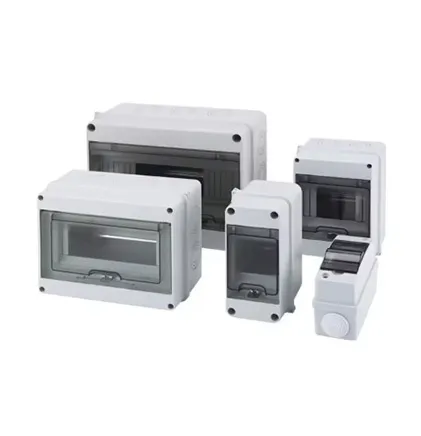
You know that moment when you walk into an industrial facility and smell chemicals in the air? That faint tang of solvents or the whiff of combustible dust hanging around equipment? That's your first clue you're in a HazardousArea – places where standard electrical equipment could literally become a bomb waiting to happen. Explosion-proof distribution boxes aren't just metal containers; they're engineered life-savers designed to contain potential disasters before they start.
When lives and million-dollar facilities hang in the balance, you don't want generic solutions. These specialized enclosures are built tougher than a bank vault with more safety checks than a space shuttle. They're constructed with thick-walled bodies, precision seals, and components that could withstand a mini-apocalypse.
Imagine a metal box built with walls thick enough to shrug off internal explosions. That's job #1 – containment. When sparks fly inside the box, these enclosures:
Gaskets aren't rubber strips – they're calculated barriers. Between the box and galvanized conduits, you'll find:
Not all metals are created equal in explosive environments:
Material selection isn't a catalog choice – it's an environmental response plan.
Picture offshore platforms battered by salt spray while processing flammable vapors. Here, boxes face the "triple threat":
In these environments, a single compromised conduit could cascade into catastrophe – which is why annual recertification isn't optional, it's sacred.
That flour in your kitchen? In industrial quantities, it becomes explosive dust. Processing facilities battle:
The solution combines IP66 waterproof rating with specialized dust-tight seals – because flour shouldn't turn facilities into fireballs.
That galvanized pipe connecting to your enclosure? Treat it like a surgical attachment:
Static electricity in explosive environments is like playing Russian roulette. Proper grounding requires:
Don't trust continuity testers alone – use milli-ohm meters to verify <0.5 Ω resistance end-to-end.
These boxes aren't install-and-forget assets. Monthly inspections should include:
Annual deep inspections require:
Maintenance logs aren't paperwork – they're legal evidence of due diligence when incidents occur.
Some facilities are upgrading to Ex p (pressurized) systems that:
The future includes:
This transforms static enclosures into active safety monitors.
Walk through any plant using these systems correctly, and you'll notice something: calm. No nervous glances toward electrical rooms, no hesitation near junction boxes. Because when explosion-proof distribution boxes are properly specified, installed, and maintained, they become invisible guardians. They represent the quiet professionalism of engineers who design for worst-case scenarios and electricians who treat every conduit connection like a matter of life and death – because it often is.
The principles we've covered aren't theoretical – they're battle-tested survival strategies for HazardousArea environments where electrical safety isn't just compliance; it's civilization holding back chaos one sealed enclosure at a time.
Recommend Products












