
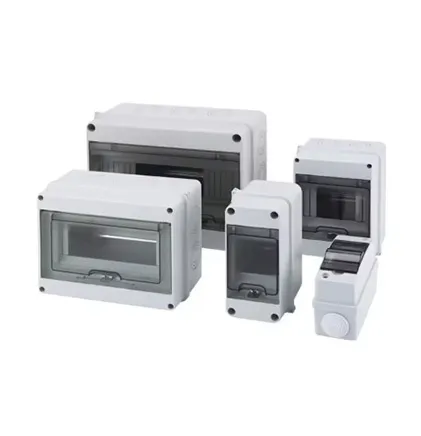
How top-tier electrical enclosures protect lives, buildings, and business operations in the modern construction landscape
Walk into any building—whether it's a cozy family home in Jeddah, a bustling hospital in Riyadh, or a sleek commercial tower in Dubai—and you'll find a silent guardian working around the clock. It's not the security guards or the fire alarms, though those are critical too. It's the distribution box: that unassuming metal or plastic cabinet tucked away in a utility room, basement, or closet, quietly managing the flow of electricity that powers every light, device, and system in the structure.
Here's the thing about electrical safety: it's invisible until something goes wrong. A faulty distribution box can turn a routine power surge into a catastrophic fire, or a minor wiring issue into a life-threatening electric shock. In fact, electrical failures are responsible for over 10% of commercial building fires globally, according to the National Fire Protection Association. For businesses and homeowners alike, cutting corners on this essential component isn't just risky—it's reckless.
"In the Middle East, where temperatures soar above 45°C in summer and humidity spikes during monsoon seasons, electrical enclosures face unique challenges. A subpar distribution box here doesn't just fail—it fails spectacularly. That's why choosing a manufacturer that understands local conditions isn't a luxury; it's a necessity."
This is where premium distribution box manufacturers step in. Companies that prioritize high-grade materials, rigorous testing, and regional expertise don't just sell products—they sell peace of mind. And in an industry where "good enough" can cost lives, peace of mind is priceless.
Not all distribution boxes are created equal. Walk into a hardware store, and you'll find cheap, flimsy enclosures priced under $50. But for critical applications—hospitals, schools, high-rise apartments, or industrial facilities—these budget options are a disaster waiting to happen. So what separates a premium distribution box from the rest?
The best distribution boxes start with superior raw materials. While low-cost options use thin galvanized steel or recycled plastic prone to cracking, top manufacturers invest in:
Take, for example, a hospital in Dammam. Its distribution boxes must not only protect wiring but also resist the harsh chemicals used in daily disinfection. A substandard box with a cheap paint finish would peel within months, exposing metal components to corrosion and increasing the risk of short circuits. A premium box, though? It stays intact for decades, even with daily exposure to bleach and alcohol-based cleaners.
Every country has electrical standards—Saudi Arabia follows SASO 2870, the UAE uses IEC 61439, and the EU adheres to EN 60439. But premium manufacturers don't just meet these standards; they exceed them. How?
| Feature | Standard Compliance | Premium Upgrade |
|---|---|---|
| Short-circuit protection | Withstands 5kA for 1 second | Withstands 10kA for 3 seconds (critical for hospitals/airports) |
| IP rating (dust/water resistance) | IP44 (splash-proof) | IP65 (dust-tight, water jet-resistant for outdoor use) |
| Thermal management | Basic ventilation slots | Integrated heat sinks and fan mounts for high-load environments |
| Locking mechanism | Standard key lock | Anti-tamper, RFID-enabled locks for secure access control |
These upgrades matter. In a school, for instance, an anti-tamper lock prevents curious students from opening the box and touching live wires. In a data center, integrated heat sinks keep sensitive circuit breakers from overheating during peak hours. And in coastal areas like Jeddah, an IP65 rating ensures sand and rain don't compromise the electrical system during storms.
In the crowded market of electrical component suppliers, one name stands out for its commitment to quality and regional understanding: Coloria. As a one-stop architectural solution provider with decades of experience in the Middle East, Coloria doesn't just manufacture distribution boxes—it engineers them for the unique challenges of the region.
With a dedicated (representative office) in Saudi Arabia, Coloria has its finger on the pulse of Middle Eastern construction. The team knows that a distribution box for a villa in Riyadh needs different features than one for a hotel in Doha. For example:
This regional focus has made Coloria a trusted partner for major projects, from the King Abdullah Financial District in Riyadh to luxury resorts in the Maldives. "We don't just ship products from a factory in China and hope they work," says a senior engineer at Coloria's Riyadh office. "We test every batch in our local lab under real Middle Eastern conditions."
What truly sets Coloria apart is its ability to integrate electrical enclosures with a full suite of building materials. As a leading electrical fixtures & cables supplier, the company offers everything from high-voltage cables to energy-efficient lighting—all designed to work seamlessly with its distribution boxes. This "one-stop" approach isn't just convenient; it's safer.
Imagine a contractor building a hospital in Bahrain. Instead of sourcing distribution boxes from one supplier, cables from another, and fixtures from a third, they can get all three from Coloria. This means every component is tested to work together, reducing compatibility issues that often lead to electrical failures. It also simplifies maintenance: if a problem arises, there's one point of contact, not a dozen.
"During the construction of a 300-bed hospital in Dammam, we saved the client over 15% on electrical costs by bundling distribution boxes, fire-rated cables, and emergency lighting through Coloria's one-stop service," recalls a project manager at a major Saudi construction firm. "More importantly, the electrical inspection passed on the first try—something that rarely happens when mixing suppliers."
In 2025, "sustainability" isn't just a buzzword—it's a regulatory requirement. With Saudi Arabia's 2030 Vision pushing for net-zero carbon emissions and the UAE aiming for 50% clean energy by 2050, construction projects are under pressure to reduce their environmental footprint. Premium distribution box manufacturers are rising to the challenge, and Coloria is leading the charge.
Coloria's power distribution box line is a case study in green innovation. The company uses:
But sustainability isn't just about materials. Coloria's distribution box factory in China runs on 100% solar power, and the company offsets remaining emissions by investing in reforestation projects in the Middle East. For clients pursuing LEED or Estidama certifications, these efforts translate directly into green building credits.
Modern distribution boxes aren't just passive enclosures—they're intelligent energy managers. Coloria's latest line includes smart features like:
In Dubai's sustainable city project, these smart boxes have helped reduce overall energy consumption by 22%—a saving that pays for the initial investment in under three years. "Sustainability and safety don't have to compete," says Coloria's sustainability director. "When done right, they reinforce each other."
So, how do you separate the premium manufacturers from the pretenders? Here are five questions to ask before signing a contract:
A manufacturer that claims to serve the Middle East should have test data proving their boxes withstand local conditions—high heat, humidity, and sand. If they can't show SASO or ESMA certification, walk away.
Construction schedules are tight. A good manufacturer should deliver custom-sized boxes within 4–6 weeks, not 3 months. Coloria, for example, keeps common sizes in stock in Jeddah and Dubai warehouses for next-day delivery.
A box failure at 2 a.m. can't wait for a technician from China. Look for manufacturers with local service teams. Coloria has engineers in Riyadh, Dubai, and Doha available 24/7 for emergency support.
Premium manufacturers test every box before shipping—no exceptions. Ask about their failure rate (Coloria's is less than 0.02%) and what happens if a product fails (they should offer a full replacement, no questions asked).
A small villa today might turn into a commercial complex tomorrow. Choose a manufacturer with a wide product range. Coloria's distribution boxes scale from 10A residential units to 6300A industrial enclosures, ensuring you won't need a new supplier as your needs grow.
At the end of the day, choosing a premium distribution box manufacturer isn't about spending more money. It's about investing in something that protects your most valuable assets: your family, your employees, your business, and your reputation. A high-quality distribution box costs 2–3 times more than a budget option upfront, but it lasts 3–4 times longer and reduces the risk of costly accidents.
For Coloria, this philosophy isn't just good business—it's personal. With roots in the Middle East dating back to the 1990s, the company has grown alongside the region's construction boom, (witnessing) firsthand the consequences of cutting corners. Today, as Saudi Arabia's 2030 Vision drives massive infrastructure development, and the UAE leads the way in sustainable building, Coloria remains committed to one goal: making electrical safety accessible, reliable, and uncompromising.
So the next time you're planning a construction project, remember: the distribution box might be out of sight, but it should never be out of mind. Choose wisely. Choose quality. Choose a partner who understands that in electrical safety, there are no second chances.
Recommend Products












