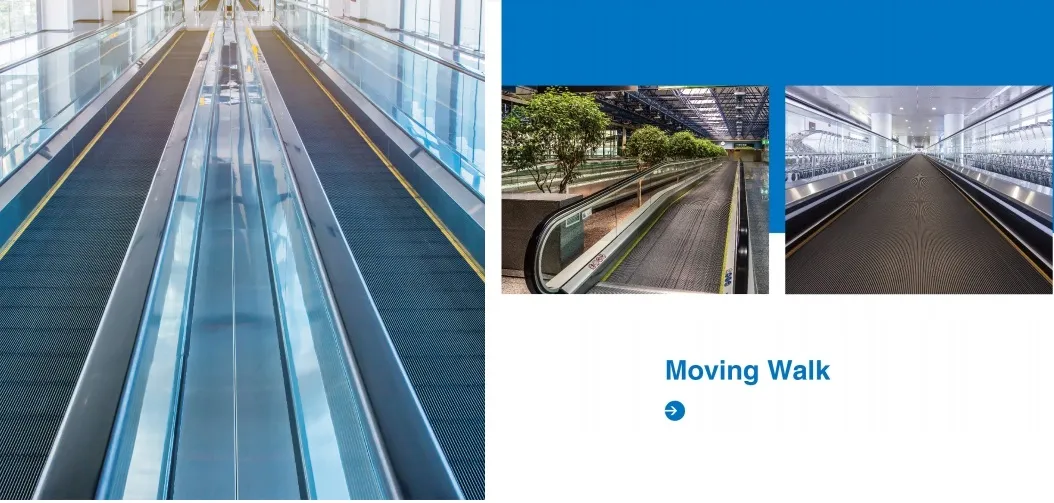
Precision Control and Interface Processing for Long-Distance Installation of Moving Walkways
"Ever stepped onto an airport walkway that suddenly slows down, throwing off your stride? Behind those seamless transitions lies a complex ballet of predictive algorithms and real-time sensors—turning mechanical pathways into intuitive journeys."
In an era of sprawling transit hubs and multi-level architectural complexes, moving walkways have evolved from simple people-movers to essential
architectural façade solutions
integrating form and function. Unlike the rigid systems of the past, today's installations require adaptive intelligence that anticipates crowd dynamics like a seasoned conductor—adjusting tempo before passengers feel the first hint of congestion. The synergy of predictive modeling and standardized control frameworks now makes kilometer-spanning walkways as responsive as neighborhood sidewalks.
The Dance of Data and Machinery
Picture London’s Waterloo Station during rush hour: rivers of travelers intersecting from subway platforms, train concourses, and bus terminals. Fixed-speed walkways choke points create domino-effect delays. The breakthrough? Treating pedestrians like dynamic particles in a fluid simulation. As one study demonstrated, predictive algorithms analyzing real-time footfall patterns proactively adjust walkway speeds by modeling passenger behavior as a responsive fluid—slowing upstream segments seconds before congestion forms downstream.
Why Reactive Control Isn't Enough:
When sensors detect overcrowding in real-time, the system throttles speed—a 12% average latency that’s the pedestrian equivalent of slamming brakes on a highway. Predictive models cut reaction times to under 3 seconds by forecasting bottlenecks through discrete event simulation.
The Software Backbone
The silent enabler is the
General Command Set (GCS)
—a universal "language" that lets different hardware like belt motors, optical sensors, and control panels communicate. Think of it as USB-C for transit systems. This standardization allows architects to design sweeping curves and integration points without worrying about proprietary lock-ins. As one software engineer described: "We upgraded a 250-meter curved walkway in Singapore just by sending GCS-compliant speed profiles—no hardware rewiring needed."
Real-world Impact: Zurich Airport slashed average transit times by 18% after shifting to GCS-integrated predictive control—proving that smarter software beats structural expansion.
Humanizing Machine Intelligence
Precision control isn’t about robots replacing intuition. Take Stockholm's tunnelbana system where engineers implemented "courtesy algorithms." When sensors spot elderly travelers stepping onto a 1.2km walkway, the system gently reduces acceleration by 40%, mimicking how a bus driver smooths starts for standing passengers. This blend of machine learning with human considerations turns functionality into hospitality.
Case Study: Dubai International's Symphony of Motion
Terminal 3’s 1.8 km network handles 14,000 passengers/hour across 17 interconnected walkways. Before optimization, evening flight surges caused chaotic bottlenecks. The solution? A three-layer approach:
1. Predictive layer:
Simulation software modeled gate-to-gate flows using historical flight/dispatch data.
2. Reactive layer:
Infrared density sensors triggered speed adjustments during unusual events.
3. Human override:
Terminal managers could manually enable "boarding assist" modes during flight delays.
The payoff: 22% fewer missed connections despite 30% higher passenger volume. The system’s intelligence now extends to syncing walkway rhythms with lighting and wayfinding displays—subtly guiding crowds through turbulence-free paths.
Future Horizons: Where Do We Walk Next?
The next frontier blurs the lines between transit and experience. Copenhagen's proposed "Culture Corridors" will pair kinetic walkways with augmented reality displays—where commuting becomes immersive storytelling. Meanwhile, piezoelectric materials research promises walkways generating their own power from footfalls, turning infrastructure into a sustainable power plant.
Most exciting? Adaptive AI creating walkways that "learn" individual movement patterns—offering personalized speeds via anonymous Bluetooth tracking. Early trials demonstrate how micro-slowdowns for phone users prevent collisions before they even happen. It’s the ultimate evolution: infrastructure that doesn’t just accommodate people but actively adapts to them.
Final Note: As our cities stretch skyward and outward, moving walkways transform mundane passages into graceful experiences. The true magic isn’t in the motors or algorithms alone—it’s in the unnoticed perfection of journeys that flow like water.