
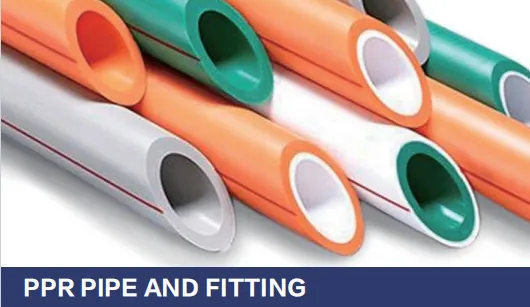
Choosing the right piping material for your construction project is more than just a box-ticking exercise—it's a decision that impacts everything from long-term durability to daily functionality, safety, and even your budget. As a leading ppr pipe and fitting supplier with years of experience serving residential, commercial, and industrial clients across Saudi Arabia and beyond, we often get asked: "PPR or PE—which one should I choose?" It's a fair question, and the answer isn't always straightforward. Both materials have their strengths, but they shine in different scenarios. In this article, we'll break down the key differences between PPR (Polypropylene Random Copolymer) and PE (Polyethylene) pipes, so you can make an informed choice tailored to your project's unique needs.
Before diving into the nitty-gritty, let's start with the basics. Both PPR and PE pipes are made from thermoplastic polymers, which means they're moldable when heated and solidify when cooled—properties that make them ideal for piping. But that's where the similarities start to diverge.
PPR Pipes : Short for Polypropylene Random Copolymer, PPR is a type of plastic pipe known for its rigidity, heat resistance, and strong molecular structure. It's created by copolymerizing propylene with a small amount of ethylene, resulting in a material that balances flexibility and strength. You'll often find PPR pipes in systems where hot water is a constant—think residential plumbing, heating systems, and even commercial buildings like hospitals or schools where hygiene and temperature stability matter.
PE Pipes : Polyethylene pipes, on the other hand, are more flexible and come in several grades, with PE80 and PE100 being the most common. PE is a lightweight, durable material made from ethylene monomers, and its flexibility makes it a favorite for underground installations, irrigation, and cold water systems. There's also PE-RT (Polyethylene of Raised Temperature Resistance), a subtype designed to handle higher temperatures, but for this comparison, we'll focus on standard PE pipes.
At the core of the PPR vs. PE debate lies their physical makeup. Let's break down how their molecular structures translate to real-world performance:
PPR: The Sturdy Contender – PPR has a semi-crystalline structure with a random arrangement of polymer chains, which gives it rigidity and high tensile strength. Imagine a pipe that holds its shape even under pressure—PPR won't bend or kink easily, making it ideal for above-ground installations where structural stability is key. It also has excellent impact resistance: drop a PPR pipe from a height, and chances are it'll bounce back without cracking, even in colder temperatures (though we don't recommend testing this on purpose!).
PE: The Flexible Workhorse – PE's structure is more amorphous, with longer, more mobile polymer chains. This makes it highly flexible—you can bend a PE pipe into tight curves without breaking, which is a huge advantage for underground projects where soil movement or uneven terrain is common. However, this flexibility comes with less rigidity: a PE pipe might sag if unsupported over long spans, so it often requires more bracketing in above-ground setups.
When it comes to weight, PE has a slight edge—it's lighter than PPR, which can make transportation and handling easier, especially for large-diameter pipes. But PPR's rigidity often means fewer supports are needed during installation, balancing out the effort.
For many projects—especially those involving hot water or heating systems—thermal performance is a dealbreaker. Let's see how PPR and PE stack up:
PPR: Built for Heat – PPR pipes are designed to withstand high temperatures. Most standard PPR pipes can handle continuous use at 70°C (158°F) and short-term spikes up to 95°C (203°F), with some industrial-grade options pushing even higher. This makes them perfect for hot water supply lines, radiators, and underfloor heating systems. As a residential building materials supplier , we often recommend PPR for homes in Saudi Arabia, where hot water demand is constant year-round.
That said, PPR does expand when heated—more so than PE. Its linear expansion coefficient (how much it stretches per degree of temperature change) is around 0.15 mm/m·°C, which means a 10-meter PPR pipe can expand by 15 mm when heated from 20°C to 80°C. To prevent stress on joints, installers need to add expansion loops or use flexible connectors, especially in long runs.
PE: Better for Cooler Applications – Standard PE pipes (like PE80) have a lower temperature limit, typically maxing out at 60°C (140°F) for continuous use. PE100 can handle slightly higher temps, but even then, it's not ideal for hot water systems. However, PE-RT (a specialized PE variant) bridges this gap, with some grades tolerating up to 82°C (180°F)—but it's important to note that PE-RT is pricier and less common than standard PE.
PE's advantage? Its lower expansion rate (around 0.20 mm/m·°C, but its flexibility helps absorb movement, so expansion loops are less critical). This makes it great for cold water lines, irrigation, and underground systems where temperature fluctuations are minimal.
Every piping system faces pressure—whether from water flow, pump systems, or elevation changes. Let's compare how PPR and PE handle pressure, especially at different temperatures:
| Material | Max Working Pressure (at 20°C) | Max Working Pressure (at 70°C) | Burst Pressure (Approx.) |
|---|---|---|---|
| PPR (S5 Series) | 10 bar (145 psi) | 4.5 bar (65 psi) | 25-30 bar |
| PE80 | 10 bar (145 psi) | 3.2 bar (46 psi) | 15-20 bar |
| PE100 | 16 bar (232 psi) | 5 bar (72 psi) | 20-25 bar |
*Values are approximate and vary by pipe diameter and manufacturer. Always check product specs for your project.
As the table shows, PPR maintains higher pressure ratings at elevated temperatures. For example, at 70°C, PPR (S5) can handle 4.5 bar, while PE80 drops to 3.2 bar. This makes PPR a better choice for high-pressure hot water systems, like those in commercial buildings or hotels where multiple floors demand strong water flow.
PE, however, often has higher pressure ratings at lower temperatures. PE100, for instance, can handle 16 bar at 20°C—great for cold water mains or industrial systems where pressure is high but temperatures stay cool. It's also more resistant to pressure surges (like water hammer) thanks to its flexibility, which acts as a natural shock absorber.
Whether you're transporting potable water, industrial chemicals, or wastewater, chemical resistance is crucial to avoid leaks, contamination, or pipe degradation.
PPR: Pure and Resistant – PPR is highly resistant to most acids, alkalis, and organic solvents, making it safe for potable water (it won't leach harmful chemicals or affect taste/odor). It's also resistant to scaling—mineral deposits from hard water are less likely to build up inside PPR pipes, keeping flow rates consistent over time. This is why we often recommend it for hospitals and schools, where water purity is non-negotiable.
PE: Tough but Selective – PE is also corrosion-resistant and safe for drinking water, but it's more susceptible to damage from certain hydrocarbons, oils, and strong oxidizing agents. For example, prolonged exposure to gasoline or diesel can cause PE to swell or crack, so it's not ideal for industrial systems handling these substances. That said, PE is excellent for transporting saltwater, agricultural chemicals, and most municipal wastewater—its smooth inner surface also resists bacterial growth, a plus for irrigation systems.
Both materials are inert and won't rust, rot, or corrode like metal pipes, which is a huge advantage in humid or coastal environments. But for projects involving aggressive chemicals or high-purity water, PPR often has the edge.
Even the best pipe material won't work if installation is a nightmare. Let's compare the practicalities:
PPR: Fusion-Friendly – PPR pipes are joined using heat fusion, a process where the pipe and fitting are heated to 260°C (500°F) and pressed together. When done correctly, the melted surfaces bond into a single, leak-proof joint—stronger than the pipe itself. As a ppr pipe and fitting supplier , we love this method because it's simple: with a portable fusion machine (which most contractors already own), even a beginner can get consistent results after a quick demo. No glue, no threads, no risk of loose connections over time.
Maintenance for PPR is minimal. The smooth inner surface resists scaling, so you won't need to descale as often. And because joints are fused, there's little risk of leaks unless the pipe is physically damaged (e.g., by a drill or heavy impact).
PE: Fusion or Fittings – PE pipes can be joined using several methods: butt fusion (similar to PPR but for larger diameters), electrofusion (using pre-fitted electric heating elements in fittings), or compression fittings (for smaller pipes). Butt and electrofusion create strong, permanent joints, but they require specialized equipment and more training than PPR fusion. Compression fittings are easier for DIYers but are less reliable for high-pressure systems—we've seen too many leaks from poorly tightened compression nuts!
PE's flexibility can speed up installation in tight spaces, but it also means more care is needed to avoid kinking (which restricts flow). Maintenance-wise, PE is durable, but its flexibility makes it prone to rodent damage—rats and mice sometimes chew through PE pipes, especially in uninsulated walls. PPR, being rigid, is less attractive to pests.
To wrap up, let's map out which projects are best suited for PPR vs. PE:
PPR Pipes Are Ideal For:
-
Residential hot water systems
: From showers to kitchen sinks, PPR handles high temps and ensures steady flow.
-
Underfloor heating
: Its heat resistance and leak-proof joints make it safe for embedded systems.
-
Commercial buildings
: Hospitals, schools, and hotels rely on PPR for reliable, hygienic water supply (we often partner with
commercial building materials supplier
networks to meet this demand).
-
Industrial processes
: Chemical plants and food processing facilities use PPR for transporting hot, pure, or mildly corrosive fluids.
PE Pipes Are Ideal For:
-
Cold water mains
: Municipal water distribution and residential cold water lines benefit from PE's flexibility and low cost.
-
Irrigation systems
: Its lightweight design and resistance to UV rays (when buried) make it perfect for farms and gardens.
-
Underground drainage
: PE handles soil movement and resists root intrusion better than rigid pipes.
-
Marine and coastal projects
: Saltwater corrosion isn't an issue for PE, making it great for piers or coastal irrigation.
Let's talk numbers. PE pipes are generally cheaper upfront—about 10-20% less than PPR for the same diameter. If you're working on a tight budget and only need cold water transport, PE might seem like the obvious choice.
But don't stop at initial cost. PPR's higher heat resistance and durability can save money long-term. For example, a PE pipe in a hot water system might need replacement after 10-15 years, while PPR can last 50+ years with proper installation. Add in the cost of labor for repairs or replacements, and PPR often has a better ROI, especially in high-temperature applications.
Installation costs also play a role. PPR fusion is faster and requires less specialized labor than PE electrofusion, which can offset PPR's higher material cost. As a supplier, we always advise clients to factor in total cost of ownership —not just the price tag on the pipe.
At the end of the day, there's no "better" material—only the right one for your project. As a leading ppr pipe and fitting supplier , here's our quick guide:
Choose PPR if you need hot water resistance, high pressure handling, or leak-proof reliability in residential/commercial settings. It's an investment that pays off in durability and peace of mind.
Choose PE if you're working with cold water, underground installations, or need flexibility and lower upfront costs. It's a workhorse for simple, low-temperature applications.
Still unsure? Reach out to our team—we'll help you assess your project's needs, from temperature and pressure requirements to budget and timeline. After all, the best decisions are the informed ones.
Recommend Products












