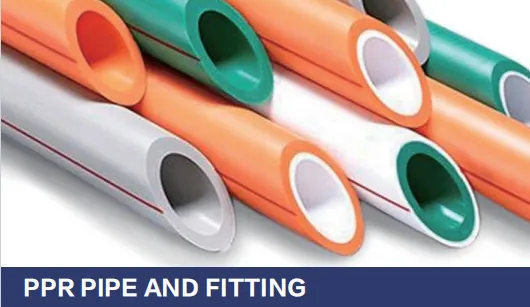
Modern plumbing infrastructure demands materials that balance durability, safety, and cost-efficiency. Whether you are outfitting a high-rise residential tower, a commercial office complex, or an industrial facility, the piping system you choose will determine long-term performance and maintenance costs. Among the most widely adopted solutions today,
ppr pipe and fitting solutions stand out for their exceptional reliability and versatility across diverse applications.
PPR (Polypropylene Random Copolymer) piping systems have become the standard choice for hot and cold water distribution, HVAC networks, and industrial fluid conveyance. Their growing adoption reflects a fundamental shift in how contractors and engineers approach plumbing design — moving away from traditional metal pipes toward advanced polymer-based systems that deliver superior performance at a lower total cost of ownership.
What Makes PPR Pipe and Fitting Solutions the Industry Standard
PPR pipes are manufactured from polypropylene random copolymer, a material engineered to withstand continuous operating temperatures of up to 70°C while maintaining structural integrity. Peak temperatures of 95°C from short-term disruptions are handled without degradation, making PPR an ideal candidate for both hot and cold water systems.
The core advantage of PPR lies in its heat fusion joining method. Unlike metal pipes that rely on threaded connections or solvent welding, PPR pipes and fittings are joined through molecular bonding at 260°C. This creates a completely homogeneous, leak-proof joint that effectively becomes one continuous piece of material. There is no risk of joint separation over time — a common failure point in traditional piping systems.
Key benefits of PPR piping systems: Excellent thermal stability, corrosion resistance, smooth inner walls that minimize scale buildup and pressure loss, lightweight construction for easier handling and installation, and a service life exceeding 50 years under normal operating conditions with minimal maintenance requirements.
Critical Applications Across Residential and Commercial Projects
pipes fittings solutions built on PPR technology serve a remarkably broad range of applications. In residential buildings, they are the backbone of potable water distribution — delivering clean, safe drinking water to every tap without the risk of corrosion contamination that plagues galvanized steel pipes. The material's inert nature ensures no chemical leaching into the water supply, making it compliant with the strictest health and safety standards worldwide.
In commercial settings,
pp-r hot/cold water pressure piping system solutions handle the demanding requirements of hotels, hospitals, and office buildings where continuous hot water availability is critical. These systems are engineered to maintain consistent pressure and temperature across multiple floors, supporting complex plumbing networks with hundreds of connection points.
Beyond plumbing, PPR pipes are increasingly specified for HVAC chilled water circuits, compressed air lines, and chemical transport in industrial environments. Their resistance to a wide range of chemicals — combined with smooth internal surfaces that resist scaling — makes them a practical choice for factories and processing plants where downtime for pipe replacement is prohibitively expensive.
Understanding the Complete PPR Product Ecosystem
A well-designed PPR piping system is more than just pipes. It requires a comprehensive range of fittings, valves, and accessories that work together seamlessly. The standard product portfolio includes:
- Couplers, elbows, and tees in various angles for directional changes and branch connections
- Reducers and end caps for diameter transitions and system termination
- Ball valves and gate valves for flow control and isolation
- Flange adaptors and union fittings for connections to equipment and other piping materials
- Pipe clips and support brackets for secure mounting
Each component is manufactured to the same material specifications as the pipe itself, ensuring uniform thermal expansion characteristics and chemical compatibility throughout the entire system. This uniformity eliminates the galvanic corrosion risks that occur when dissimilar metals are joined in traditional plumbing networks.
Installation Best Practices for Long-Term Reliability
The performance of any PPR piping system depends heavily on proper installation. The heat fusion process requires precise temperature control: the welding machine must maintain a stable 260°C with a deviation no greater than ±3%. Professional-grade fusion equipment with PTFE-coated die heads prevents molten material from sticking to the heating surface, ensuring clean, uncontaminated joints every time.
Before fusion, pipes must be cut cleanly at a 90-degree angle and deburred. The insertion depth should be marked on the pipe using a depth gauge to prevent over-insertion, which can narrow the internal flow diameter. During the heating phase, both the pipe end and fitting socket are heated simultaneously for the manufacturer-specified duration, then joined without twisting and held steady during the cooling period. This allows complete molecular cross-linking to occur.
Environmental conditions also matter. Welding should not be performed in windy environments without a draft shield, as wind can rapidly cool the heating plate before the thermostat can compensate. Ambient temperatures below 5°C may require adjusted heating times to ensure proper fusion depth.
Sourcing PPR Pipe and Fitting Solutions from a Reliable Partner
Choosing the right
building material supplier is as important as the product specification itself. A dependable supplier should offer more than just competitive pricing — they should provide technical guidance, quality certifications, and consistent supply chain reliability. International certifications such as ISO 9001 for quality management, along with product-specific certifications like CE marking, demonstrate a manufacturer's commitment to meeting global standards.
COLORIA GROUP, headquartered in Foshan, China, is a one-stop solution provider for building materials that supplies a comprehensive range of PPR pipes and fittings alongside 12 other product categories. From walls and flooring to sanitary fixtures, lighting, and solar panels, the company covers the full spectrum of interior and exterior construction needs. This integrated approach allows contractors and project developers to consolidate their procurement through a single, trusted partner — reducing logistics complexity, streamlining communication, and achieving better cost control across the entire project.
With an overseas agent in Saudi Arabia and decades of industry experience, COLORIA GROUP has built a reputation for reliable supply and responsive service. The company's PPR pipe and fitting product line includes PPR pipes, PPR fittings, PP-R hot/cold water pressure piping systems, and a variety of complementary products such as PVC-U pressure piping, CPVC high-pressure systems, and PEX pipe and fitting solutions. Each product is manufactured to meet international standards, ensuring compatibility with projects across the Middle East, Africa, Southeast Asia, and beyond.
Comparing PPR with Alternative Piping Materials
When evaluating piping options, it helps to understand how PPR compares to the alternatives. Traditional galvanized steel pipes are heavy, prone to internal rust and scaling, and require threaded connections that can leak over time. Copper pipes offer excellent heat resistance but come at a significantly higher material cost and are susceptible to corrosion in aggressive water conditions. PVC and CPVC pipes are lighter and more affordable, but they lack the high-temperature tolerance needed for hot water systems and are joined with solvent cement — a chemical bonding method that introduces potential health concerns for potable water applications.
PPR combines the best of all worlds: it handles high temperatures like copper, resists corrosion better than steel, and maintains water quality like the best food-grade plastics. The heat fusion joining method produces permanent, leak-free connections without chemicals or mechanical fasteners. For most residential and commercial plumbing applications, PPR offers the optimal balance of performance, safety, and cost.
The Future of Plumbing Infrastructure
As building codes evolve toward higher efficiency standards and sustainability requirements, PPR piping systems are positioned to become even more prevalent. Their long service life — exceeding 50 years — reduces the need for replacement and the associated material waste. The lightweight nature of PPR pipes (roughly one-eighth the weight of equivalent steel pipes) lowers transportation emissions and makes on-site handling safer and faster. And because the material is fully recyclable, end-of-life PPR pipes can be reprocessed into new products rather than ending up in landfills.
For developers, contractors, and engineers looking to future-proof their projects, investing in high-quality PPR pipe and fitting solutions is a decision that pays dividends over decades. The key is partnering with a supplier that understands the complete picture — from product quality and certification to logistics and after-sales support.
Looking for a reliable PPR pipe and fitting solutions provider? COLORIA GROUP offers a complete range of PPR pipes, fittings, and pressure piping systems backed by international quality standards and decades of industry experience. Whether your project is a single-family home, a multi-story hotel, or a large-scale industrial facility, our team can help you specify the right products and ensure on-time delivery. Contact us today to discuss your project requirements and receive a customized quotation.