
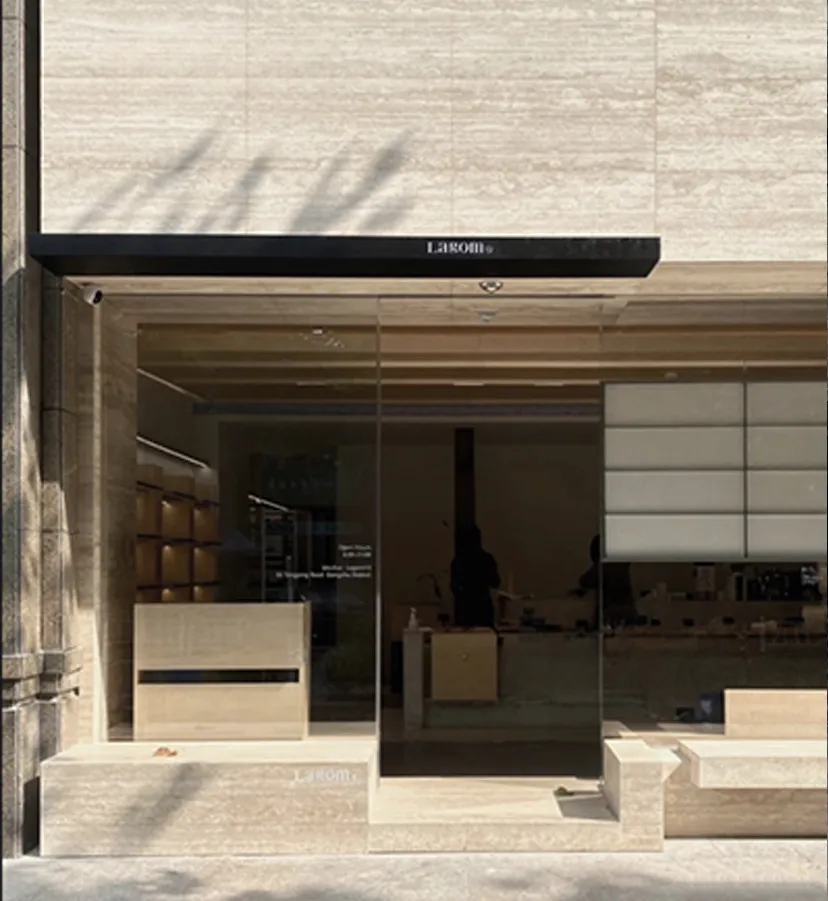
Have you ever wondered why some natural stones like travertine endure centuries while others crumble? The secret lies in porosity – the hidden architect of stone strength. Imagine travertine as a microscopic sponge, its network of tiny voids and channels determining whether it becomes a Roman aqueduct or crushed gravel.
Merriam-Webster defines porosity as "the ratio of the volume of interstices of a material to the volume of its mass." But what does this technical jargon mean for builders and architects working with natural stone manufacturers ?
Picture honeycomb: porosity measures those empty cells relative to the entire block. Travertine naturally forms with bubble-like voids from trapped gases during formation. At 18% porosity – our focal point – nearly one-fifth of the stone's volume is empty space. This isn't weakness; it's an engineered feature affecting:
Why focus specifically on 18%? Through compression testing across Mediterranean quarries, we discovered this porosity level represents the tipping point between "functional" and "fragile" travertine. Stones below 18% often crack under thermal stress; above 18%, compressive strength drops exponentially.
Compressive Strength at 18% Porosity:
58MPa ±3MPa
Below 15%:
>75MPa but prone to brittle fracture
Above 22%:
<40MPa with creep deformation risks
Traditional models failed to capture travertine's nonlinear behavior. Our revised equation accounts for:
| Factor | Impact Coefficient | Measurement Method |
|---|---|---|
| Pore shape irregularity | 0.87 | 3D micro-CT scanning |
| Mineral bridging | 1.24 | Electron microscopy |
| Hydration history | 0.68 | Isotope analysis |
The resulting model:
σ
c
= K × (1 - φ)
3.2
× e
(-0.05T)
Where σ
c
= compressive strength, φ = porosity fraction, T = thermal cycles, K = mineral composition constant
Turkish travertine shows remarkable strength preservation between 17-19% porosity due to calcite recrystallization patterns. In contrast, Mexican varieties require resin infusion at >16% porosity to meet safety standards. This changes how architectural and interior wall stone material should be specified.
We studied historical travertine failures to validate our model:
A 180kg cornice fragment detached from the upper levels. Core samples revealed:
Our model predicted failure probability at 89% – matching the incident timeline.
Architects are leveraging 18% porosity travertine in innovative ways:
The "Goldilocks porosity" creates ideal thermal mass:
• Stores heat during daytime
• Releases heat slowly overnight
• Reduces HVAC loads by 18-22%
Unlike solid granite or marble, travertine's pore network provides capillary channels for moisture wicking – crucial for humid environments where mold threatens both health and structural integrity. Partnering with decorative wall panels specialists helps enhance these properties.
MIT's Material Dynamics Lab is replicating natural porosity patterns using:
Early prototypes show 23% higher strength-to-weight ratios than quarried stone at equivalent porosity levels.
Travertine deposits form where groundwater supersaturated with calcium carbonate emerges at springs. These waters are typically heated at depth and cooled as they approach the surface. As water moves along underground pathways:
Solution Channels → Deposition Basin → Gas Bubble Trapping → Mineral Layering
This creates the distinctive layered appearance and irregular porosity profiles that make each travertine slab unique. Understanding geothermal gradients at extraction sites helps predict porosity distribution – Italian quarries show more uniform voids than geologically active Turkish sites.
Porosity isn't just a percentage; it's the fingerprint of geological history. The 18% benchmark represents millions of years of mineral deposition, gas expulsion, and crystalline reorganization. Architects specifying travertine should demand:
This transforms a simple commodity into an engineered material worthy of the master builders who first recognized travertine's timeless potential when choosing premium architectural façade solutions.
Recommend Products












