

When sourcing porcelain slab tiles for wall applications, quality is not a single metric — it is a chain of standards that starts with raw materials, runs through manufacturing precision, and ends with consistent on-site performance. For importers, contractors, and project developers, understanding the technical benchmarks that separate a reliable porcelain slab tile for wall supplier from an inconsistent one can save tens of thousands of dollars in rework, delays, and material rejection.
Porcelain slab tiles are fully vitrified ceramic panels fired at temperatures exceeding 1200°C. Their defining characteristic is a water absorption rate below 0.5%, which qualifies them as impervious under ISO 10545-3. This low porosity is what makes them suitable for interior wall cladding, bathroom wet zones, kitchen backsplashes, and even ventilated facade systems. However, not all slabs marketed as "porcelain" meet this threshold. Some factories cut corners on firing time or raw material purity, resulting in slabs that absorb moisture over time, develop micro-cracks, or show visible shade variation between batches.
For any project — whether a 200-room hotel or a single-family residence — the cost of replacing defective wall cladding after installation far exceeds the upfront savings from buying uncertified product. This is why a thorough understanding of supplier quality standards is an essential part of procurement due diligence.

The following table summarizes the key technical parameters that should be verified with test reports before committing to a supplier. These standards are referenced from the ISO 10545 series and ASTM specifications, which are globally recognized benchmarks for ceramic tile quality.
| Parameter | Standard | Acceptable Threshold | Why It Matters |
|---|---|---|---|
| Water Absorption | ISO 10545-3 | ≤ 0.5% (porcelain grade) | Determines moisture resistance; critical for bathroom and exterior wall applications |
| Modulus of Rupture (MOR) | ISO 10545-4 | ≥ 35 MPa (12mm slabs) | Measures bending strength; slabs with low MOR crack during transport and handling |
| Scratch Resistance (PEI) | ISO 10545-7 | PEI 3–4 for walls | Indicates surface durability against abrasion from cleaning and daily use |
| Chemical Resistance | ISO 10545-13 | Class AA or A | Ensures resistance to household cleaners, pool chemicals, and acidic substances |
| Thermal Shock Resistance | ASTM C484 | Pass (no visible damage) | Essential for exterior walls exposed to temperature swings; also relevant for kitchen backsplashes near cooktops |
| Dimensional Tolerance | ISO 10545-2 | ±0.5mm (rectified edges) | Tight tolerances allow minimal grout joints (2–3mm) and cleaner visual lines |
| Frost Resistance | ISO 10545-12 | Pass (100 freeze-thaw cycles) | Mandatory for exterior wall cladding in cold climates |
A reputable walls supplier should be able to provide third-party test reports — from laboratories such as SGS, TÜV, or Intertek — that confirm each of these parameters. Factory self-certification alone is not sufficient. Independent verification protects buyers from receiving substandard batches that look acceptable on the surface but fail in service.
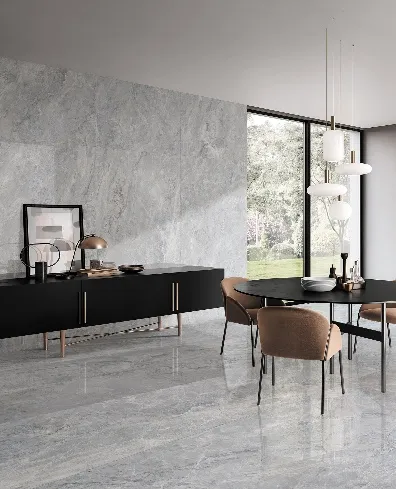
The quality of a porcelain slab tile is largely determined before it ever reaches the kiln. Three stages of production have an outsized impact on the final result:
High-grade porcelain slabs begin with a precise blend of kaolin, feldspar, quartz, and ball clay. The purity and ratio of these minerals affect the slab's whiteness, vitrification behavior, and dimensional stability. Impurities in the clay body — particularly iron oxide — can cause discoloration, pinholing, or inconsistent surface finish. Suppliers that invest in consistent raw material sourcing and pre-treatment produce slabs with predictable quality batch after batch.
Large-format slabs (1200×2400mm and above) require hydraulic presses with a minimum force of 3600 tons to achieve uniform density across the entire panel. Inadequate pressing force leads to density variations that cause warping during firing. The kiln cycle itself must be precisely controlled: a full vitrification cycle at 1200–1250°C lasting 60–90 minutes is standard. Shortened firing cycles — a common cost-cutting measure — produce slabs with higher water absorption and lower breaking strength.
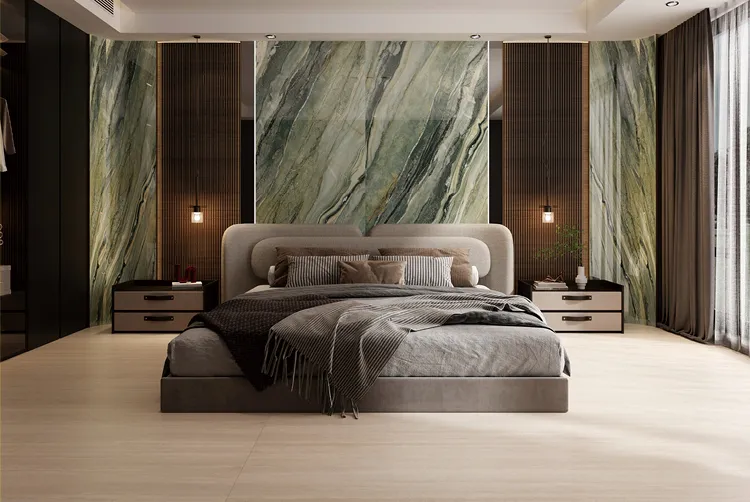
Modern digital inkjet printing technology enables highly realistic marble veining, stone textures, and solid color finishes. Quality control at this stage involves shade monitoring across production runs, ensuring that slabs from the same order match in tone and pattern. For book-matched installations — where adjacent slabs mirror each other's veining — the supplier must have the capability to track and sequence production output.
Beyond technical specifications, there are operational and commercial indicators that reveal whether a supplier can reliably deliver quality at scale. Use the following checklist when evaluating potential partners:
Key insight: The true cost of a porcelain slab tile is not its FOB price per square meter — it is the total cost delivered to the project site, installed without defects, and performing without failure over the building's lifecycle. A supplier that cuts corners on quality will eventually cost more than one that invests in rigorous standards from the start.

For project developers and contractors managing multi-category procurement, working with a building material supplier that covers walls, flooring, sanitary fixtures, furniture, and appliances under one roof brings significant efficiency gains. Instead of coordinating with five or six specialized factories — each with its own quality control standards, lead times, and shipping schedules — a single integrated supplier streamlines communication, reduces logistics complexity, and ensures consistent quality across all material categories.
COLORIA GROUP, headquartered in Foshan — the global center of ceramic and building materials manufacturing — offers exactly this integrated approach. As a one-stop solution provider, the company supplies porcelain slab tiles alongside a comprehensive portfolio that includes bamboo charcoal wall panels, WPC wall panels, MCM flexible cladding, PU stone panels, and Class A fireproof inorganic boards. This breadth means that a single project can source all wall materials from one partner, with unified quality assurance and coordinated container loading. The company's agent network in Saudi Arabia further strengthens its ability to serve Middle Eastern markets with localized support and faster response times.
Even experienced buyers can encounter problems when sourcing large-format porcelain slabs. Being aware of the most common pitfalls helps avoid them:
Quality in porcelain slab tiles is not an abstract concept — it is measurable, verifiable, and directly tied to supplier capability. By insisting on ISO 10545 test reports, evaluating manufacturing practices, and selecting a partner with a proven track record in international supply, buyers can minimize risk and ensure that their wall cladding performs as intended for decades. Whether you are sourcing for a single residential project or a multi-building commercial development, the principle remains the same: verify the standards, inspect the samples, and choose a supplier that treats quality as a system — not an afterthought.
Recommend Products











