
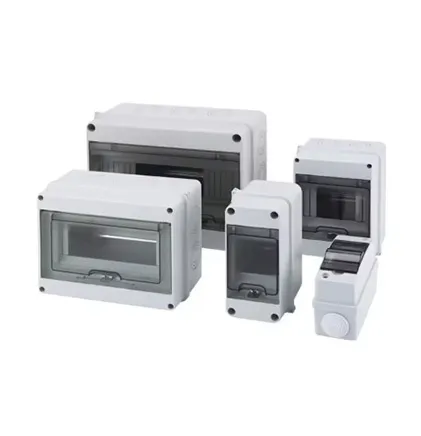
Walking through a petrochemical facility feels like stepping onto another planet. The hum of high-pressure systems, the tang of chemicals in the air, the intricate lattice of pipes stretching toward the sky. It's a world where safety isn't just a priority—it's a fundamental pillar holding everything together. One spark in the wrong place could cascade into catastrophe. That's why explosion-proof distribution boxes and corrosion-resistant cables aren't just equipment; they're silent guardians keeping thousands of workers safe every single day.
Flammable gases, volatile liquids, combustible dust—petrochemical environments are essentially tinderboxes waiting for ignition sources. Standard electrical components? They're like lit matches in these conditions. Explosion-proof distribution boxes literally build containment chambers around electrical components, engineered to:
️ Contain any internal explosion within the enclosure
️ Prevent external temperatures from triggering combustion
️ Withstand brutal impacts without compromising seals
️ Endure decades of chemical corrosion
️ Maintain integrity at pressure extremes
So what makes these boxes different from standard electrical cabinets? Let's peel back the layers:
We're not talking thin sheet metal here. These enclosures use materials like marine-grade stainless steel or cast aluminum alloys. Thickness matters—we're seeing 5-12mm walls that laugh off impacts that'd crumple standard enclosures. The joints? Precision-flanged surfaces cut with CNC machines to tolerance levels tighter than human hair.
This is where physics becomes lifesaving. When gases ignite inside the box, they expand rapidly through precisely engineered channels—flame paths. These labyrinthine passages cool escaping gases below ignition temperatures before they reach external hazardous areas. Think of it like running exhaust through an ice maze.
During containment events, pressure builds like a shaken soda can. Smart venting systems release this pressure gradually through sintered metal filters that quench flames chemically. It's the difference between a controlled sigh and a violent explosion.
In ethylene processing plants where chlorides eat metal for breakfast, the BXM's 316L stainless steel construction forms an invisible shield. Operators affectionately call these "the tanks" for good reason:
Sealed cable entries withstand 150mph hurricane-force winds
Internal thermal management runs 20°C cooler than ambient
Testing includes submersion in sulfuric acid for 500+ hours
Middle Eastern LNG facilities face a brutal combo—130°F heat plus sandstorms. SEM's fiberglass-reinforced polyester bodies become non-conductive shields against both:
UV-resistant coatings prevent solar degradation
Internal heat sinks dissipate 50% more thermal energy
Particle-trapping gaskets keep abrasive sands out
While boxes get attention, cables are the circulatory system—and they face brutal chemical exposure. When traditional insulation cracks? Short circuits become ignition sources.
Modern solutions like Teflon-coated or cross-linked polyethylene cables offer:
Chlorine resistance 18x greater than PVC
Flexible service down to -60°C in cryogenic plants
Dielectric strength maintaining 100MΩ after 5-year ammonia baths
Self-extinguishing properties preventing flame propagation
Even superhero-grade equipment fails with poor installation. Lessons learned from refinery retrofits:
Torque Matters: Cable gland seals need precise 25-30 N·m force—under-tightened invites gases, over-tightened cracks seals
Avoid Mixed Metals: Dissimilar metals (e.g., aluminum + steel) create galvanic corrosion hot spots
Drainage is Key: Conduit loops at high/low points capture condensate like chemical traps
The technology isn't static—innovations emerging in pilot plants:
Embedded sensors monitor internal pressure, temperature, and gas concentrations. When thresholds approach danger zones, ventilation systems purge enclosures with inert gases automatically.
Ceramic nanocomposite coatings applied molecularly that actually strengthen surfaces chemically when exposed to corrosives—a "self-healing" effect observed in lab tests.
Intumescent barrier tapes that expand 10x their size during thermal events, sealing conduit penetrations that traditionally compromised containment.
Reading certification labels might feel tedious—until you comprehend they’re literal lifesaving documentation:
▪︎ ATEX II 2G Ex db IIC T6: Survives gas ignition at 85°C ambient
▪︎ IECEx UL 1203: Withstands 7 J impact tests (equivalent to steel pipe strikes)
▪︎ IP66/IP67: Remains dry under fire hose blasts or tidal submersion
▪︎ NEMA 4X: Endures 10+ years coastal salt fog without perforation
Beyond technical specs lies deeper value:
Workers sleep easier knowing enclosures contain worst-case scenarios. Maintenance teams spend less time battling corrosion, more time on critical tasks. Financial benefits compound too:
→ Saudi Aramco documented 72% reduction in electrical fire incidents after full facility upgrades
→ Shell Canada reported replacing boxes every 12-14 years rather than 4-5—massive CapEx savings
→ BASF plants decreased "hot work" permits by 37% with intrinsically safer designs
Petrochemical processing pushes materials and engineering to absolute limits. In these frontiers, explosion-proof distribution boxes and corrosion-resistant cables are technological bodyguards—unassuming but critically positioned between routine operations and catastrophe. Their evolution reflects our growing understanding that safety isn't just about preventing failures; it's about engineering systems that inherently make failure impossible.
The next-generation innovations emerging—smart monitoring, adaptive materials, predictive analytics—will further transform protection from passive to active guardianship. But the core principle remains unchanged: when you're harnessing volatile energies and substances, the tolerance for compromise is absolute zero.
Because in the calculus of petrochemical safety, every decimal point of protection, every micron of corrosion resistance, every contained spark adds up to people going home safely—today, tomorrow, and decades from now.
Recommend Products












