


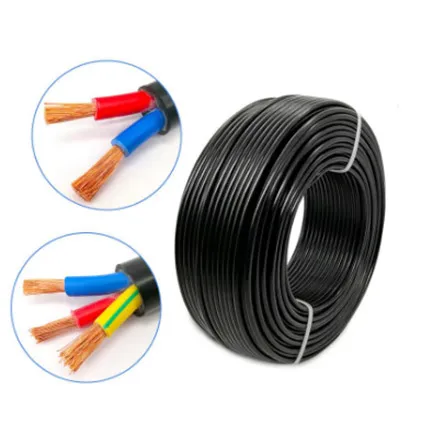
When was the last time you thought about what keeps electrical systems running safely in harsh industrial environments? Those unassuming cables threading through factories, oil rigs, and chemical plants are engineering marvels designed to laugh in the face of corrosive substances and extreme conditions. It's not just about insulation; it's about survival. Chemical degradation can turn robust cables into brittle, dangerous failures waiting to happen. Today, we're pulling back the curtain on the unsung heroes of industrial cabling – oil-resistant, acid-resistant, alkali-resistant, and UV-resistant cables – and the rigorous testing that ensures they perform when it matters most.
The Oil Resistance Challenge
Imagine cables swimming in cutting fluids in CNC workshops or buried in oily soil at drilling sites. As the Lapp Group notes, oils don't just dirty cables – they chemically attack materials at a molecular level. Different oils have different chemical "personalities". Mineral oils might make PVC swell like a sponge, while synthetic lubricants can turn certain plastics brittle. That's why specialized testing oils like IRM 902 and IRM 903 simulate real-world conditions.
Acid & Alkali Warriors
Acid-resistant cables aren't just for chemistry labs – they protect vital power cables in wastewater treatment plants where sulfuric acid lurks, or in battery manufacturing facilities. Alkaline environments like concrete plants or textile mills demand cables that won't dissolve when doused with caustic solutions. The resistance dance here is delicate: materials must maintain flexibility while their molecular bonds withstand chemical assaults.
UV Radiation Battleground
Sunlight might feel gentle, but its UV rays deliver a brutal beating to unprotected cables. Photodegradation isn't just about fading colors; it breaks polymer chains, causing cracking and brittleness. Outdoor solar installations, construction equipment, and marine applications need cables that won't turn to dust after one summer in the sun.
How We Put Cables Through Their Paces
The Immersion Torture Test
Cables get dunked like donuts in aggressive solutions for 168+ hours. But we're not just watching clocks – precision instruments measure:
- Tensile Strength Changes : How much muscle they lose after chemical baths
- Elongation Retention : Whether they can still stretch without snapping
- Hardness Shifts : If they turn rock-hard or marshmallow-soft
- Mass Change : Absorption indicates material breakdown
For oil resistance, tests follow ISO 1817 using standardized oils. Acid/alkali testing uses molar solutions matching industrial concentrations. UV resistance relies on QUV accelerated weathering chambers that simulate years of sun damage in weeks.
| Resistance Type | Key Standards | Failure Indicators | Champion Materials |
|---|---|---|---|
| Oil Resistance | ISO 1817, ASTM D471, UL 1581 | >30% tensile loss, >40% elongation reduction, cracking | TPU, CR, TPE, specialty PVC |
| Acid Resistance | IEC 60811-2-1, ASTM D543 | Visible degradation, >25% hardness change, swelling | FEP, PTFE, XLPO, certain EPDM blends |
| Alkali Resistance | ISO 6722, ASTM D471 | Surface tackiness, >35% elongation loss, blistering | Neoprene, certain PCP blends, TPE |
| UV Resistance | UL 1581, ISO 4892, ASTM G154 | Chalking, cracking after 1000+ hours QUV, color shift | Black XLPE, HDPE with carbon black, TPE-U |
Real-World Wisdom: Beyond Lab Tests
Laboratory tests are vital but can't capture every industrial scenario. Engineers should consider:
- Temperature Amplification : Chemicals become more aggressive at higher temperatures
- Mechanical Stress Combo : Flexing cables while exposed accelerates degradation
- Residue Buildup : Some oils leave deposits that trap corrosive elements
- Material Compatibility : Connectors and glands must match cable resistance
When selecting oil-resistant cables for marine drilling rigs, Lapp Group's experts advise combining oil resistance with seawater resistance – a harsh environment where standard power cables would quickly fail. Hybrid solutions like PUR-sheathed cables with oil-resistant TPE jacketing offer multilayered protection.
UV Resistance: More Than Sunblock for Cables
UV damage is sneaky - what starts as minor surface crazing becomes deep cracks inviting moisture ingress. Solar radiation hits cables with a brutal double punch: thermal stress from heat buildup plus photochemical breakdown. The testing process reveals fascinating patterns:
- Color Matters : Black cables containing 2-3% carbon black outperform lighter colors by absorbing rather than transmitting UV
- Additives Aren't Equal : Some UV stabilizers migrate or evaporate over time
- Thickness Isn't Everything : Thin but properly stabilized jackets outlast thick unstable ones
During accelerated weathering tests, we track gloss retention, surface cracking using digital microscopy, and Fourier-transform infrared spectroscopy (FTIR) to detect chemical structure changes invisible to the eye.
Beyond Material Science: The Future of Resistance Testing
Tomorrow's test protocols are evolving:
Multistressor Simulations
Testing chambers that combine UV exposure with salt spray, temperature cycling, and mechanical vibration – because real-world environments don't offer single challenges.
Digital Twin Modeling
Creating virtual cable models that predict degradation patterns based on chemical exposure history and environmental data.
Nano-Additive Tracking
Using tracer elements in compounds to monitor additive depletion – when exactly UV stabilizers give up their protective ghosts.
Installation: Where Good Cables Go Bad
Even superhero cables fail if improperly installed. Common pitfalls include:
- Bending Radius Violations : Creating stress points where chemicals penetrate
- Support Spacing Errors : Allowing sagging that traps corrosive substances
- Connector Incompatibility : Neglecting sealing accessories designed for hostile environments
- Cleaning Chemical Mismatch : Using solvents that attack cable sheathing during maintenance
Remember: cable systems age together. An oil-resistant cable with non-resistant conduit creates vulnerability points – an integrity chain is only as strong as its weakest link.
Conclusion: Resistance as a System
The quest for true chemical resistance isn't about finding magical materials; it's about rigorous testing protocols and recognizing that cables function in interconnected systems. As we push into more extreme environments – deep-sea operations, battery recycling plants, Arctic energy projects – the demands on oil-resistant, acid-resistant, alkali-resistant and UV-resistant cables intensify. Fortunately, advanced testing continues to reveal how polymers respond at molecular levels, guiding smarter material selection. Because ultimately, in industrial applications, cable failure isn't just inconvenient – it's dangerous. And in the silent battle against corrosion and radiation, rigorous testing is our strongest armor.










