
Let's talk about something we've all experienced – that moment when winter hits and everything seems to get a bit more brittle. Plastic water bottles left in the car? Shattered. Garden hoses? Frozen solid. Now imagine that same chill attacking the veins of your industrial systems or home plumbing. That's exactly what happens to PVC pipes when temperatures plummet. Unlike metals that just get colder, PVC actually undergoes molecular changes in freezing conditions.
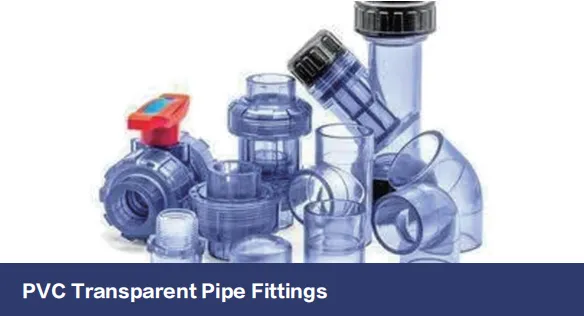
Here's the fascinating part: PVC transparent fittings aren't just pretty versions of regular pipes. Their see-through nature gives us a front-row seat to observe how fluids behave under stress. Ever seen ice crystals forming inside a pipe during a deep freeze? With transparent PVC, you can actually watch the crystallization process – something that would remain hidden in opaque systems. This visibility isn't just cool science; it's preventative maintenance gold.
Picture PVC at a microscopic level – long chains of vinyl chloride molecules that normally slide past each other like cooked spaghetti. Now drop the temperature below 40°F (4°C). Those flexible chains start locking into place. Go below freezing, and they become as rigid as uncooked pasta. This transition isn't gradual either; it happens in distinct phases that manufacturers call the glass transition temperature .
The real danger zone? Between -20°F and 32°F (-29°C to 0°C). This is when impact resistance can drop by up to 60% compared to room temperature performance. But here's the silver lining: transparent PVC formulations often contain special plasticizers that act like molecular antifreeze. These additives create microscopic air pockets that absorb expansion stress – think of them as tiny shock absorbers built right into the pipe walls.
You wouldn't wear flip-flops in a snowstorm, so why install generic PVC in freezing conditions? Here's what actually works:
Material Matters:
Not all PVC is created equal. CPVC (chlorinated PVC) contains extra chlorine atoms that act like molecular armor against cold-induced brittleness. Tests show CPVC maintains 85% of its impact resistance at -30°F (-34°C) where standard PVC fails catastrophically.
Installation Wisdom:
Ever notice how glass breaks easiest at the edges? Same principle applies. Using radiused elbows instead of sharp 90-degree angles distributes stress. And always allow for thermal contraction – that extra 1/4 inch per 10 feet might save your entire system.
Chemical Guardians:
Modern stabilizers like methyltin create molecular shields that prevent chlorine loss – PVC's Achilles' heel in freezing conditions. It's like applying invisible armor that gets stronger when the mercury drops.
Consider the Alaskan pipeline monitoring project. Engineers used transparent PVC fittings in -50°F (-45°C) conditions to track coolant flows. While metal pipes required constant heating tapes and insulation, the PVC system ran unassisted for three winters. The secret? A custom polymer blend with acrylonitrile additives that created microscopic "air pillows" within the material.
Or the Canadian dairy farm that switched to transparent PVC for manure transfer lines. Their old system cracked annually during freeze-thaw cycles. After installing cold-formulated PVC with reinforcing fibers visible through the transparent walls, they've gone five winters without a single failure – all while monitoring flow consistency through the pipe walls.
With transparent PVC, you gain a superpower: seeing problems before they happen. As ice begins forming, you'll notice:
• Cloudy patterns appearing in the pipe walls (crystallization starting)
• Flow streaks changing direction (viscosity increasing)
• Bubble formation at connection points (pressure differentials developing)
These visual cues typically appear 8-12 hours before actual blockage occurs. That's half a day most systems never get with opaque piping. For critical processes, combining transparent fittings with thermal cameras creates an incredibly responsive monitoring system.
Here's what most people miss: the transition back to warm temperatures is actually more dangerous than the freeze. When ice melts suddenly, it creates pressure spikes that hit systems at their most brittle state. Transparent pipes show you exactly where these hydraulic shocks are happening in real-time.
The solution? A graded thaw process. By watching flow patterns in your clear pipes, you can slowly increase temperature in 5°F (-15°C) increments only when fluid movement stabilizes. This prevents the "popcorn effect" that destroys so many systems during spring thaws.
Imagine PVC fittings with built-in thermochromic indicators that change color at specific temperature thresholds. Or nanocomposite materials that actually strengthen when cold through molecular rearrangement. Some labs are even testing self-healing polymers with microcapsules that release sealants when cracks form – visible through transparent walls before they become critical.
These innovations highlight a crucial point: the future of PVC in freezing environments isn't just about surviving the cold, but leveraging it to create smarter, more resilient systems using visible pipe systems as diagnostic tools.
•
Visibility equals prevention
– use transparency proactively
• Cold-formulated CPVC outperforms standard PVC by 3:1 in freeze tests
• Install with expansion gaps and gentle curves
• Grade your thaw process like a careful chef reheating sauce
• Train teams to "read" what the transparent pipes show them
These approaches transform PVC from a simple conduit into an intelligent component of your thermal management strategy.
Recommend Products












