


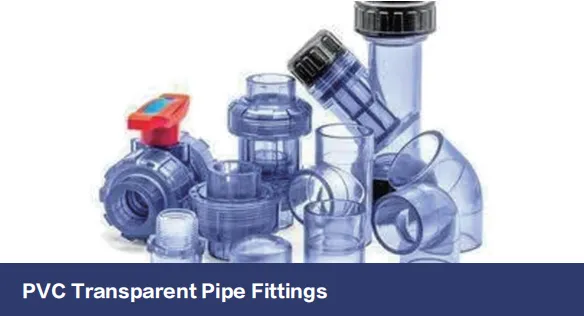
Imagine never needing to scrub mineral deposits from your pipes again. Visualize plumbing systems that detect leaks before they happen and heal themselves like living tissue. Sounds like science fiction? Thanks to nanotechnology, these capabilities are emerging in our bathrooms, kitchens, and municipal water systems. This revolutionary shift transforms our approach to one of civilization's oldest technologies—plumbing—and particularly redefines what we can expect from humble PVC transparent pipe fittings.
The Quiet Revolution in Our Pipes
Most of us rarely think about the pipes behind our walls until a leak stains the ceiling or clogged drains cause headaches. Yet within this invisible infrastructure, a technological renaissance is occurring. Nanotechnology operates at the scale of atoms and molecules—one nanometer is a billionth of a meter, about 100,000 times thinner than a human hair. At this microscopic level, ordinary materials exhibit extraordinary properties, turning standard PVC pipes into something resembling science fiction.
Why PVC?
PVC (polyvinyl chloride) has been plumbing's dependable workhorse for decades. It's affordable, corrosion-resistant, and lightweight. Transparent variants allow visual inspection—great for laboratories or educational demonstrations—but until now, it was essentially a passive material. Nanotechnology changes this story completely, giving these pipes capabilities that sound almost alive:
Self-Cleaning Mechanisms: Microscopic Maid Service
The dream of self-cleaning pipes addresses one of plumbing's most persistent headaches—buildup. Minerals in hard water gradually accumulate like plaque in arteries, reducing flow efficiency and requiring maintenance. Nanoparticle coatings offer two primary self-cleaning strategies:
The Lotus Effect
Water-repellent nanostructures inspired by lotus leaves create a "self-washing" mechanism called superhydrophobicity. These engineered surfaces mimic nature's brilliance with microscopic bumps that make water form beads. Instead of spreading, these droplets roll downhill, dragging mineral particles and bacteria along with them—like tiny bulldozers cleaning surfaces.
Photocatalytic Nanocoatings
These coatings contain nanoparticles of titanium dioxide that become activated by ultraviolet light. When light hits these particles, they generate powerful oxidizing agents that break down organic contaminants and bacteria into harmless byproducts. It's like having millions of microscopic oxidation scrubbers constantly scouring the pipe interior without chemicals or manual effort.
Real-World Impact: Singapore's Water Revolution
Singapore's Public Utilities Board has tested nano-enhanced pipes in reclaimed water systems. By integrating photocatalytic nanocoatings, they reduced pipe maintenance costs by 40% while extending service life. The technology prevents organic buildup where pipes transport treated wastewater—proving its effectiveness in real-world harsh conditions. Buildings equipped with these pipes require less chemical flushing and see fewer corrosion-related issues.
Beyond Self-Cleaning: Advanced Functions
Self-cleaning capabilities are impressive but represent just one dimension of nanotechnology's potential for PVC pipes. Here are other emerging functions:
Self-Healing Structures
Researchers at MIT have embedded microcapsules containing healing agents into PVC pipe composites. When cracks form, these capsules rupture and release their contents—monomers that polymerize rapidly to seal the breach. Additional microcapsules contain catalytic nanoparticles that accelerate the repair process. The result? Pipes that self-heal within hours of detecting stress cracks.
Anti-Biofilm Technologies
Water systems often face biofilm formation—slimy communities of bacteria that cling to pipe walls like stubborn mold. Silver nanoparticles, embedded into PVC matrix, provide continuous antimicrobial protection. They disrupt bacterial cell membranes without entering the water supply themselves. Hospitals have begun installing these pipes to combat Legionella and other waterborne pathogens.
Smart Sensing Integration
Transparent PVC enables optical sensors detecting impurities through the pipe walls. Adding graphene nanoribbons creates electrical pathways that detect flow changes indicating hidden leaks. This transforms passive pipes into diagnostic tools—sensing pressure drops or chemical imbalances we'd otherwise miss until damage occurs.
Thermal Regulation
Phase-change nanoparticles suspended within PVC provide thermal buffering. As hot water flows, they absorb excess heat; as water cools, they release stored energy to maintain temperatures. This reduces water heating costs and prevents scalding in recirculating systems. The eco-friendly building materials movement championed by architects is increasingly embracing these innovations for sustainable construction.
Making Science Reality: Manufacturing Challenges
Implementing these technologies involves sophisticated manufacturing. Nanomaterials must bind uniformly to PVC without compromising optical clarity. This requires plasma-assisted techniques where surfaces are activated before applying nano-coatings. For bulk integration, twin-screw extruders thoroughly mix nanoparticles into PVC resin while avoiding unwanted clustering.
Cost remains a barrier. Nano-enhanced PVC pipes currently cost 3-5 times more than standard equivalents. However, lifecycle analysis shows compelling economics. Self-cleaning pipes extend maintenance intervals by up to 70%, while self-healing properties prevent catastrophic failures. Municipal projects in Germany have demonstrated ROI within 18 months despite higher upfront costs.
Safety: Critical Considerations
With nanoparticles, we must ask: could they migrate into water? Current research suggests proper embedding stabilizes particles in PVC matrixes. TiO2 nanoparticles, for instance, exhibit leaching rates below detection limits. Rigorous NSF/ANSI Standard 61 testing ensures water safety before market introduction.
Future Horizons: What's Next?
The frontier continues advancing. Several labs are developing:
- Photoluminescent pipes that glow when leaks occur
- Shape-memory polymers that temporarily expand around blockages
- Nanofiber coatings that generate micro-turbulence to prevent buildup
- Biomimetic surfaces that mimic shark skin to reduce friction
Manufacturers are also exploring responsive color-changing nanoparticles that provide instantaneous water quality information through transparent pipe walls—turning plumbing networks into diagnostic tools.
Conclusion: The Transformative Promise
Nanotechnology elevates PVC pipes from passive components to sophisticated, multi-functional systems. Self-cleaning capabilities alone solve persistent maintenance issues, while self-healing properties enhance reliability. Integrated sensing turns plumbing systems into sources of actionable data rather than hidden liabilities.
This evolution extends beyond convenience—it promises significant conservation benefits. By reducing maintenance cycles, preventing leaks, and minimizing cleaning chemicals, nano-enhanced PVC contributes to sustainable water management. As manufacturing improves and costs decrease, expect these smart pipes to flow into homes as standard features.
The plumbing industry's future runs through these nanoscale innovations. Once humble PVC pipes are becoming self-cleaning, self-repairing systems with integrated intelligence. It's not exaggeration to say nanotechnology transforms plumbing into a responsive, living extension of our water infrastructure—and that transparent fittings become windows into that revolution.










