
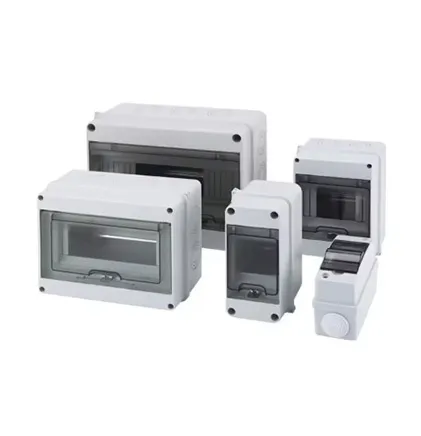
How misunderstandings about electrical distribution systems lead to costly mistakes and safety hazards – and what professionals should really know
Many contractors assume oversizing a distribution box provides "room to grow." They'll install a 300A box for a home requiring just 150A, thinking it's good planning. But this creates problems.
Electricians sometimes distribute circuits evenly across phases without considering appliance power demands. Treating all circuits identically leads to imbalanced phases and hotspots.
Most installers calculate peak instantaneous loads to size boxes, ignoring harmonic distortions from modern electronics. This explains why new buildings experience mysterious breaker trips.
Distributors frequently ignore ambient temperature when selecting enclosures. Installing standard boxes in boiler rooms or attics causes premature aging and safety hazards.
"UL-listed" and "UL-recognized" get confused regularly. Some projects use components certified only for specific implementations, creating liability nightmares.
"We'll just add a big uninterruptible power supply" seems like a solution for inadequate boxes. But UPS systems draw significant currents during recharge cycles, overloading undersized panels.
Jam-packed boxes with conduit entries covering every knockout seem efficient. Contractors push conduit density limits thinking wire insulation compensates – risking containment failure.
DIYers reuse home distribution concepts in cafes or shops. Residential split-phase setups fail catastrophically when powering commercial three-phase appliances.
Cost-cutting leads to mixing conductive metals without adjustments. Aluminum lugs and breakers get treated as copper equivalents, causing oxidation issues and thermal failure.
Boxes get sized with empty breaker spaces for growth. But transformers for future solar integration or EV charging fundamentally change distribution needs beyond adding circuits.
Selecting distribution boxes requires understanding electrical physics and anticipating real-world demands. Energy efficient appliances (like variable-speed HVAC systems) actually complicate capacity planning due to their irregular power factor demands.
Ultimately, successful power distribution combines mathematical precision with practical wisdom. By avoiding these misconceptions and implementing rigorous planning processes - including thermal imaging during commissioning - professionals can design systems that deliver both safety and adaptability for decades.
Recommend Products












