
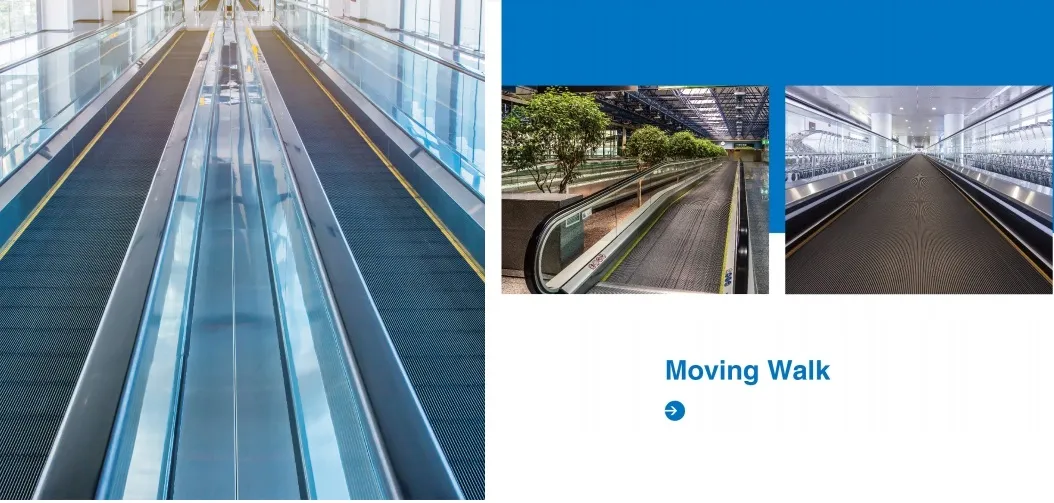
How these silent workhorses are transforming airports, malls, and cityscapes
Picture this: You're rushing through a bustling airport with heavy luggage. Suddenly, a moving pathway appears like an urban oasis. As you step on, your shoulders relax - this simple invention just turned stress into effortless glide.
Moving walkways, those horizontal escalators we often take for granted, represent one of the most intelligent integrations of engineering and human-centered design. Unlike their vertical cousins, they work silently in the background, solving mobility challenges with remarkable subtlety.
Modern moving walkways have evolved far beyond basic conveyor belts. Safety innovations include:
When combined with proper maintenance protocols including regular lubrication cycles and alignment checks, these features create a transportation method with accident rates significantly lower than stairs or stationary walkways.
| Safety Feature | How It Works | Real-World Impact |
|---|---|---|
| Guarded Skirt Brushes | Flexible barriers preventing clothing/items from getting caught | Reduces entrapment incidents by over 95% compared to first-generation models |
| Automatic Speed Synchronization | Walkway adjusts to pedestrian flow density | Prevents pile-ups during peak travel times |
| Durable Aluminum Framing | Impact-resistant structural components | Ensures stability even under heavy loads during events |
Moving walkways solve fundamental urban challenges:
A 100-meter walkway covering 200 meters of ground effectively "shrinks" large facilities. This is why modern airports now place walkways between terminals - one famous Asian hub reduced connection times from 35 to just 11 minutes.
Shanghai's Maglev train station handles 120,000 daily transfers seamlessly through precisely timed walkway networks. The secret? Speed variations:
Many manufacturers now include eco-friendly flooring materials that not only reduce energy consumption during operation but also utilize sustainable production methods. These materials align perfectly with modern architectural trends toward green building certifications.
The latest generation of moving walkways incorporates multiple energy-recovery technologies:
A Munich airport study showed their walkway network reduced terminal energy consumption by 17% annually - equivalent to powering 600 homes. Some pioneers now experiment with modular **solar panels** integrated directly into walkway canopies, turning transit zones into power generators.
| Energy Feature | Technology | Savings Impact |
|---|---|---|
| High-Efficiency Motors | Permanent magnet synchronous motors | 40% less energy consumption vs standard AC motors |
| Advanced Lubrication Systems | Self-metering polymer chains | Reduces friction losses by 60%, extending component life |
| Predictive Load Management | AI-powered crowd flow algorithms | Optimizes acceleration profiles saving 22-35% daily power |
The longevity of modern moving walkways owes much to innovative materials:
These high-quality building materials ensure walkways operate reliably for decades even in harsh environments like coastal cities with salt-heavy air or Middle Eastern destinations with extreme heat and sand exposure. The best manufacturers now offer 200,000-hour operational guarantees - equivalent to 22 years of continuous service.
The Dubai International Airport walkway system uses specialized polymer composites that withstand 50°C temperatures while maintaining flexibility. Each tread contains RFID chips enabling predictive maintenance before failures occur.
Next-generation moving walkways currently in prototype phase include:
Temporary configurations for events that install in hours rather than weeks, featuring foldable segments and battery power packs. Imagine pop-up walkways at festivals, convention centers, or temporary evacuation routes.
Systems that communicate with your phone: "Your gate is 8 minutes away. Walkway A7 will save 5 minutes." Tactile guidance for visually impaired users and climate-controlled pathways will soon become standard in premium installations.
Combining ultra-low friction materials, piezoelectric power generation from footsteps, and aerodynamic canopies for self-sufficient operation. Engineering competitions now challenge students to create solar-powered walkways with 100% energy recapture capabilities.
When planning a moving walkway installation, consider these crucial factors:
| Decision Factor | Key Considerations | Recommendation |
|---|---|---|
| Load Capacity | Peak user volumes, luggage/cart traffic, emergency scenarios | Always design for 125% of predicted maximum load |
| Environmental Factors | Temperature ranges, humidity, precipitation exposure | Salt-resistant components for coastal areas, heated treads for snowy climates |
| Operational Profile | Daily operating hours, maintenance access windows | Choose sealed bearings and lubrication-free components for 24/7 operations |
| Sustainability Goals | Energy recovery systems, recyclable materials, carbon tracking | Demand transparency on material sourcing and manufacturing emissions |
Moving walkways represent more than convenience - they embody how thoughtful engineering creates human-centered spaces. As urbanization intensifies, these systems:
The next time you glide effortlessly through an airport terminal, notice the subtle engineering around you - the precise gaps between moving plates, the gentle lighting along the path, the almost imperceptible acceleration. What feels like simple technology is actually a sophisticated dance of mechanics, material science, and human psychology.
Seoul's award-winning Transit Hub features moving walkways lined with special wall panels that absorb air pollutants. Each day, the 1.2-kilometer system cleans as much air as 300 mature trees - demonstrating how mobility infrastructure can actively improve urban environments.
From humble beginnings in 19th century amusement parks to essential infrastructure in global transit hubs, moving walkways continue evolving. As we design smarter cities, their safety features, efficiency advantages, and increasingly impressive energy profiles will make them not just convenient amenities, but fundamental components of sustainable urban mobility. The pathway to the future, it turns out, is moving beneath our feet.
Recommend Products












