
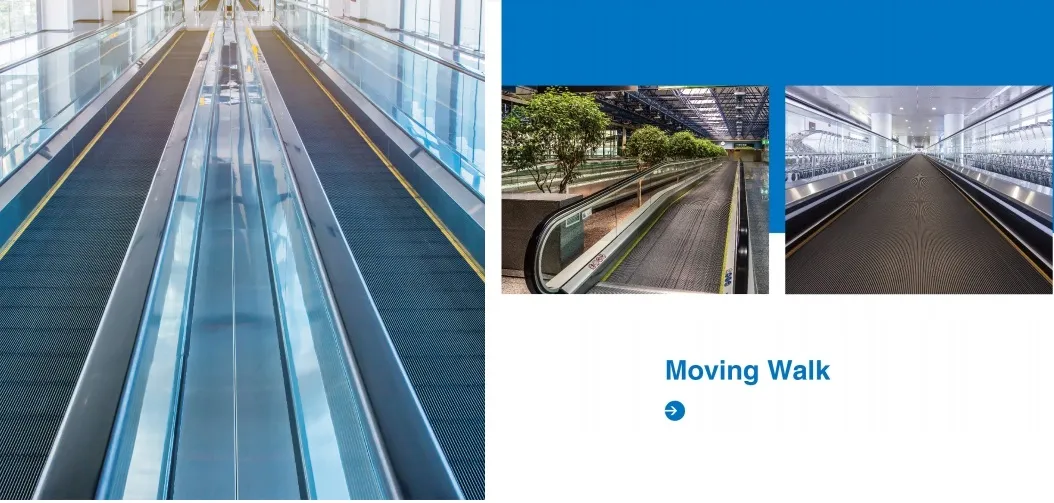
Picture this: You're rushing through a massive airport terminal, late for your flight. Suddenly, you step onto a moving walkway and feel instant relief as it carries you forward. That brief moment of assistance makes all the difference in your journey. Selecting the right walkway length isn't just about convenience – it's about creating seamless experiences in our busiest spaces.
Moving walkways (or travelators) are like the unsung heroes of modern architecture. They transform exhausting treks into effortless journeys, especially when thoughtfully integrated with high-quality building materials in both airports and shopping malls.
But here's the thing most people don't realize: that smooth glide you're enjoying is the result of incredibly precise engineering calculations. The length isn't arbitrary – it's meticulously matched to the corridor's distance, traffic patterns, and human behavior.
Choosing walkway length feels like solving a puzzle with three pieces: engineering constraints, human psychology, and architectural reality. Too short? It feels pointless. Too long? Maintenance costs skyrocket. That Goldilocks "just right" spot makes all the difference.
Imagine airport corridors as emotional landscapes: travelers experience everything from excitement to panic. Well-proportioned walkways transform anxiety into relief. Industry research shows walkways under 40 meters feel insignificant, while those over 100 meters cause "conveyor fatigue" where people subconsciously slow down.
| Location Type | Optimal Length Range | Peak Usage Patterns | Common Mistakes |
|---|---|---|---|
| Major International Airports | 70-90 meters | Morning departures, evening arrivals | Ignoring connection flight rushes |
| Regional Airports | 45-60 meters | Weekend peaks, holiday seasons | Overestimating passenger volume |
| Large Shopping Malls | 30-50 meters | Weekends, lunch hours, promotions | Poor placement near food courts |
| Mixed-Use Developments | 25-40 meters | Evenings, special events | Not accounting for strollers/carts |
Getting walkway length right involves solving multiple equations simultaneously. It's not rocket science, but it requires careful consideration of several interconnected factors.
The most fundamental calculation involves matching walkway length to corridor distance. Industry guidelines recommend walkways covering 60-75% of straight corridors. For curved sections, specialists use "comfort radius" calculations to prevent awkward transitions.
Peak passenger volumes dictate width more than length, but length impacts flow dynamics. Terminal designers use computational fluid dynamics software to simulate crowd patterns. You'd be surprised how a well-placed 80-meter walkway can move people faster than three shorter sections.
Here's something counterintuitive: passengers walk slower on moving walkways than on solid ground. Research from Tokyo's Haneda Airport revealed a 17% average speed reduction. That means your walkway needs to be longer than pure distance math suggests to achieve time savings.
Why does this happen? Safety awareness kicks in. People get self-conscious about walking on a moving surface or hesitate before exiting. Understanding this psychological factor separates adequate design from exceptional design.
Savvy architects plan for tomorrow's needs. Modular walkway systems allow adding sections as traffic grows. We've seen terminals start with 50-meter installations that expand to 80 meters over a decade. That's smart planning.
The proof comes not from blueprints but from passenger experiences. Some projects nail the walkway experience while others serve as cautionary tales.
Facing passenger complaints about endless walks to gates, designers installed 87-meter walkways covering 68% of critical corridors. The result? 34% reduction in average connection times and measurable increases in passenger satisfaction scores.
Their West Wing added 35-meter walkways that felt pointless. Why? They covered less than 25% of the corridor. The solution? Extending them to 48 meters transformed the experience dramatically without adding much cost.
Walkways aren't standalone features but integrated elements within your larger infrastructure. Properly incorporating them creates experiences greater than the sum of their parts.
| Integration Factor | Airport Priorities | Mall Priorities | Critical Measurements |
|---|---|---|---|
| Entry/Exit Zones | Security sightlines | Storefront visibility | 3-meter transition zones |
| Safety Integration | Emergency stop spacing | Child safety barriers | 15-meter visibility |
| Wayfinding Synergy | Flight information displays | Directory placement | 60° viewing angles |
| Accessibility | Wheelchair maneuvering | Stroller accessibility | 1.8-meter clear width |
While installation grabs headlines, maintenance determines true long-term value. Every additional meter creates exponential maintenance implications rather than linear ones.
A typical 100-meter walkway costs just 35% more to install than a 70-meter version but requires 62% more maintenance over five years. Why? More moving parts, more wear points, and exponentially more diagnostic complexity.
Tomorrow's walkways won't have fixed lengths. Emerging technologies like Madrid's variable-length prototypes adjust during peak hours. Sensors detect crowd density and expand walkway sections like a high-tech accordion.
The next frontier? "Smart flow" systems that communicate with building management platforms to dynamically balance walkway use with stair/escalator alternatives during emergencies or maintenance.
Selecting walkway length shouldn't feel like guesswork. Follow these steps to achieve confidence in your decision:
Gather corridor measurements with laser precision – not just straight-line length but elevation changes and bends. Conduct pedestrian counts at 15-minute intervals for a week to spot patterns.
Use these formulas as starting points:
Base Length (meters) = (Corridor Length × 0.65) + (Peak Hourly Traffic ÷ 150)
Adjusted Length = Base Length + (1.5 × Number of Direction Changes)
Always develop multiple scenarios: minimum viable, optimal performance, and extended coverage options.
Map entry/exit zones against storefronts or security checkpoints. Run fire evacuation simulations. Plan for modular expansion by oversizing foundations by 30% at extension points.
Reserve space for potential extensions. Install conduit for future sensor systems. Negotiate maintenance contracts with incentives for uptime guarantees.
Selecting moving walkway length balances physics and psychology. When you match the distance to human needs rather than technical capabilities, you create spaces that feel welcoming rather than intimidating. The most successful installations become invisible – travelers simply flow through spaces, arriving energized rather than exhausted.
In the end, the numbers matter because people matter. Whether you're designing tomorrow's grand airport terminal or expanding a neighborhood mall, remember that walkway length shapes first impressions. Get it right, and passengers won't notice the distance – they'll notice how effortlessly they moved through your space.
Recommend Products












