
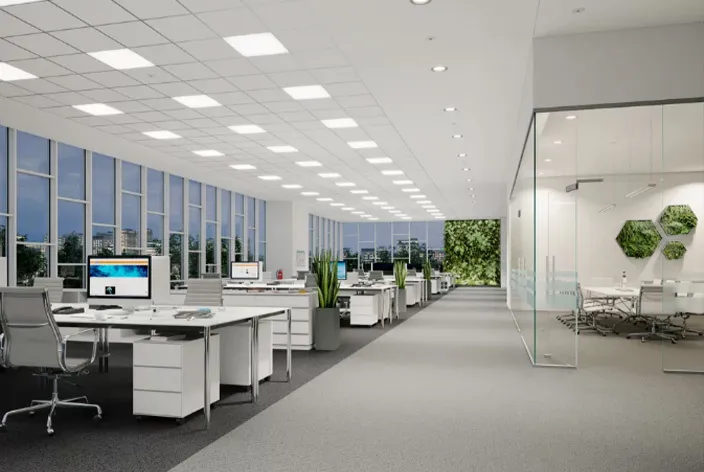
Remember the last time you walked into an office that just felt... off? The humming fluorescent lights casting strange shadows, the headache creeping in after just an hour at your desk, that overwhelming urge to rub your tired eyes? Truth is, lighting isn't just about illuminating space—it's the invisible architect of productivity. Imagine swapping that dreary glare for soft, natural-feeling illumination that makes your reports feel clearer and your energy levels feel limitless.
A Harvard Business Review study found workers in well-lit offices performed 20% faster on cognitive tests and reported 50% less eye strain. That's not just comfort—that's dollars saved on lost productivity.
Lighting today isn't just about flipping a switch. When we talk modern office solutions, we're diving into a revolution where panel lights and linear fixtures create human-centric environments. I've seen first-hand how updating lighting systems transforms workplaces from draining environments to inspiring hubs of focus and creativity.
Your old fluorescent tubes? They're secretly devouring your electricity bill. Traditional lighting systems consume up to 75% more energy than modern LED equivalents. That buzzing sound? That's dollars evaporating daily.
Harsh lights create contrast glare that forces your pupils into constant battle mode. It's no wonder 70% of office workers report regular headaches and dry eyes. Your lighting shouldn't feel like an obstacle course for your retinas.
Most offices cling to outdated lighting because change seems disruptive. But here's the kicker: modern solutions install faster than repainting walls and start paying back immediately. The true cost isn't the upgrade—it's maintaining painful inefficiency.
LED panels are the ninjas of illumination—disappearing into ceilings while delivering museum-quality light distribution. Their magic? Uniform diffusion that erases shadows and glare entirely.
Linear fixtures are the paintbrushes of modern illumination. Their sleek profiles make them perfect for highlighting architecture, defining zones, and creating visual rhythm in open offices.
The DOE reports businesses save $6 billion annually just by switching to LEDs. That's not energy efficiency—it's financial liberation disguised as lighting.
Light isn't just visual—it's biological. Our circadian rhythms respond to lighting quality the same way plants bend toward sunlight. Modern lighting solutions are specifically engineered to support our natural energy rhythms:
Cool white light in the 5000K range boosts serotonin production sharpening focus during critical morning hours and crunch-time deadlines. Studies show this high-CCT lighting reduces errors by up to 30% in detail tasks.
Warmer light in meeting spaces lowers cortisol levels making teams 40% more open to creative problem-solving. Smart controls remember these settings creating ideal environments for different types of teamwork.
The magic happens when these systems integrate with circadian algorithms. Picture lights that gradually warm as evening approaches, signaling your nervous system to unwind naturally without caffeine crashes.
Switching to LED panels and linear lights isn't like rebuilding infrastructure—it's more like updating software:
Most companies recoup lighting investments within 18 months through energy savings alone—before counting productivity gains or maintenance reductions. That's like getting lighting upgrades with negative cost.
Tomorrow's office lighting solutions feel like sci-fi today: systems that learn employee preferences, biologically calibrated circadian rhythms, and AI that optimizes both efficiency and wellbeing. This isn't just illumination—it's environmental intelligence where lights adjust to create perfect conditions for each task automatically.
The businesses winning tomorrow understand lighting isn't overhead—it's their secret productivity accelerator. Making lighting decisions that prioritize both human biology and architectural excellence isn't just smart business—it's creating environments where people actually love to do their best work.
The National Institute of Health confirms workers in optimized lighting environments take 25% fewer sick days and demonstrate 34% higher job satisfaction.
So when you think about modern office upgrades, remember: changing lights changes everything. Your workplace doesn't just get brighter—it gets smarter, healthier, and fundamentally more human.
Recommend Products












