
In the sun-drenched landscapes of the Middle East, a transformation is underway. From the glittering skylines of Dubai to the ambitious megaprojects of Riyadh, and the rapidly expanding urban centers of Doha and Abu Dhabi, construction cranes dot the horizon like modern-day sentinels. This isn't just about building taller or fancier structures—it's about creating resilient, future-ready cities that can sustain growing populations, support thriving economies, and withstand the region's unique environmental challenges. At the heart of this transformation lies an often unsung hero: the piping systems that form the circulatory system of every building, industrial facility, and infrastructure project.
As governments and private developers pour billions into healthcare facilities, educational institutions, commercial towers, and industrial complexes, the demand for reliable, high-performance piping has never been higher. In a region where temperatures soar above 50°C in summer, water scarcity is a pressing concern, and safety regulations grow increasingly stringent, not all piping systems are created equal. Enter CPVC SCH80 high pressure piping systems—engineered to handle extreme pressures, resist corrosion, and meet the strict fire safety standards that are non-negotiable in critical sectors like hospitals and schools. But behind these innovative solutions are the suppliers who design, manufacture, and distribute them, turning blueprints into functional, durable reality.
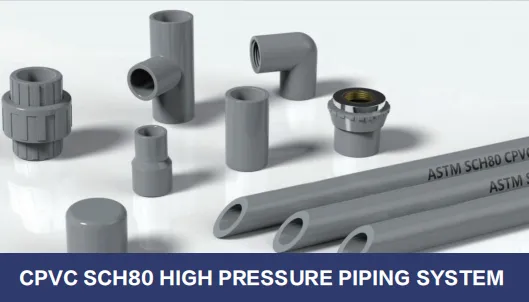
To understand the rising popularity of CPVC SCH80 high pressure piping systems in the Middle East, it helps to start with the basics. CPVC, or chlorinated polyvinyl chloride, is a thermoplastic material known for its exceptional strength, chemical resistance, and thermal stability. When rated as SCH80, it's designed to withstand higher pressure levels than standard SCH40 piping, making it ideal for applications where water, chemicals, or gases are transported under significant force. But what makes it particularly well-suited for the Middle East?
First, consider the region's water quality. Many areas rely on desalinated water, which, while a lifeline, can be corrosive due to higher salt content. Traditional metal pipes often fall victim to rust and scaling, leading to leaks, reduced water flow, and costly replacements. CPVC SCH80, with its smooth inner surface and resistance to chemical corrosion, ensures that water systems remain efficient and low-maintenance over decades. Then there's fire safety—a paramount concern in densely populated urban areas and critical facilities like hospitals and schools. CPVC SCH80 is inherently fire-resistant, meeting Class A fire ratings in many cases, which aligns with the Middle East's rigorous building codes aimed at protecting lives and property.
Perhaps most importantly, CPVC SCH80 thrives in extreme temperatures. Unlike some plastics that become brittle in cold or warp in heat, CPVC maintains its structural integrity even when exposed to the Middle East's scorching summers and occasional cold snaps. This durability translates to fewer disruptions, lower lifecycle costs, and peace of mind for project managers and facility owners. It's no wonder, then, that demand for CPVC SCH80 high pressure piping system solutions has surged, with suppliers racing to meet the needs of a market that refuses to compromise on quality.
As the Middle East's appetite for CPVC SCH80 grows, a handful of suppliers have emerged as leaders, distinguished by their technical expertise, regional presence, and commitment to innovation. Let's take a closer look at the companies shaping the market in 2025.
With headquarters in Dubai and manufacturing facilities in Jebel Ali, Gulf Piping Solutions (GPS) has cemented its reputation as a homegrown champion in the region's piping industry. Founded in 2005, GPS began as a small distributor but quickly pivoted to manufacturing, recognizing the need for localized production to meet the Middle East's unique demands. Today, it stands as one of the largest cpvc sch80 high pressure piping system suppliers in the GCC, with a portfolio that spans residential, commercial, and industrial applications.
What sets GPS apart is its focus on customization. The company works closely with architects, engineers, and contractors to develop tailored cpvc sch80 high pressure piping system solutions that address specific project challenges. For example, in Riyadh's King Abdullah Financial District, GPS supplied over 50 kilometers of CPVC SCH80 piping for a mixed-use tower complex, where the system needed to handle both high-pressure potable water and HVAC condensate lines. The company's in-house testing lab, accredited by the Emirates Authority for Standardization and Metrology (ESMA), ensures that every batch of pipes meets ASTM D2846 standards—the gold standard for CPVC piping performance.
Beyond CPVC, GPS has expanded its offerings to include complementary products like upvc pipe solutions and ppr pipe and fitting solutions, allowing it to serve as a one-stop shop for clients managing multiple piping needs. Its commitment to sustainability is also noteworthy: the company's manufacturing process reduces energy consumption by 20% compared to traditional methods, and its pipes are 100% recyclable at the end of their lifecycle. With ongoing projects in Qatar's Lusail City and Abu Dhabi's Masdar City, GPS shows no signs of slowing down.
While Gulf Piping Solutions leans into local roots, EuroPipe Middle East (EPME) brings European engineering excellence to the region. A subsidiary of a leading Italian piping manufacturer with over 60 years of experience, EPME established its regional hub in Doha in 2010, drawn by Qatar's FIFA World Cup infrastructure push and long-term vision for growth. Today, it's a go-to supplier for projects that demand precision, especially in healthcare and education—sectors where even the smallest defect can have life-altering consequences.
EPME's CPVC SCH80 product line is engineered with a focus on fire safety and hygiene, making it a top choice for hospitals and schools. The company's class a fireproof cpl inorganic board for hospital and school solutions, while distinct from piping, complement its CPVC offerings in these sectors, creating a holistic safety package. For example, when Hamad Medical Corporation expanded its pediatric hospital in Doha, EPME supplied CPVC SCH80 piping for medical gas systems, ensuring leak-free, corrosion-resistant performance in a environment where patient safety is paramount.
What clients value most about EPME is its technical support. The company employs a team of engineers who provide on-site training for installers, conduct pressure testing, and offer 24/7 troubleshooting assistance—critical in a region where construction timelines are often tight. EPME also prides itself on its adherence to global certifications, including ISO 9001 for quality management and ISO 14001 for environmental management. With a distribution network spanning Saudi Arabia, Kuwait, and Oman, EPME has become a trusted partner for international contractors and local developers alike.
A relative newcomer compared to GPS and EPME, AquaFlow Industries has made waves in the Middle East market since its launch in 2015. Headquartered in Bahrain, with a manufacturing plant in Saudi Arabia's Jubail Industrial City, the company carved a niche by focusing on sustainability and affordability without compromising on quality. AquaFlow's CPVC SCH80 piping systems are designed to reduce water waste—a critical selling point in a region where every drop counts—and its production process prioritizes recycled materials, earning it recognition from the UAE's Green Building Council.
AquaFlow has found particular success in the residential and commercial sectors, where developers are balancing cost pressures with the need for durable infrastructure. In Dubai's Expo 2020 Legacy District, AquaFlow supplied CPVC SCH80 piping for over 2,000 residential units, offering a 50-year warranty that gave homeowners and property managers confidence in their investment. The company also offers innovative pex pipe and fitting solutions, which, when paired with CPVC, provide a flexible, cost-effective alternative for complex plumbing layouts in high-rise buildings.
What truly distinguishes AquaFlow is its customer-centric approach. The company offers free site visits to assess project requirements, provides detailed 3D models of piping layouts to minimize installation errors, and has introduced a mobile app that allows clients to track orders in real time. For small to mid-sized contractors, this level of support is a game-changer, leveling the playing field with larger firms. As AquaFlow expands into Oman and Kuwait, it's clear that its formula of sustainability, affordability, and service is resonating.
| Supplier | Key Product Lines | Certifications | Target Sectors | Notable Middle East Projects |
|---|---|---|---|---|
| Gulf Piping Solutions | CPVC SCH80, UPVC, PPR pipes and fittings | ASTM D2846, ESMA, ISO 9001 | Commercial, Industrial, Residential | King Abdullah Financial District (Riyadh), Masdar City (Abu Dhabi) |
| EuroPipe Middle East | CPVC SCH80, CPL Inorganic Boards | ISO 9001, ISO 14001, CE Mark | Healthcare, Education, Hospitality | Hamad Pediatric Hospital (Doha), Qatar Foundation Schools |
| AquaFlow Industries | CPVC SCH80, PEX pipes and fittings | ASTM D2846, Green Building Council Certified | Residential, Commercial, Mid-Sized Projects | Dubai Expo 2020 Legacy District, Jubail Industrial Residences |
As the Middle East embraces smart city technology, piping systems are getting an upgrade too. Suppliers like GPS and AquaFlow are experimenting with CPVC pipes embedded with sensors that monitor pressure, temperature, and flow rates in real time. This data is transmitted to cloud-based platforms, allowing facility managers to predict leaks, optimize water usage, and schedule maintenance proactively. In a region where water loss costs billions annually, this "predictive plumbing" could revolutionize efficiency.
Sustainability is no longer a buzzword—it's a business imperative. Suppliers are increasingly investing in recycling programs for old CPVC pipes, turning waste into raw material for new products. EPME, for instance, has partnered with waste management firms in Dubai to collect and process used piping, reducing its reliance on virgin plastic. This not only lowers carbon footprints but also aligns with the UAE's goal of achieving net-zero emissions by 2050.
The Middle East's climate is unforgiving, and suppliers are responding with tailored solutions. Some are developing CPVC SCH80 pipes with enhanced UV resistance for outdoor applications, while others are experimenting with additives that improve performance in high-salinity water. AquaFlow, for example, recently launched a "Desert Grade" CPVC line designed specifically for desalination plants and coastal projects, where corrosion from saltwater is a major concern.
Global shipping delays and raw material shortages have hit the piping industry hard, but Middle East suppliers are adapting by localizing production. GPS and AquaFlow have expanded their manufacturing facilities in the region, reducing reliance on imports. EPME, meanwhile, has diversified its supplier base, sourcing raw materials from both Europe and Asia to mitigate risks.
While CPVC SCH80 is gaining ground, it faces competition from materials like stainless steel and PE-RT. To stay ahead, suppliers are educating the market—hosting workshops for engineers, publishing case studies, and partnering with universities to research CPVC's long-term performance. EuroPipe Middle East, for example, sponsors a annual "Sustainable Piping Summit" in Dubai, bringing together industry experts to discuss CPVC's role in green building.
As countries like Saudi Arabia and the UAE update their building codes, suppliers must stay agile. Gulf Piping Solutions has a dedicated regulatory affairs team that works closely with local authorities to ensure its products meet new standards, often before they're officially enforced. This proactive approach has made GPS a preferred supplier for government projects.
In the Middle East's race to build tomorrow's cities today, the role of CPVC SCH80 high pressure piping system suppliers cannot be overstated. They are more than vendors—they are partners in progress, providing the backbone for hospitals that save lives, schools that educate future generations, and commercial hubs that drive economic growth. Whether through local innovation (Gulf Piping Solutions), global expertise (EuroPipe Middle East), or customer-focused sustainability (AquaFlow Industries), these companies are proving that quality, reliability, and adaptability are the keys to success in a dynamic market.
As the region continues to grow, the demand for CPVC SCH80 will only increase. With emerging trends like smart piping and circular economy practices, and suppliers rising to challenges like supply chain disruptions and regulatory changes, the future looks bright. In the end, it's not just about pipes and fittings—it's about building a Middle East that is resilient, sustainable, and ready to thrive for decades to come. And in that mission, the top CPVC SCH80 high pressure piping system suppliers of 2025 are leading the way.
Recommend Products












