
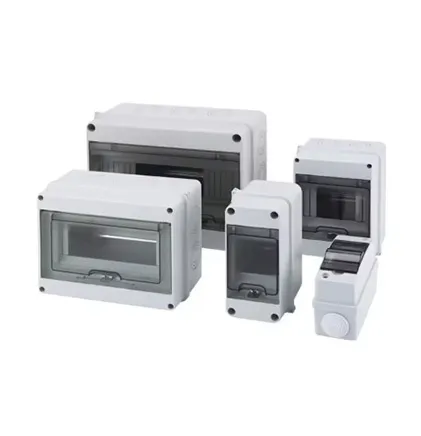
Picture this: You're at home when suddenly the lights flicker and a loud pop echoes through the walls. That terrifying sound often signals a short circuit – an electrical nightmare that can turn into a catastrophic fire within seconds. It's moments like these where the silent hero of your electrical system springs into action: the humble distribution box. But what exactly makes this unassuming metal box capable of containing such explosive energy?
Short-circuit withstand strength isn't just technical jargon – it's the make-or-break factor between safety and disaster in electrical systems. We'll unpack why this parameter matters more than you realize, how it's rigorously tested, and what it means for protecting lives and property. Along the way, we'll explore how modern design innovations (including power cables, a critical infrastructure component) create layered protection against one of electricity's most dangerous phenomena.
A short circuit occurs when electricity takes an unintended shortcut – like when damaged insulation allows live wires to touch. Imagine opening a fire hydrant full-blast into a drinking straw. That's essentially what happens electrically: The normal current flow suddenly multiplies up to 1000x within milliseconds. This creates:
Without proper containment, this energy can vaporize copper wiring, melt steel enclosures, and ignite surrounding materials. This is precisely where short-circuit withstand strength becomes the unsung hero – the measure of how much abuse your distribution box can absorb before failing catastrophically.
Think of short-circuit withstand strength as your electrical system's immune system – a multi-layered defense with specific benchmarks:
This measures the maximum fault current the box can tolerate. Typical ratings range from 10kA (residential) to 100kA (industrial). Schneider Electric's Prisma series demonstrates exceptional capacity, handling up to 100kA – equivalent to 200 household circuits overloading simultaneously!
How LONG the box endures that current matters as much as the amount. International standards like IEC 61439 mandate:
This timing allows backup protection devices (like circuit breakers) to activate without the enclosure becoming a fragmentation grenade.
The initial milliseconds of a short circuit deliver the most violent jolt. Top-tier boxes withstand staggering peaks – 187kA in advanced models. This requires reinforced mechanical design as magnetic forces at this level could rip poorly secured busbars from their mounts like paper clips near an MRI.
Consider a real-world example: A popular café chain installed low-cost distribution boxes rated for just 6kA. When a commercial cooler shorted during morning rush, the resulting 9kA fault vaporized the box's interior, sending molten metal spray across the kitchen. Thankfully, no one was injured, but the incident shows why cutting corners with withstand ratings courts disaster.
Creating boxes that survive short-circuit hell requires meticulous engineering:
Busbars become ground zero for short-circuit forces. Engineers precisely calculate:
One German manufacturer discovered that asymmetrical bolt patterns reduced withstand capacity by 30% – proving that microscopic details have macroscopic consequences.
Modern insulators do more than prevent shocks – they're engineered force fields:
The difference became tragically clear in a 2019 factory fire where substandard insulators turned a small fault into an inferno that destroyed power cables throughout the facility.
A distribution box doesn't work in isolation – it's part of a coordinated defense grid:
Your distribution box's withstand rating must exceed your breakers' response time. If a box can endure 10kA for 0.5 seconds but your breaker takes 0.6 seconds to trip, you're gambling with fire. Modern digital relays now trip within 0.03 seconds – faster than a hummingbird's wing flap.
Sophisticated facilities use "intelligent" boxes that communicate during faults. If Box A detects a downstream fault, it tells upstream Box B: "I've got this!" preventing unnecessary shutdowns. It's like having electrical bouncers coordinating during a crisis.
Think of your electrical system like airport security layers:
| Security Layer | Electrical Equivalent |
|---|---|
| Passenger screening | Circuit breakers |
| Baggage scanners | Ground fault detectors |
| Reinforced cockpit doors | Short-circuit withstand capacity |
The final layer saves lives when others fail – that's your distribution box's withstand strength.
Modern ICUs feature distribution boxes with dual-bus designs (rated ≥65kA). Why? A 2016 Johns Hopkins study showed even 2-second outages during surgery increased mortality by 17%. Their solution? Boxes that withstand faults long enough for backup generators to seamlessly engage – quite literally saving lives through superior engineering.
A major cloud provider's outage taught a painful lesson when a faulty server triggered cascading failures. They now deploy distribution boxes rated 150% above expected faults. As their chief engineer noted: "Our withstand rating isn't about preventing outages – it's about limiting damage to one module instead of the entire farm."
"What's your distribution box's withstand rating?" has become the new "What's your credit score?" in facility management. It quantifies your electrical vulnerability.
– Electrical Safety Foundation International Annual Report
Meeting minimum standards is like wearing a seatbelt at 30mph – adequate until crisis strikes. Consider:
Insurers now map distribution box ratings to premium structures. Facilities with IEC-certified boxes (≥35kA) see 18–22% lower premiums. Why? Historical data shows they reduce fire claims by 73% compared to uncertified units.
A manufacturing plant with poorly rated boxes experienced $3.2 million in losses from a 6-hour outage caused by a minor fault that cascaded. Upgraded distribution boxes with higher withstand capacity paid for themselves in 11 months through avoided disruptions.
That gray metal box on your wall isn't just housing circuit breakers – it's a precisely engineered fortress designed to contain contained electrical hurricanes. Short-circuit withstand strength represents the difference between a contained incident and a catastrophic failure. In our increasingly electrified world, understanding this parameter isn't just for engineers – it's for anyone who values safety, continuity, and peace of mind.
As we demand more from our devices and infrastructure – from energy-efficient appliances to smart factories – robust distribution systems become not just necessary, but foundational. The next time you flip a switch without consequence, remember: There's an invisible lifeguard in your walls, always watching, always ready.
Recommend Products












