
Practical approaches to balancing clarity, durability, and environmental responsibility
Walking through any modern building, you'd be amazed how many clear PVC pipes silently work behind walls and under floors. These transparent pathways aren't just functional - they give technicians visible confirmation that systems are working properly. But creating pipes that maintain crystal clarity while standing up to constant pressure and chemical exposure? That's where the real magic happens in material formulation.
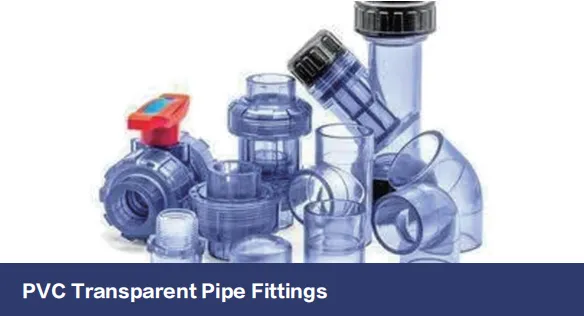
The challenge intensifies when we need customized shapes - elbows, reducers, specialized connectors - all requiring that same visual access. Unlike standard opaque PVC fittings, the transparent versions can't hide flaws behind colorants or stabilizers. Every ingredient must earn its place while preserving that window-like quality. It's like formulating glass that bends, threads, and withstands decades of pressurized fluids.
Most people don't realize that PVC starts transparent by nature. That milky appearance in common pipes comes from additives and processing techniques. To maintain clarity, we need to:
The quest for perfect clarity becomes especially critical when we consider fittings in water systems. Visible flow helps technicians troubleshoot issues quickly without disassembly - a game-changer for maintenance crews working in tight spaces.
Adding impact modifiers feels like walking a tightrope. Too little and fittings shatter during installation. Too much and you get that foggy milkiness defeating the purpose of transparency. The sweet spot comes from hybrid impact modifiers that integrate molecularly rather than floating as separate particles.
Ever notice how plastic containers get yellowish over time? That's exactly what we battle with transparent PVC. Traditional tin-based stabilizers - while effective - tend to shift color. Calcium-zinc alternatives provide better optical clarity but require tighter process controls. New organic stabilizers show promise with improved initial color and long-term stability.
Fittings bear the brunt of pressure fluctuations. Transparent versions can't rely on fillers that reinforce opaque formulas. Instead, we build strength through polymer chain alignment during extrusion and optimized molecular weight distribution. It's amazing how pipe walls that appear thin as glass can withstand surprising internal pressures when formulated correctly.
Today's environmental requirements push us beyond mere compliance. Modern transparent PVC fittings increasingly use recycled content while maintaining optical clarity - something once thought impossible. The secret? Specialized compatibilizers that "heal" the polymer chains in recycled material, restoring optical properties nearly to virgin-grade levels.
| Material Aspect | Traditional Formula | Optimized Transparent PVC | Improvement |
|---|---|---|---|
| Virgin Material Consumption | 100% | 55-65% | 40% reduction |
| Energy in Production | 280 kg CO₂/t | 210 kg CO₂/t | 25% reduction |
| End-of-Life Recyclability | Downcycling only | Closed-loop recycling | Material circularity |
| Long-Term Durability | 15-20 years | 25-30+ years | Extended service life |
The most exciting innovations come in bio-based plasticizers derived from non-food plant sources. These not only eliminate concerns about traditional phthalates leaching into water systems but also demonstrate better compatibility with transparent formulations. Initial field trials in hospital water systems show zero visual degradation after three years of continuous use.
In sterile environments, visual verification of flow provides critical safety. One pharmaceutical manufacturer reduced system validation time by 30% after switching to transparent fittings. Their technicians can now spot particulate contamination during routine rounds rather than through scheduled maintenance.
Public aquariums face unique challenges with aggressive saltwater environments. Transparent fittings allow constant visual monitoring for corrosion precursors or biological buildup. The Monterey Bay Aquarium documented a 45% reduction in unexpected system failures since implementing specialized transparent PVC fittings with corrosion inhibitors.
Some forward-thinking builders now incorporate transparent sections near shutoff valves. Homeowners can visually confirm water shutoff before repairs - a simple innovation preventing countless flooded basements. These "visual check" fittings demonstrate how performance optimization serves practical needs beyond industrial applications.
Creating custom transparent fittings requires precision beyond standard pipe extrusion. Three-stage drying of PVC resin prevents moisture-induced voids that scatter light. We employ:
The post-extrusion treatment matters as much as the formulation. Special annealing processes relieve internal stresses that could create micro-fractures months later. Finished fittings undergo optical scanning against digital references before packaging - because human eyes miss subtle variations that could affect installation.
The horizon holds fascinating possibilities. At AIMPLAS, researchers are developing light-responsive formulations where fittings subtly change hue with temperature fluctuations - providing passive monitoring without electronics. Another team works on self-cleaning surfaces using hydrophilic agent integration that prevents mineral deposits from clouding surfaces.
Imagine fittings that do more than just connect pipes:
These innovations could transform passive components into active system elements. The transparent nature provides the perfect platform for such integrations without compromising their primary function.
While some industry voices predict plastics being eclipsed, transparent PVC fittings counter that narrative by offering irreplaceable functionality. No alternative material combines such visibility with chemical resistance, affordability and manufacturing flexibility. The evolution continues not through replacement but through sophisticated refinement.
Optimizing transparent PVC fittings represents more than technical achievement - it delivers tangible benefits in maintenance efficiency, resource conservation, and system reliability. The next time you notice a clear pipe fitting, consider the sophisticated chemistry and engineering behind its apparent simplicity.
As material scientists, we continually balance what seem like contradictory demands: strength versus transparency, sustainability versus longevity, innovation versus practicality. Yet each formulation breakthrough opens new applications that expand our relationship with these essential components. The future of PVC doesn't lie in abandoning its strengths but in elevating them through thoughtful optimization.
Recommend Products












