
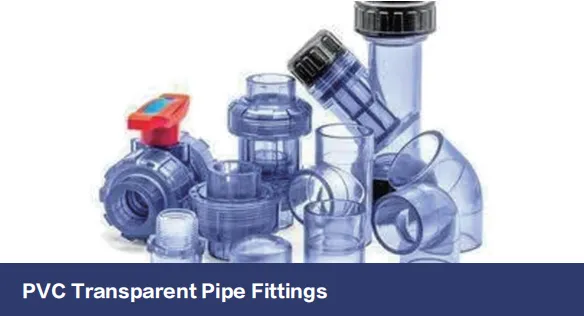
Picture walking through a state-of-the-art water treatment plant, but instead of metal pipes wrapped in insulation, you see crystal-clear PVC channels carrying water with total visibility. This isn't science fiction—it's the emerging reality of transparent PVC pipe technology. The days of "out of sight, out of mind" plumbing are giving way to an era where we can literally see the flow of water through transparent pvc pipe connectors, revolutionizing maintenance and quality control across industries.
The global piping industry stands at a fascinating crossroads. As we grapple with aging infrastructure and sustainability pressures, transparent PVC fittings are emerging as an unexpected hero. Beyond just being see-through tubes, these innovations represent a fundamental shift in how we interact with our built environment. Their development path reveals five critical directions that will define the future of fluid management systems worldwide.
Traditional PVC has durability limitations, but next-gen formulations solve this through nanotechnology. By embedding silica nanoparticles into polymer matrices, manufacturers achieve optical clarity rivaling glass while maintaining structural integrity. These microscopic reinforcements create a "chainmail effect" within the material, dramatically improving impact resistance without compromising visibility.
Scratches that cloud visibility? Not anymore. Borrowing from automotive clear-coat technology, new micro-capsule additives release healing agents when surface abrasions occur. This self-repair mechanism maintains optical clarity throughout decades of service life—especially valuable in industrial settings where pipe exteriors face constant wear.
Imagine pipes that don't just carry water but also information. The transparent foundation creates unique opportunities for embedded sensor technology that traditional opaque pipes can't match:
By integrating microscopic reflective particles and optical sensors, engineers can transform pipelines into precision flow measurement systems. The transparent walls allow lasers to map particle movement with nanometer precision, providing real-time viscosity and velocity data without intrusive probes.
Optical spectroscopy integration represents perhaps the most promising breakthrough. As light passes through transparent pipes traveling through the pipe system, embedded sensors continuously analyze the water's "light signature." Unexpected changes in refraction or absorption trigger immediate alerts for potential contaminants—detecting problems in seconds rather than weeks.
The shift away from fossil fuel-based materials has begun using agricultural waste products as polymer building blocks. Non-food biomass like rice hulls and algae extracts now provide the ethylene for PVC synthesis. These renewable feedstocks maintain optical properties while dramatically lowering carbon footprints—early adopters report 70% reduction in cradle-to-grave emissions.
New separation technologies now allow recovery of transparent PVC from demolition waste with unprecedented purity. Using spectroscopic sorting that "reads" the polymer's light signature, facilities can isolate specific formulations for reuse rather than downcycling. Pilot programs in Amsterdam have achieved 95% recovery rates, turning old pipes into equally clear new ones.
Hospitals represent an unexpected growth sector where visual flow verification saves lives. Transparent medical-grade PVC has become critical infrastructure in IV therapy systems and dialysis machines, allowing clinicians to instantly spot air bubbles or contamination that could endanger patients. The material's chemical stability handles sterilization while maintaining clarity after hundreds of autoclave cycles.
Modern hydroponic farms leverage transparent PVC to create illuminated nutrient delivery systems. LED arrays surrounding the pipes provide growth spectrum lighting directly to root zones while enabling visual monitoring of nutrient density and root health. Vertical farms in Singapore using these systems report 40% yield increases over traditional hydroponics.
The production evolution matches material innovation. Next-generation manufacturing techniques are solving historical challenges in clear PVC fabrication:
Advanced multi-layer extrusion creates pipes with functional stratification—crystal-clear cores surrounded by UV-protective outer layers, colored identification stripes embedded within walls, or conductive tracer wires seamlessly integrated. This eliminates post-production processing while enhancing functionality.
Smart factories now create digital replicas of every pipe segment produced. By scanning optical properties during extrusion, manufacturers generate unique digital fingerprints tracking each fitting's light transmission characteristics. Installation teams reference these twin models for quality assurance during assembly and maintenance.
As infrastructure modernization becomes a global priority, PVC transparent pipe technology presents compelling solutions. The combination of visual verification capability with evolving material intelligence creates systems where problems get spotted before they cascade, where resource flows become transparent in both literal and metaphorical senses.
The future belongs to fluid systems we can trust because we can see them at work. From monitoring chemical processes in industrial plants to ensuring pure water reaches homes, these transparent pipelines represent more than convenience—they embody the democratization of infrastructure awareness. And that visibility might just be our most valuable asset as we rebuild the world beneath our feet.
Recommend Products












