
What Your Utility Bills Aren't Telling You About Lighting Choices
Picture walking into your favorite café—the warm glow makes you linger, the mood invites conversation, and somehow, the space just feels... right. That's no accident. Lighting architects call this emotional engineering. Now imagine flipping the switch in a warehouse office: the flickering buzz of fluorescent tubes instantly draining energy—both yours and the grid's. This daily experience hides a financial reality few business owners confront: lighting choices make or break operational costs for decades.
Commercial lighting—a $100 billion global industry—consumes nearly 40% of a typical business's electricity budget. Yet most decision-makers analyze lighting costs like they're buying milk: focusing on today's price tag instead of lifetime value. This oversight quietly bleeds thousands annually from commercial bottom lines.
Fluorescent tubes operate like miniature lightning storms. Gas excited by electrodes emits ultraviolet light, converted to visible spectrum by phosphor coating. It's inefficient magic—about 60% of energy escapes as heat. Walk near an old fixture; feel the warmth? That's your money evaporating.
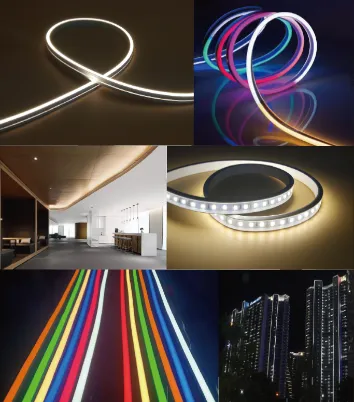
LED strips work like digital semiconductors. Electrons dance across materials like gallium arsenide, emitting photons with nearly surgical precision. NASA adopted LEDs in the 1960s not for efficiency, but reliability—zero flicker during rocket vibrations. This solid-state design converts 95% of energy to light with negligible heat waste.
| Parameter | Fluorescent Tubes | LED Strips | Difference (%) |
|---|---|---|---|
| Energy-to-Light Conversion | 40-60% | 90-95% | Up to +57% |
| Lifespan (Hours) | 10,000 - 15,000 | 50,000 - 100,000 | +400% |
| Heat Emission | High | Negligible | - |
| Mercury Content | 3-5 mg/tube | 0 mg | - |
For a mid-sized warehouse (10,000 sq ft):
Fluorescent Setup
:
- Initial install: 120 tubes @ $15/each = $1,800
- Annual replacements: 40 tubes @ $15 = $600 (3-year lifespan)
- Energy: 38,400 kWh @ $0.12/kWh = $4,608/year
LED Strip Setup
:
- Initial install: Custom strips @ $2,500
- Replacements: Near-zero over 10 years
- Energy: 10,400 kWh @ $0.12/kWh = $1,248/year
| Cost Factor | Fluorescent (10 years) | LED Strips (10 years) | Savings |
|---|---|---|---|
| Hardware & Install | $1,800 + $600×3 = $3,600 | $2,500 | $1,100 |
| Energy Consumption | $4,608×10 = $46,080 | $1,248×10 = $12,480 | $33,600 |
| Maintenance Labor | $200×10 = $2,000 | $20×10 = $200 | $1,800 |
| TOTAL | $51,680 | $15,180 | $36,500+ |
These cold numbers don't capture the productivity boost in LED-lit environments. Cornell researchers found warehouse error rates dropped 45% under consistent LED vs flickering fluorescent—saving far more than electricity costs.
Aircraft manufacturer Boeing redesigned assembly hangars with tunable LED strips matching natural daylight cycles. Result: 18% fewer worker errors during night shifts. Hotels using "circadian rhythm lighting" report 26% higher guest satisfaction scores. Retailers like Apple tune LED color temperatures to psychologically trigger longer browsing times.
"Commercial spaces aren't just containers for people—they're behavior modification systems," explains lighting designer Elena Rossi. "The right commercial lighting silently convinces customers to linger longer or workers to focus better. Fluorescent tubes can't compete; they're stuck in one emotional frequency."
Case in point: When Seattle's Pike Place Fish Market switched to waterproof LED strips, energy bills dropped 63%. Surprisingly, fishmongers reported fewer slips: consistent lighting revealed wet floor patches fluorescent shadows hid.
Disposal Fees : Fluorescent tubes qualify as hazardous waste due to mercury. Commercial facilities pay $0.50-$2 per tube for EPA-compliant disposal. Multiply that across hundreds annually.
Climate Control : Fluorescents turn 40% of energy into heat—an HVAC tax. During summer, every watt of lighting requires 0.3-0.5 watts of extra cooling. LEDs erase this penalty.
Insurance Premiums : Many insurers offer 5-8% discounts for LED retrofits. Why? Solid-state lighting eliminates fire risks from ballast failures—a leading cause of commercial electrical fires.
Comparing fluorescent tubes to LED strips is like comparing dial-up modems to fiber optics—both transmit "data" (light), but through fundamentally different paradigms. The financial gap keeps widening too: LED prices dropped 94% since 2008 while efficiency doubled.
Commercial lighting is no longer a utility; it's a productivity amplifier and brand sculptor. Those flickering tubes in your ceiling? They're not just dated technology—they're leaky buckets draining capital from your business every time you flip the switch.
The numbers shout clearly: businesses ignoring the LED transition pay 3X more over a decade for inferior light. With smart controls like daylight harvesting and occupancy sensors further slicing waste, the path forward isn't just brighter—it's financially luminous.
Recommend Products












