
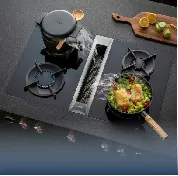
Walk into any hotel kitchen during breakfast service, and you will see the difference immediately. Some kitchens hum with efficiency \u2014 four burners firing, staff moving in rhythm, plates leaving the pass every ninety seconds. Others stumble on a single bottleneck: the stove. Too few burners, uneven heat distribution, or a cooktop that cannot keep up with demand. The stove is not just another appliance. It is the engine of the kitchen. For project managers, hotel operators, and residential developers, choosing the right kitchen stove solutions at the procurement stage can determine whether a kitchen runs smoothly for a decade \u2014 or becomes a daily source of frustration.
Before diving into procurement specifics, it helps to understand the three main types of kitchen stoves on the market. Each has distinct advantages depending on the application, and the wrong choice for a given project can be costly.
| Type | How It Works | Best For | Key Considerations |
|---|---|---|---|
| Gas Stoves | Open flame heats cookware directly; instant, visible heat control via dial | Hotel and restaurant kitchens, traditional cooking styles, high-volume food service | Requires gas line connection; offers precise flame control favored by professional chefs; all cookware types compatible |
| Electric Stoves | Heating elements beneath a smooth glass-ceramic surface transfer heat to cookware | Residential projects, apartments, serviced residences | Easy-to-clean flat surface; no gas line required; steady, consistent heat; hot surface indicators for safety |
| Induction Stoves | Electromagnetic coils heat cookware directly; surface stays cool to touch | High-end residences, modern commercial kitchens, energy-conscious projects | Fastest heating; requires magnetic cookware (cast iron, certain stainless steel); cools rapidly when pan is removed; energy-efficient |
The choice is not purely technical. It is contextual. A luxury hotel in Riyadh may demand gas for its main kitchen and induction for its show kitchen. A residential tower in Lagos might standardize on electric for safety and simplicity. A building material supplier that understands these regional and contextual differences brings more value than a catalog of products.
A stove is rarely purchased in isolation. In most construction and renovation projects, it is part of a larger kitchen package that may include range hoods, ovens, refrigerators, dishwashers, and cabinetry. Evaluating a stove in isolation can lead to compatibility issues, scheduling delays, and budget overruns. Here are four dimensions procurement teams should assess:
1. Compatibility with kitchen layout and ventilation. A gas stove requires a powerful range hood and proper ducting. An induction cooktop needs adequate electrical capacity. The stove must fit the designated countertop cutout and align with the overall kitchen design. Ordering late in the project cycle often leads to costly rework.
2. Volume and durability requirements. A stove in a residential apartment might cook two meals a day. A stove in a hotel breakfast buffet might run continuously for six hours. Burner output (measured in BTU for gas, watts for electric/induction), material quality of knobs and grates, and warranty terms all matter proportionally to usage intensity.
3. After-sales support and spare parts availability. In international projects, a stove that cannot be serviced locally becomes a liability. Procurement teams should verify that the supplier has a track record of delivering to the project's region and can provide technical documentation, installation guidance, and replacement parts.
4. Certification and compliance. Different markets require different certifications \u2014 CE for Europe, SASO for Saudi Arabia, SONCAP for Nigeria. A supplier that already holds the relevant certifications for your target market saves months of compliance work.
Here is a scenario that plays out in projects around the world: a developer sources kitchen stoves from one supplier, range hoods from another, and kitchen cabinets from a third. The shipments arrive at different times. One container is held at customs. The installation team waits. The project timeline stretches. The developer ends up managing three supplier relationships, three payment schedules, and three sets of documentation \u2014 for one kitchen.
This is where working with a one-stop architectural solution provider changes the equation. Instead of coordinating multiple vendors, the procurement team deals with a single point of contact. The stove, the hood, the cabinets, the flooring, the lighting \u2014 all consolidated into one shipment, one invoice, one set of compliance documents. The time saved on coordination alone often offsets any per-unit price difference.
COLORIA GROUP operates as a comprehensive home/kitchen/hotel appliances supplier, offering kitchen stoves alongside the full ecosystem of kitchen and building products \u2014 from cabinets and countertops to flooring, lighting, and sanitary ware. For project buyers, this means one supplier handles the entire kitchen specification, from the stove to the sink to the ceiling panels.
Before placing an order, project procurement teams should run through this checklist:
Fuel type confirmed: Is natural gas available at the site? If not, is LPG conversion supported? Does the electrical infrastructure support induction or electric cooktops?
Burner count and configuration: For residential units, 4 burners is standard. For commercial kitchens, 5-6 burners with a wok burner or griddle may be necessary. Confirm the configuration matches the intended use.
Dimensions verified: Standard widths are 30 inches (76 cm) and 36 inches (91 cm). Measure the countertop cutout and confirm the stove dimensions before ordering.
Safety features: Flame failure devices (for gas), hot surface indicators (for electric), and automatic shut-off (for induction) are essential for projects where multiple users \u2014 including guests or tenants \u2014 will operate the stove.
Certification documentation: Request copies of the relevant compliance certificates for the destination market. Do not rely on verbal assurances.
Consolidation opportunity: Check whether the same supplier can provide other kitchen components \u2014 hoods, cabinets, sinks, taps \u2014 to reduce logistics complexity.
COLORIA GROUP, headquartered in Foshan, China \u2014 one of the world's largest building materials manufacturing hubs \u2014 has built its reputation on simplifying procurement for international projects. With an overseas agent in Saudi Arabia and a product catalog spanning 13 categories and over 560 products, the company serves as a single procurement window for developers, contractors, and hotel operators across the Middle East, Africa, Southeast Asia, and beyond.
The kitchen stove portfolio covers gas, electric, and induction models suitable for residential apartments, hotel suites, staff canteens, and restaurant kitchens. Each stove is backed by the full supply chain capability of a company that also delivers the cabinets above it, the flooring beneath it, the sink beside it, and the lights above it. For project buyers, this integration is not a luxury \u2014 it is a practical advantage that reduces procurement risk.
When a project in Jeddah needs 200 kitchen stoves, 200 range hoods, 200 sets of kitchen cabinets, and 200 bathroom vanities, the alternative to a one-stop supplier is four separate RFQs, four separate quality inspections, four separate shipping arrangements, and four separate sets of customs clearance paperwork. The math is straightforward.
Ready to specify kitchen stoves for your next project? Contact COLORIA GROUP today to discuss your requirements. Whether you need gas stoves for a hotel kitchen, electric cooktops for a residential tower, or a complete kitchen package including cabinets, hoods, and appliances, our team can provide a consolidated quotation. Reach us at +86-13630185350 (WhatsApp/WeChat) or visit www.coloriagroup.net to explore the full product range.
Recommend Products












