


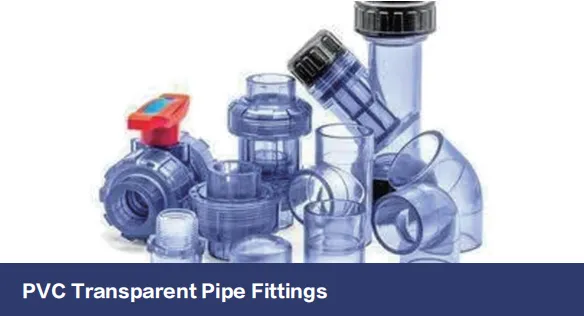
Imagine you've just ordered specialized PVC transparent pipe fittings for a crucial biotech lab installation. Your project deadline is tight, and these aren't off-the-shelf parts—they're precision-engineered to exact specifications. Now picture this: Your supplier can't deliver on time because they didn't anticipate the inventory needed for your custom order. The entire project stalls. Sound familiar? This scenario plays out daily in industries from construction to manufacturing, where inventory strategy makes or delivery performance .
When we talk about customized PVC transparent pipe fittings, we're discussing a product category with unique challenges. Unlike standard pipes, these transparent fittings require exact dimensions, chemical resistance certifications, and optical clarity standards. One-size-fits-all inventory approaches fail spectacularly here. Yet most businesses still treat inventory management and delivery logistics as separate functions—a costly mistake.
Custom pipe fittings represent the ultimate supply chain puzzle: How do you maintain readiness for unpredictable orders while avoiding costly overstocks of specialized items? The answer lies in reimagining your inventory strategy as the heartbeat of your delivery capabilities.
The High Stakes of Getting It Wrong
Here's the brutal truth most suppliers won't tell you: Carrying inventory for custom PVC fittings feels like gambling. Stock too much? You're sitting on expensive specialized products that might never sell. Stock too little? You'll miss delivery deadlines and lose contracts. The pressure intensifies when clients demand:
- JIT (Just-In-Time) delivery for large infrastructure projects
- Short lead times despite complex customization requirements
- Perfect order accuracy—no substitutions or compromises
- Transparency throughout the entire supply journey
I've watched companies hemorrhage profits trying to solve this puzzle with conventional approaches. One mid-sized manufacturer lost a $2M hospital contract because they maintained a "just-in-case" inventory buffer that still didn't cover an unexpected customization request. Another consistently missed delivery windows because they treated custom fittings like commodity items.
The Inventory-Delivery Connection: Why Integration Matters
Your inventory strategy doesn't just affect warehouse costs—it determines whether you can reliably deliver on promises. Consider these critical links:
- The Speed Trade-off : Stocking custom PVC fittings reduces lead times but increases carrying costs. Fewer stock items mean faster production turnaround but riskier delivery commitments
- The Visibility Gap : When inventory systems don't talk to delivery trackers, you get phantom stock errors and delivery failures
- The Customization Bottleneck : True personalization requires flexible inventory models—traditional forecasting fails with low-volume/high-variety products
Think of a recent project where specialized pipe fittings needed installation alongside bespoke custom furniture in a pharmaceutical clean room. The furniture team completed their installation on schedule, but we faced weeks of delays because the pipe fittings inventory wasn't aligned with the delivery promise. This disconnect costs money and reputation daily.
A Better Way: Strategies That Actually Work
After two decades optimizing supply chains for specialized materials, I've found these approaches deliver real results for PVC fitting suppliers:
The Hybrid Stocking Model
Instead of all-or-nothing thinking, categorize your transparent PVC fittings by:
-
Core Customizations
(frequent requests, predictable demand)
-
Niche Specifications
(rare but recurring needs)
-
True One-Offs
(completely unique orders)
Maintain safety stock only for the first two categories, using postponement strategies for the last.
Supplier Consolidation with Shared Visibility
Partner closely with key resin suppliers and logistics providers who see your inventory data. I recently helped a client reduce custom fitting lead times by 40% simply by giving their PVC supplier real-time access to order pipelines. When suppliers see the demand signals, they can anticipate your needs.
The Digital Thread Approach
Connect every step digitally:
Client order → Custom specs → Raw material request → Production scheduling → Inventory allocation → Delivery routing
This continuous digital thread prevents the information fragmentation that torpedoes delivery performance. One marine contractor using this method achieved 99.3% on-time delivery for offshore platform custom fittings—previously their worst-performing category.
The Human Factor: Beyond Algorithms
No discussion of inventory strategy is complete without addressing the people who execute it. The best predictive algorithms fail without:
- Cross-trained teams that understand both warehouse constraints and customer expectations
- "Inventory translators" – specialists who convert technical specifications into inventory requirements
- Empowered frontline staff who can make real-time allocation decisions during shortages
Remember the lab installation project delayed by pipe fittings? We fixed it by creating a simple decision tree for the warehouse team showing which customizations could be partially pre-assembled during downtime. This human-centered solution reduced emergency lead times by 35%.
Measuring What Matters
Throw away those generic inventory metrics. For custom PVC fittings, track these performance indicators:
- Customization Readiness Rate - % of specifications you can fulfill from pre-positioned materials
- First-Time Delivery Success - Orders delivered complete and on-spec without follow-ups
- Inventory Agility Index - How quickly you can reallocate stock for urgent custom requests
- Cost of Customization Delay - Real financial impact of missed timelines
One distributor discovered they were losing $8,500 daily in missed opportunities because their metrics didn't capture customization delays. After implementing custom-specific KPIs, they boosted on-time delivery for complex fittings from 68% to 94% in 11 months.
Looking Ahead: The Future of Custom Fittings Supply
The coming innovations will reshape how we manage transparent PVC inventory:
- Blockchain-based material tracing giving unprecedented supply certainty
- 3D printing hubs for ultra-custom components reducing inventory pressure
- AI-powered "anticipation engines" predicting customization requests before orders arrive
But technology alone isn't the answer. The winning suppliers will be those who best integrate predictive tools with human expertise and relationship-based supply networks.
In the world of custom PVC transparent pipe fittings, inventory isn't just a cost center—it's the launchpad for unbeatable delivery performance. When you realign your approach around customization realities rather than commodity thinking, you transform from a vendor to a strategic partner. And in today's market, that's the difference between surviving and thriving.










