


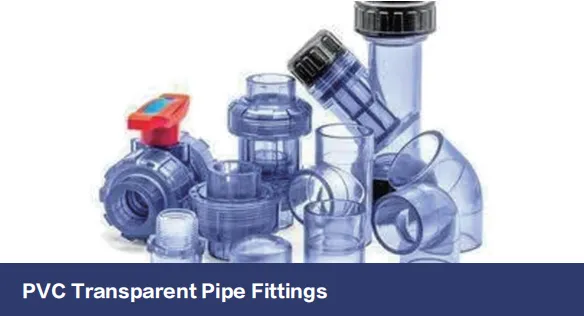
When you're choosing PVC transparent pipe fittings for your home or industrial projects, the terms RoHS and REACH might seem like confusing jargon. But here's the thing - these regulations actually matter to your health and the environment you live in. Today, we're going to peel back the technical layers and help you understand why these compliance standards are crucial for manufacturers, suppliers, and end-consumers.
Picture this: You're installing a new hydroponic garden system using PVC pipes. Or maybe you're renovating your bathroom with clear drain pipes. You'd naturally assume these materials are safe, right? Well, that's where RoHS and REACH come into play, quietly working behind the scenes to ensure harmful chemicals don't seep into your water or air.
The Unseen World of PVC Composition
PVC (Polyvinyl Chloride) seems straightforward - just plastic pipes, what's complicated? But here's the reality: Pure PVC is too rigid for practical use. That's why manufacturers add plasticizers, stabilizers, and pigments to create those crystal-clear pipes we commonly use. And some of those additives contain the very substances RoHS and REACH regulate.
Take plasticizers like DEHP or BBP, for example. While they make PVC beautifully flexible, they also happen to be endocrine disruptors. Imagine these chemicals gradually releasing into the water flowing through your home irrigation system. Not exactly comforting, is it? That's why compliance isn't about bureaucratic box-ticking - it's about tangible protection for families and workplaces.
REACH vs RoHS - Decoding the Alphabet Soup
REACH Regulation (The Chemical Watchdog)
Think of REACH as the guardian of everyday chemicals. Its job? To ensure no harmful substances sneak into products we regularly handle. What matters for PVC pipe manufacturers:
- Covers virtually all chemical substances used in manufacturing
- Requires registration of substances exceeding 1 tonne/year
- Mandates special permission for particularly hazardous chemicals
- Demands notification if pipes contain SVHCs above 0.1%
RoHS Directive (The Electronics Specialist)
RoHS focuses squarely on electronics. So why should PVC pipe manufacturers care? Because when your transparent pipes become:
- Lighting system conduits
- Heating system components
- Smart home water monitoring installations
they suddenly fall under RoHS regulations. It specifically restricts 10 substances at precise thresholds.
| Compliance Area | REACH Requirements | RoHS Requirements |
|---|---|---|
| PVC Pipe Applications | Applies to ALL pipe fittings regardless of use | Applies ONLY when used in electronic/electrical equipment |
| Chemical Restrictions | 200+ substances on Candidate List | Specifically regulates 10 substances |
| Lead Limits | 0.1% (general), 0.05% (child-related products) | 0.1% in homogeneous materials |
| Cadmium Limits | 0.01% in plastic materials | 0.01% in homogeneous materials |
| Compliance Proof | SCIP database submission required | Technical documentation and Declaration of Conformity |
Global Landscape - Navigating Atlantic Differences
Europe's approach feels like a protective embrace - comprehensive regulations covering every stage from factory to disposal. REACH's requirement to register chemicals preemptively creates a high barrier for hazardous substances.
Across the ocean, the U.S. feels more like navigating a patchwork quilt. While TSCA (Toxic Substances Control Act) does restrict specific chemicals like PCBs and asbestos, it lacks Europe's proactive system. What does this mean practically? PVC pipes manufactured to meet EU standards typically exceed U.S. requirements, explaining why many American manufacturers voluntarily adopt them as quality benchmarks.
But here's the twist - as more U.S. states like California implement their own stricter standards, compliance complexity grows for manufacturers supplying transparent pipe fittings nationwide.
Practical Compliance - Beyond Theory
Material Sourcing Challenges
Sourcing compliant raw materials resembles detective work. A PVC pipe manufacturer recently shared: "We tested a seemingly identical 'REACH-compliant' plasticizer from two suppliers. One passed easily, the other showed trace cadmium contamination at 0.012%. That 0.002% difference was enough to require extensive documentation explaining why we couldn't eliminate it completely."
The Certification Maze
Third-party certification isn't just a rubber stamp exercise. Effective testing means:
- XRF screening for restricted metals at receiving docks
- GC-MS analysis for phthalate content
- Batch testing rather than quarterly checks
- Supplier audits including sub-suppliers
Transparent pipes add complexity since color cannot mask impurities. As one lab technician noted: "Clear PVC reveals quality issues immediately - haze, yellowish tint, or specks often indicate material inconsistencies."
Cost vs Value - The Sustainability Equation
Does compliance increase costs? Absolutely. Premium plasticizers like DOTP (Diocyl terephthalate) cost nearly 15% more than non-compliant alternatives. But the alternative - recalls, lawsuits, and brand damage - proves far costlier in the long run. One manufacturer estimated that a single non-compliance discovery in Germany cost them €500,000 in penalties and lost contracts.
Beyond penalties, there's a quiet revolution happening: consumers increasingly favor environmentally friendly building materials . Retailers report that transparent pipes with clearly labelled "REACH/RoHS Compliant" stickers move 30% faster than unbranded alternatives.
The Crystal Ball - Future Regulatory Trends
Regulators aren't standing still. Watch for these developing trends affecting PVC transparent pipe fittings:
- Expanding RoHS scope to include secondary-market products
- Tighter migration limits for phthalates in water-contact applications
- New requirements for microplastic release documentation
- Green Chemistry incentives rewarding non-halogenated alternatives
The emergence of bio-based plasticizers derived from cardanol (cashew nut liquid) represents promising innovation. While currently more expensive, manufacturers investing now build technical expertise ahead of future regulations.
Your Compliance Action Plan
For Manufacturers
Map your entire chemical supply chain - including tier-3 suppliers
For Importers
Require validated test reports for every shipment
For Installers
Request compliance documentation and keep records for liability protection
For Consumers
Look for CE markings and compliance labels - they translate to real safety
The Clear Path Forward
RoHS and REACH compliance for PVC transparent pipe fittings isn't about crossing regulatory finish lines. It's an ongoing journey of accountability where every player - from raw material supplier to homeowner - shares responsibility.
The transparency we value in these pipes should mirror transparency in how they're manufactured. Because when chemicals seep from pipes, trust seeps from brands, communities, and regulatory systems. Compliant pipes become silent testimonials to a manufacturer's respect for both law and life.
"In our industry, clear pipes shouldn't just let light through - they should let confidence through. That's the true meaning of compliance."
- Quality Director, European PVC Pipe Manufacturer










