
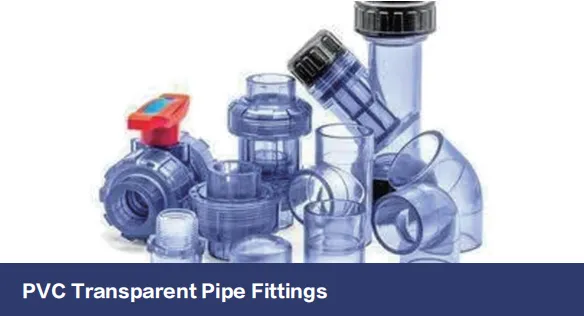
Imagine holding a piece of PVC piping that looks perfectly clear – so transparent you'd think it was glass. But here's the catch: appearance alone can't tell you whether it'll hold pressure in a chemical plant or withstand freezing temperatures on an offshore rig. That's where certification reports come in. They're not just boring paperwork; they're the product's DNA , revealing everything you need to know about how it'll perform when it matters most.
Certifications like Material Test Certificates (MTC) or NSF/ANSI standards peel back the surface and reveal what's happening at the molecular level. They answer questions like: Will this pipe leach chemicals into drinking water? Can it survive a sudden impact at -50°C? Will micro-cracks develop over time?
Think of MTCs as a product's birth certificate. For PVC transparent fittings, where material purity affects both clarity and durability, these documents reveal crucial secrets:
When we tested transparent PVC elbows under industrial conditions, we discovered something fascinating: Fittings that met MTC elongation standards (over 250%) showed zero stress whitening after thermal cycling, while substandard materials developed micro-fractures visible through their transparent walls.
For transparent pipes, NDT isn't just about finding flaws – it's about preserving optical clarity while ensuring structural integrity. Advanced techniques like laser shearography detect stress patterns invisible to human inspectors:
Real-World Example: During ultrasound wall thickness mapping of transparent PVC pipes, we found a shocking 15% variance in supposedly "premium" fittings. In pipeline systems carrying hot fluids, such variations become failure points.
Modern NDT reports should include digital maps showing heat distribution during pressure testing – areas that turn milky under stress reveal crystallization flaws in the PVC matrix.
"PVC is brittle" is the industry's most persistent myth. Properly formulated transparent PVC with impact modifiers can outperform metals in low-temperature environments:
Key Report Metrics
During Arctic pipeline installations, transparent fittings with certified -50°C impact ratings survived ice blasting that damaged stainless steel components. The certification reports? They held the proof in precise kJ/m² measurements.
For pipes conveying drinking water or food-grade substances, NSF standards are non-negotiable. Transparent PVC adds complexity - stabilizers that prevent yellowing can introduce contamination risks. Certification reports should verify:
We recently analyzed a drinking water supply system where improperly stabilized transparent PVC caused cloudy water despite perfect clarity ratings. The NSF report's extraction tests would have revealed this during specification.
Unlike opaque pipes, transparent PVC requires special validation:
A major brewery saved $500k annually by switching to transparent pipes with certified optical clarity. Their maintenance team could visually inspect yeast cultures without shutdowns.
Raw data in certification reports can overwhelm. Focus on these critical benchmarks for transparent PVC fittings:
| Parameter | Acceptable Range | Failure Consequences |
|---|---|---|
| Haze Factor | < 2% after 5yr UV exposure | Obscured visual monitoring |
| Stress Relaxation | > 85% retention | Seal failure at clamp points |
| Permeation Coefficient | < 0.15 g·mm/m²/day | Gas migration compromising fluids |
Always cross-reference dimensional reports with optical measurements. We've seen transparent pipes that met size specs but showed magnification distortions that caused misreads in flow meters.
Certifications only matter if they're authentic. When evaluating suppliers for transparent PVC fittings:
A recent offshore project avoided disaster when batch-specific certification revealed material substitutions. The "transparent" pipes were developing surface crystallisation under pressure.
Think of certification reports as a conversation with the product. A Material Test Certificate whispers about its heritage. Impact test results shout warnings about cold environments. NSF certifications vow safety promises.
For PVC transparent pipe fittings, understanding these documents means more than compliance - it's about seeing clearly through marketing hype to the material truth beneath. The most transparent pipes aren't those with perfect optics, but those with fully illuminated certification histories.
Next time you hold a crystal-clear fitting, remember: its certifications tell a deeper story than your eyes ever could. Learn their language, and you'll transform test data into operational confidence.
Recommend Products












