
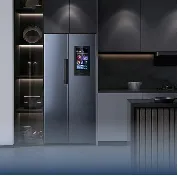
Most operators fixate on cubic feet while ignoring workflow geometry. A 40 cu.ft. prep fridge with poorly positioned shelves creates more congestion than a 30 cu.ft. unit designed with kitchen ergonomics. The true capacity metric combines:
Generic volume measurements mislead. Different densities require specialized calculations:
| Product Type | Cubic Ft/Lb | Optimal Temp Zone | Airflow Requirement |
|---|---|---|---|
| Produce (leafy greens) | 4.2-4.8 | 34-38°F / HIGH humidity | Vertical laminar (gentle) |
| Proteins (beef primal) | 1.1-1.4 | 28-32°F / LOW humidity | Horizontal turbulent (aggressive) |
While residential units sip 5-8 amps, commercial refrigerators demand robust power infrastructure:
Modern variable-frequency drives (VFD) revolutionized efficiency:
| Technology | Energy Use | Temp Stability | Noise Level |
|---|---|---|---|
| Reciprocating (standard) | 100% baseline | ±5°F swing | 65-75 dB |
| Scroll (mid-range) | 25% reduction | ±3°F | 58-63 dB |
| VFD Digital (premium) | 40-60% reduction | ±0.5°F | 48-52 dB |
Global regulations force transitions away from high-GWP refrigerants:
Heat removal calculations determine compressor sizing:
        Q = U × A × ΔT
        Where:
        Q = Heat load (BTU/hr)
        U = Overall heat transfer coefficient
        A = Surface area (sq ft)
        ΔT = Temperature difference (°F)

        Practical example:
        Walk-in cooler dimensions: 10'×15'×8'
        Wall construction: 4" PIR foam (U=0.1)
        ΔT = 70°F (ambient) to 38°F = 32°F
        Q_walls = 0.1 × [2×(10+15)×8] × 32 = 0.1 × 400 × 32 = 1,280 BTU/hr
        Add product load + infiltration + lighting = 5,200 BTU/hr total
Proper calculations prevent the two biggest mistakes: oversized compressors (short cycling) and undersized systems (food spoilage).
Premium manufacturers validate through:
The refrigeration revolution continues:
| Technology | Mechanism | Efficiency Gain |
|---|---|---|
| Magnetic Refrigeration | Magneto-caloric effect | Potential 30% over VFD |
| Acoustic Refrigeration | Sound wave compression | Zero-GWP refrigerant |
| Thermoelectric | Peltier effect | Silent operation (medical/sensitive apps) |
Choosing commercial refrigeration demands forensic attention to thermal dynamics and operational patterns. True capacity isn't measured in empty cubic feet but in accessible space that aligns with kitchen flow. Power systems must balance electrical infrastructure realities with long-term efficiency. Refrigerant choices carry environmental and regulatory consequences. This technical ecosystem demands an integrated approach – failure in any domain compromises food safety, costs, and sustainability goals.
The future lies in connected refrigeration systems that predict maintenance needs, auto-adjust settings based on inventory sensors, and leverage AI for demand-based pulldown. Regardless of technological advances, the fundamental equations of heat transfer remain physics that cannot be cheated. Master these principles to build kitchens where refrigeration isn't just cold, but intelligently optimized for culinary excellence.
Recommend Products












