


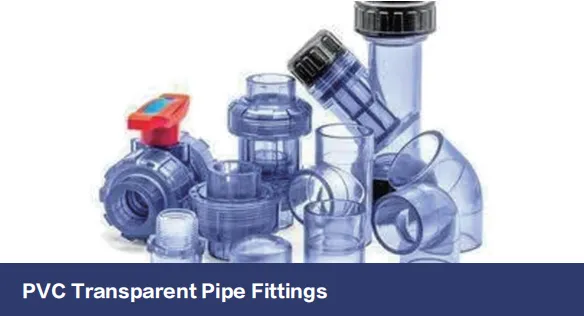
Ever wondered why some plastic pipes shatter like glass when dropped while others bounce back unscathed? That invisible superhero quality is called toughness - the unsung hero of piping systems. For PVC transparent pipe fittings that handle everything from aquarium setups to chemical transport, getting this right isn't just technical—it's what keeps systems running safely and reliably day after day.
Why This Matters
When PVC fittings fail during installation or from unexpected impacts, it's not just about replacing parts. We're talking about flooded labs, chemical leaks in manufacturing plants, or even contaminated water supplies. That rattling sound you hear? That's the real cost of overlooking impact resistance.
The Science Behind the Smack
Toughness isn't a single number—it's a material's entire biography written in stress-strain curves. Picture pulling on a plastic sample: the area under that curve tells the full story of how much abuse it absorbs before giving up. For PVC pipes, this translates to whether a dropped wrench becomes an inconvenience or a catastrophe.
PVC's Secret Weapons Against Shattering
- Molecular Design: Those long vinyl chloride chains are like crowd-surfers at a concert—they absorb energy by rearranging themselves on impact
- Additive Magic: Impact modifiers act like microscopic shock absorbers, especially crucial in transparent formulations where clarity can't compromise durability
- Crystal Control: Manufacturing tweaks that balance crystalline and amorphous regions create optimized energy dissipation pathways
"But here's what engineers sometimes miss—temperature plays Jedi mind tricks on toughness. That fitting that survived a 3-foot drop in July might shatter from 6 inches in January. Material science isn't just lab coats and formulas; it's understanding real-world variables."
Proving Ground: Impact Testing Demystified
The Heavy Hitter: ISO 3127 drop Impact Testing
Imagine this brutal honesty test: a weighted tup dropped precisely onto pipe samples at controlled temperatures. This standardized beating reveals exactly when and how fittings surrender to impact forces. Here's why manufacturers swear by it:
- Real-World Brutality: Simulates actual drops during handling—no sugarcoating
- Failure Mode Intel: Distinguishes brittle fractures from ductile dents like a forensic analyst
- Temperature Reality: Tests at service temperature extremes, not just room-comfort conditions
| Impact Scenario | Required Resistance (J/m) | Premium PVC Fittings | Standard PVC |
|---|---|---|---|
| Tool drop during installation | 25-35 | 58±2 | 32±5 |
| -20°C service temperature | 15+ | 22±3 | 9±4 |
| 3m fall onto concrete | 40+ | No fracture | Cracked 8/10 samples |
Notch Sensitivity: The Silent Killer
That microscopic scratch from installation? It becomes a fracture highway during impact. ISO 3127 exposes this vulnerability like no other test. Quality transparent PVC formulations maintain ≥85% of unnotched impact strength even with controlled notches—a key differentiator for critical applications.
Beyond the Standards: Real-World Survival Strategies
While standardized tests establish baselines, field intelligence reveals extra layers of protection:
- UV Armor: Transparent formulations incorporating UV stabilizers prevent the slow-burn embrittlement that makes fittings unexpectedly fragile over time
- Chemical Harmony: Impact modifiers that resist extraction by solvents or cleaning agents maintain toughness over the product lifespan
- Installation Guardians: Protective films that stay on fittings until final assembly prevent invisible scratches that become failure points
"Walk any factory floor and you'll hear techs say 'These don't break like the old ones.' That's not luck—it's manufacturers translating impact test data into molecular architecture. Premium PVC pipes incorporate proprietary impact modifiers, often ethylene-based copolymers, that create optimal rubber-phase domains for energy absorption."
Decoding the Numbers
| Material | Izod Impact Strength (J/m) | ISO 3127 Pass Height (m) | Ductile Fracture Behavior |
|---|---|---|---|
| Premium Transparent PVC | 100±15 | 3.0 | 95% samples |
| Standard PVC | 35±20 | 1.5 | 40% samples |
| CPVC | 25±8 | 1.0 | 10% samples |
The Transparency-Toughness Balancing Act
Getting crystal clarity with impact resistance is like tightrope walking. New generation PVC formulations use nano-scale impact modifiers that don't scatter light but still create energy-absorbing microdomains. The trick? Precisely controlling particle size below 100nm—smaller than light wavelengths—making them essentially invisible yet mechanically potent.
Failure Forensics
When PVC pipe fittings break on impact, the fracture patterns tell the real story:
- Mistake: Smooth, glass-like surfaces indicate brittle failure—material couldn't absorb impact energy
- Success: Whitened, fibrous fractures show ductile behavior—material deformed before failing
- The Warning Sign: Radial cracks originating from installation scratches prove inadequate notch sensitivity resistance
"We analyzed a failed fitting from a pharmaceutical plant flood—the fracture surface glistened like broken glass. The culprit? UV degradation combined with solvent exposure created brittle zones invisible to the naked eye. No standardized test caught this combo; it took specialized environmental conditioning testing to replicate."
Future-Proofing Impact Performance
Emerging technologies are redefining toughness benchmarks:
- Multi-Axial Impact Testers: Simulating complex real-world collisions rather than single-direction hits
- In-Line Monitoring: IR sensors during extrusion detecting uneven dispersion of impact modifiers—before cutting pipe sections
- Digital Twins: Creating impact-resistance simulations for specific fitting geometries before tooling begins
The Human Factor
All the testing in the world fails if installers treat fittings like footballs. Progressive manufacturers now include impact-resistant packaging that doubles as installation training kits—proving drop resistance while teaching proper handling.
Choosing Beyond the Spec Sheet
When selecting transparent PVC fittings where impact matters:
- Demand actual third-party test reports—not just compliance statements
- Verify temperature range matches your coldest service conditions
- Ask for evidence of long-term toughness retention after chemical exposure
- Prioritize manufacturers whose testing includes surface-damaged samples
"Don't be shy—ask suppliers to demonstrate impact resistance in person. The confident ones will drop fittings on concrete during sales meetings. That visceral proof beats any datasheet."
The Ultimate Goal: Forgiveness
What are premium PVC pipe fittings really selling? It's not just toughness—it's forgiveness. Forgiveness for that accidental tool drop. Forgiveness for the new technician's learning curve. Forgiveness for temperature swings beyond spec. That's why impact resistance testing is the ultimate engineering humility—preparing for failure to prevent it.
When designing plumbing infrastructure, transparent inspection fittings must deliver more than simple functionality—they must withstand unpredictable physical forces while maintaining visibility integrity. Impact strength testing serves as both gatekeeper and guide on this journey toward resilient piping systems.










