
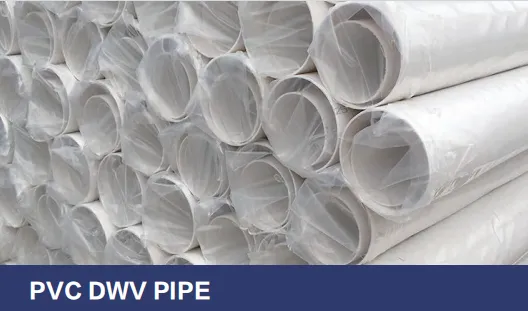
Walk onto any construction site, and your eyes are drawn to the big stuff—the cranes lifting steel beams, the workers framing walls, the architects poring over blueprints. But if you ask any seasoned contractor what keeps them up at night, it's rarely the dramatic, visible parts of the job. More often, it's the hidden elements—the ones you don't see until something goes wrong. And when it comes to hidden heroes, few are as critical as the pipes that carry waste and water through our buildings. Today, we're diving deep into one key trait that separates reliable pipes from disaster waiting to happen: impact strength. Specifically, we'll explore why PVC DWV pipes are the unsung champions of withstanding construction stresses, and how partnering with the right PVC DWV pipe supplier and pipes fittings supplier can make all the difference in your project's success.
Let's start with the basics. When someone tosses around the term "impact strength," what are they really talking about? In simple terms, it's a material's ability to absorb a sudden, forceful blow without cracking, shattering, or deforming permanently. Think of it like a football player taking a hit—some can bounce back, others crumple. For pipes, especially those used in Drain-Waste-Vent (DWV) systems, impact strength isn't just a nice-to-have; it's a make-or-break quality.
Here's why: Construction sites are chaotic places. Heavy tools get dropped. Pallets of materials are stacked and shifted. Machinery rumbles past, vibrating the ground. Even after construction, pipes hidden in walls or under floors might face accidental impacts from renovation work, furniture moving, or just the wear and tear of daily life. If a pipe has poor impact strength, a single misstep—like a plumber accidentally hitting it with a wrench during installation—could lead to a tiny crack. And tiny cracks in DWV pipes? They don't stay tiny. Over time, they grow, leading to leaks, water damage, mold, and expensive repairs. Suddenly, that "minor" impact becomes a major headache for homeowners, building managers, and contractors alike.
So, what makes PVC DWV pipes stand out when it comes to impact strength? It all starts with the material itself. PVC, or polyvinyl chloride, is a thermoplastic polymer known for its toughness and durability. But not all PVC is created equal. The PVC used in DWV pipes is specially formulated with additives—like impact modifiers and stabilizers—that enhance its ability to flex and absorb energy when struck. Unlike rigid materials such as cast iron (which is strong but brittle) or older clay pipes (prone to cracking under stress), PVC DWV pipes have a "give" to them. When a heavy object hits them, they bend slightly, dissipating the force instead of snapping.
The manufacturing process plays a role too. High-quality PVC DWV pipes are extruded under precise conditions, ensuring uniform thickness and consistent material distribution. This uniformity means there are no weak spots—no thin areas that might give way first when impacted. Compare that to some cheaper alternatives, where inconsistent wall thickness can create hidden vulnerabilities. A reputable PVC DWV pipe supplier understands this, investing in state-of-the-art extrusion technology to ensure every pipe that leaves their facility meets strict impact strength standards.
Temperature is another factor. We've all heard that plastic gets brittle in the cold, right? While that's true for some plastics, PVC DWV pipes are designed to perform even in low temperatures. Many are tested at 0°F (-18°C) to simulate cold construction environments or unheated spaces like attics and crawlspaces. This cold-weather impact resistance is a game-changer, especially in regions with harsh winters or for projects that span multiple seasons. Imagine installing pipes in December only to have them crack when a frost hits—with PVC DWV, that's a risk you can significantly reduce.
Talk is cheap, so let's get real: How do you actually verify that a PVC DWV pipe has the impact strength its manufacturer claims? The answer lies in rigorous testing. Most PVC DWV pipe solutions adhere to industry standards set by organizations like ASTM International (specifically ASTM D2665 for DWV pipes) or ISO. These standards outline specific impact tests that pipes must pass before they're deemed fit for use.
One common test is the "drop weight impact test." Here's how it works: A pipe sample is chilled to a specified temperature (often 0°F) for a set period to mimic cold conditions. Then, a weighted dart is dropped from a predetermined height onto the pipe. If the pipe doesn't crack or split, it passes. The height and weight of the dart are calibrated based on the pipe's diameter—bigger pipes need to handle bigger impacts. For example, a 4-inch PVC DWV pipe might be tested with a 5-pound weight dropped from 2 feet, while a 2-inch pipe could use a 2-pound weight from 1 foot. Reputable suppliers don't just run these tests once; they do them batch after batch to ensure consistency. When you work with a trusted PVC DWV pipe supplier, you can ask for test reports—transparency is key here. If a supplier hesitates to share their testing data, that's a red flag.
Another test to look for is the "notched impact test," which measures a material's toughness by striking a sample with a pre-cut notch (a deliberate weak point). This test is especially rigorous because it simulates a pipe that might already have a small defect—if it can withstand an impact even with a notch, you know it's tough. PVC DWV pipes consistently outperform many other materials in these tests, thanks to their inherent flexibility and the additives we mentioned earlier.
To really appreciate PVC DWV pipes' impact strength, let's compare them to other common pipe materials used in DWV systems. We'll break it down in the table below, looking at impact strength, temperature resistance, weight, and cost—factors that matter most on the job site.
| Material | Impact Strength (Typical, ft-lbs at 0°F) | Cold Temp Performance | Weight (per foot, 4-inch pipe) | Installation Ease | Cost (Relative) |
|---|---|---|---|---|---|
| PVC DWV | 5-10 (varies by diameter/wall thickness) | Excellent—resists brittleness at 0°F+ | 2.5 lbs | High—lightweight, solvent-welded | Moderate—affordable, low long-term costs |
| Cast Iron | 2-4 | Poor—brittle in cold; prone to cracking | 10+ lbs | Low—heavy, requires special tools | High—expensive upfront and to install |
| ABS (Acrylonitrile Butadiene Styrene) | 3-6 | Fair—can become brittle below 20°F | 2.2 lbs | High—similar to PVC | Moderate-High—slightly pricier than PVC |
| Copper | 4-7 (annealed copper is more flexible) | Good—ductile, but softens at high temps | 5 lbs | Low—requires soldering, skilled labor | Very High—expensive material and installation |
As you can see, PVC DWV pipes hold their own in impact strength, often outperforming cast iron and ABS, especially in cold weather. They're also lighter than cast iron and copper, which makes handling and installation easier—less strain on workers, fewer dropped pipes (which, ironically, reduces the risk of impact damage during installation!). And while copper might have similar impact strength, its high cost and installation complexity make it a non-starter for most DWV projects. When you factor in all these variables, PVC DWV emerges as the most practical, cost-effective choice for impact resistance.
Numbers and tests are great, but nothing beats real stories. Let's look at a few scenarios where PVC DWV pipes' impact strength made a tangible difference for contractors and building owners.
A commercial renovation project in Riyadh was on a tight deadline. The crew was working double shifts to gut and rebuild the second floor of an old office building. One evening, a worker accidentally knocked a 20-pound toolbox off a scaffold, and it plummeted 12 feet onto a stack of 3-inch PVC DWV pipes stored below. The team held their breath—replacing damaged pipes would mean delays and extra costs. But when they inspected the pipes, there wasn't a scratch. The pipes had absorbed the impact, thanks to their high impact strength. The project stayed on track, and the contractor later switched to that same PVC DWV pipe supplier for all future jobs.
A residential construction project in Ankara, Turkey, started in late fall. By December, temperatures were regularly dropping below freezing. The crew was installing DWV pipes in an unheated basement when a backhoe operator misjudged the distance and bumped a wall, sending a shower of bricks and debris onto the newly laid 4-inch PVC DWV pipes. Again, expectations were low—frozen pipes are notoriously brittle. But after clearing the debris, the pipes were intact. The project manager later noted that if they'd used cast iron (as the original plan had suggested), the pipes almost certainly would have cracked, requiring a full replacement and pushing the project into the new year. Instead, they finished on time, and the homeowners never had to worry about leaks from that incident.
These stories highlight a key point: impact strength isn't just about avoiding immediate damage. It's about preventing cascading problems down the line. A cracked pipe today leads to mold tomorrow, which leads to health issues and expensive remediation later. By choosing PVC DWV pipes with strong impact resistance, you're not just protecting your project—you're protecting your reputation.
Here's a truth many people overlook: A DWV system is only as strong as its weakest link. That means even if you have the toughest PVC DWV pipes on the market, if your fittings—elbows, tees, couplings—are flimsy, you're still at risk. Fittings are the joints where pipes connect, and they're often under more stress than the straight sections. They have corners and angles that can concentrate impact force, making them prime candidates for failure if they're not up to par.
That's where partnering with a reliable pipes fittings supplier comes into play. The best pipes fittings solutions are designed to match the impact strength of the pipes they connect. They use the same high-quality PVC resin and additives, and they undergo the same rigorous testing. For example, a 90-degree elbow should be able to withstand the same drop weight impact as the straight pipe it's attached to. Cheap, generic fittings might save you a few dollars upfront, but they're a liability. Imagine a pipe surviving a tool drop, only for the fitting it's connected to to crack—that's just as bad as a pipe failure, and it's entirely preventable.
When evaluating a pipes fittings supplier, look for fittings that are "dimensionally compatible" with your pipes. That means they're designed to fit snugly, with no gaps or weak points. Solvent-welded fittings (the kind you glue together with PVC cement) are generally stronger than push-fit or threaded fittings for DWV applications, as the glue creates a chemical bond that fuses the pipe and fitting into a single, solid piece. A good supplier will also offer a full range of fittings—elbows, tees, reducers, traps—to ensure you can complete your entire system with components that work together seamlessly.
By now, you're probably convinced that impact strength is critical, and PVC DWV pipes are the way to go. But how do you choose the right supplier? With so many options out there, it's easy to get overwhelmed. Here are the key qualities to prioritize:
1. Transparency in Testing and Standards: As we mentioned earlier, a good supplier will happily share their test reports and certifications. Look for compliance with ASTM D2665, ISO 1452-2, or local standards (like SASO in Saudi Arabia). If they can't provide proof that their pipes meet these standards, walk away.
2. Consistency in Quality: Batch-to-batch consistency is crucial. Ask about their manufacturing process—do they use virgin PVC resin, or recycled material (which can vary in quality)? Do they have quality control checks at every stage, from raw materials to finished products? A supplier with strict quality control is less likely to deliver a "bad batch" of pipes.
3. Range of Solutions: The best PVC DWV pipe suppliers offer more than just pipes—they provide complete PVC DWV pipe solutions. That includes a full line of compatible fittings, as well as expert advice on system design. Maybe you need a specific pipe thickness for a high-rise building, or a special fitting for a tight corner—your supplier should be able to meet those needs.
4. Local Support and Availability: In construction, delays cost money. A supplier with local warehouses or distribution centers can get you the pipes and fittings you need quickly, reducing downtime. If you're based in Saudi Arabia, for example, a Saudi Arabia-based PVC DWV pipe supplier will understand local building codes and climate challenges better than an overseas company with no regional presence.
5. Reputation in the Industry: Talk to other contractors or project managers. Who do they trust? Online reviews and testimonials can help, but word-of-mouth is often more reliable. A supplier with a long history of satisfied customers is a safer bet than a new player with flashy marketing but no track record.
At the end of the day, construction is about building things that last. Whether you're putting up a single-family home, a hospital, or a skyscraper, the pipes hidden in the walls and under the floors are the circulatory system of your building. They need to be tough enough to handle the chaos of construction, the rigors of daily use, and the unexpected hits that come with the territory. Impact strength is the measure of that toughness, and PVC DWV pipes deliver it in spades—thanks to their flexible, additive-enhanced PVC formulation, rigorous testing, and proven real-world performance.
But remember: even the strongest pipe is only as good as the supplier and fittings that support it. By choosing a reputable PVC DWV pipe supplier and pipes fittings supplier, you're not just buying products—you're investing in peace of mind. You're ensuring that when that tool drops, when the temperature plummets, or when the unexpected happens, your DWV system will stand strong. And in construction, where every delay and repair costs time and money, that's an investment that pays off tenfold.
So the next time you're planning a project, don't just order the cheapest pipes you can find. Ask about impact strength. Ask for test reports. Ask about the supplier's reputation. Your future self (and your clients) will thank you. After all, in the world of construction, the best projects aren't just built with bricks and steel—they're built with reliability, and that starts with pipes that can take a hit.
Recommend Products












