
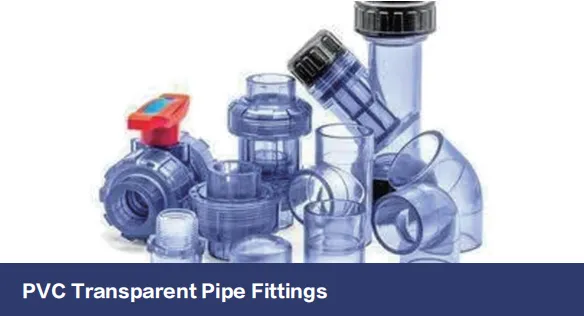
Why modern industry relies on transparent PVC fittings for safe, visible, and resilient fluid handling systems
You're walking through a modern beverage manufacturing plant when something catches your eye – an intricate network of crystal-clear pipes carrying colorful liquids across the production floor. Those aren't glass tubes, though they might look like it. What you're seeing is the unsung hero of fluid transportation: transparent PVC pipe fittings that combine visibility, durability, and safety in ways older technologies simply couldn't match.
Transparency in piping might seem like a small thing until you've seen a maintenance tech instantly spot a contamination issue brewing in a chemical transfer line. Or witnessed a brewer monitoring fermentation progress without cracking open a tank. That visibility – paired with PVC's remarkable impact resistance – is changing how industries handle everything from fruit juices to industrial solvents.
Let's break down why these fittings work so well. Standard PVC (polyvinyl chloride) gets its ruggedness from tightly interlocked polymer chains. But transparent variants? They take this further using proprietary formulations that maintain optical clarity without sacrificing strength. Picture reinforced glass with a plastic's resilience.
"Modern PVC compounds achieve up to 90% light transmission while matching the impact resistance of industrial-grade steel pipes" – a surprising fact that makes maintenance crews do double-takes.
Three factors give transparent PVC its remarkable toughness:
1. Molecular Alignment: During extrusion, manufacturers precisely control how polymer chains arrange themselves. Think of it like stacking logs versus throwing them in a pile – the organized structure absorbs shocks better.
2. Impact Modifiers: Specially engineered additives create microscopic "shock absorbers" within the material. When something hits the pipe, these particles deform temporarily rather than letting cracks propagate.
3. Wall Engineering: Strategic reinforcement at stress points – elbows, joints, and connection points – creates a safety factor exceeding typical requirements.
Imagine working in these environments:
Food & Beverage: At a kombucha brewery in Oregon, they switched from stainless to transparent PVC fittings after noticing two problems: brownish oxidation spots appearing in acidic brews, and condensation making labels illegible. Now, their hibiscus-infused batches flow through crystal-clear lines where operators spot sediment immediately. Maintenance time dropped 40%.
Chemical Processing: A Midwest solvent recycler shares how their previous setup – marked metal pipes carrying methanol – caused dangerous mistakes. After three near-misses where lines were cut open during maintenance, they switched to color-coded transparent PVC. Operators now see phase separation happening real-time, and safety incidents vanished.
Pharmaceuticals: Vaccine production demands absolute purity. One manufacturer found microscopic steel particles contaminating batches traced to pipe corrosion. Their switch to transparent PVC wasn't just about visibility – the non-reactive material passed FDA validation while cutting contamination events to zero.
"We didn't realize how much guesswork we were doing until we could actually see fluid behavior in the lines. It changed everything," confesses a plant manager at a major juice producer.
While seeing inside pipes is the obvious win, these fittings deliver surprising bonuses:
Temperature Tolerance: Modern PVC blends comfortably handle fluids from 0°F (-18°C) to 140°F (60°C) – perfect for chilled dairy lines or pasteurization processes. Insulation becomes simpler too since you're not fighting metal's thermal conductivity.
Chemical Resilience: Unlike metals that corrode or stain, PVC laughs off acids, alkalis, and solvents that turn other materials into Swiss cheese. One winery found their citric acid cleaning cycles degraded stainless elbows in 18 months – their transparent PVC replacements are entering year seven unscathed.
The Weight Factor: Imagine carrying a 20-foot section of steel pipe versus PVC. At about 1/5 the weight, install crews report fewer injuries and quicker deployments. One municipal water project cut installation time by 60% using PVC fittings.
Manufacturers don't just hope these fittings hold up – they beat them up to prove it. Industry standards like ASTM D2444 put fittings through punishing trials:
Cold-Impact Testing: Pipe sections chilled to -10°C get whacked with a 15-lb pendulum. If they crack or shatter? Back to the drawing board. Modern transparent PVC consistently survives unscathed.
Hydrostatic Burst Tests: Engineers gradually crank pressure inside sealed pipes until something gives. Industry-grade transparent PVC handles pressures exceeding 350 PSI – far beyond what most applications require.
drop Testing: Full pipe assemblies get dropped onto concrete from heights that would dent metal. The PVC versions typically bounce rather than break.
UV Exposure: Since some systems run outdoors, samples bake for weeks under artificial sunlight ensuring clarity and strength don't degrade.
What's next for these transparent workhorses? Industry whispers suggest:
Smart Integration: Imagine pipes with embedded micro-sensors detecting flow rate, temperature, and even contamination alerts – all visible through the walls. Prototypes already exist.
Self-Healing Surfaces: Materials science labs are developing PVC compounds that seal microscopic scratches using capillary action – potentially extending lifespans beyond 50 years.
Bio-Based PVC: Manufacturers are experimenting with plant-derived feedstocks to create greener versions without performance compromises.
Consider an automotive paint line that upgraded last year:
The Challenge: Solvent-based paints circulating through stainless pipes. Workers couldn't see blockages developing, leading to pressure spikes blowing fittings. Maintenance was reactive and messy.
The Solution: Custom transparent PVC fittings throughout. Now:
The plant manager summarized it best: "Transparency stopped being just about seeing inside pipes – it became transparency into our whole operation. We finally understand what's happening in our fluid systems."
In the world of industrial water supply systems and beyond, the shift toward transparent PVC fittings represents more than a material change – it's a philosophy shift. Instead of hiding processes behind metal walls, modern facilities gain visibility, safety, and control.
Next time you see those crystalline pipes snaking through a factory, know that inside flows more than liquids. It's confidence that systems won't fail, certainty that contaminants won't sneak through, and trust that technology can make industrial operations both stronger and more transparent.
The future of fluid handling isn't just tough – it's clear.
Recommend Products












