
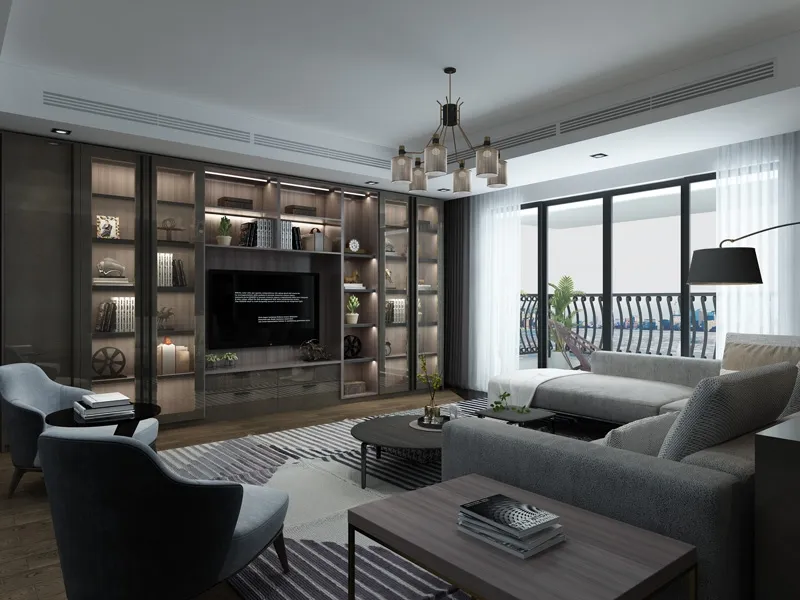
Picture your living room. What's the center of gravity? For most modern homes, it's that glowing rectangle we gather around each evening – the television. But have you ever stopped to consider the stage holding this digital storyteller? That humble TV cabinet isn't just furniture; it's a philosophy made tangible. In our quest for serene spaces, two ancient design traditions have quietly revolutionized this household staple: Minimalism ’s razor-sharp clarity and Wabi-Sabi's warm embrace of imperfection.
Minimalism taught us to whisper – to strip away the unnecessary until only essential beauty remains. Wabi-Sabi, Japan's ancient aesthetic of imperfect beauty, taught us to listen – to value the whispers of time in weathered wood and asymmetrical forms. Together, these philosophies are having coffee in your living room, redesigning that functional piece we've taken for granted.
Remember the 90s? Massive entertainment centers swallowed walls whole, plastic laminate screaming for attention. Then came Minimalism's revolution: Scandinavian designers shrank forms, muted colors, whispered "less is more." Simultaneously, Wabi-Sabi introduced handmade character – an antidote to sterile perfection. The result? TV cabinets evolved from shouty storage units to thoughtful spatial poetry.
Walk through a modern furniture showroom. What feels different? That pine TV console isn't disguised beneath plastic veneers pretending to be mahogany. Wabi-Sabi insists materials speak authentically: solid wood shows grain, knots, saw marks – testaments to its origin story. The Minimalist approach? Unpainted, unstained, unapologetic. Together they demand integrity:
Material Honesty in Action:
- Solid oak with visible mineral streaks becomes a feature, not flaw
- Recycled steel shows its industrial past through subtle patinas
- Textured stone supports aren't hidden, but celebrated for geological uniqueness
Cable management? Storage compartments? Dust prevention? These mundane requirements transform under Wabi-Minimalist principles. Forget hidden panels trapping dust bunnies. Imagine discreet ventilation slots carved like Japanese woodwork joints. Picture cord channels lined with handmade ceramic tiles celebrating craftsmanship.
Why does that floating walnut console feel peaceful? Minimalism teaches "Ma" – the Japanese principle of purposeful emptiness. Around the TV cabinet, this translates to breathing room:
- Floating shelves create visual stillness beneath displays
- Asymmetric compartments leave space for contemplation
- Recessed handles carve negative space into functional art
Meanwhile, Wabi-Sabi adds humanity. That indentation on the shelf where you place the remote? It's not machine-perfect. The stain variations? Proof of handcraft. These imperfections tell a story: yours.
Notice modern TV cabinets embracing natural irregularities? That's Wabi-Sabi honoring entropy. A Douglas fir plank might bend slightly, following the tree's original growth curve rather than industrial straightness. Minimalist rigor ensures these features don't become chaos but bring organic rhythm into technological spaces.
Waterfalls cascade down the sides of stone plinths. Vertical grain patterns create visual flow between shelves. And here's where Japanese wisdom transforms electronics: concealed compartments allow TV screens to disappear entirely when not in use, restoring visual stillness.
Touch your TV cabinet. Does your hand meet cold plastic or warm history? Wabi-Sabi insists surfaces feel alive:
- Rough-sawn textures create friction for wandering fingers
- Wire-brushed wood exposes grain valleys
- Hand-rubbed oils sink into thirsty wood pores
- Cast concrete reveals pebble aggregates like geological specimens
Minimalism frames these textures simply. No competing patterns. No distracting finishes. Each tactile experience stands in quiet clarity.
Your TV cabinet anchors entertainment, but now also sanctuary. Minimalist storage solutions contain digital clutter while Wabi-Sabi brings soul:
- Display niches framed in bronze darkening with time
- Hidden charging stations behind handwoven rush panels
- Cable access points disguised with imperfect ceramics
It’s functional poetry. And crucially, it’s adaptable – Wabi-Sabi cabinets anticipate change. Modular components let toddlers’ board games eventually become vinyl collections without replacing the entire piece. This isn't furniture; it's a life companion.
How do you invite these principles home? Forget rigid rules; seek resonance:
Choosing Your Palette:
• Ask materials for permission: Does oak feel honest in your space? Will concrete bring grounding?
• Celebrate constraints: Does limited space mandate ingenious proportions? Let that shape the character
• Incorporate repair history: Fix cracks with kintsugi gold instead of hiding scars
• Allow future changes: Floating components let storage evolve as media formats inevitably change
Ultimately, the Minimalist-Wabi-Sabi TV cabinet transforms entertainment into ceremony. It teaches us that surrounding our digital worlds with intentional tranquility isn't just design – it's nourishment for the contemporary soul.
When you next sit before your television, notice what holds it. See the breathing space Minimalism created. Touch the wood that Wabi-Sabi allowed to be imperfectly true. In this quiet spot where technology meets tranquility, the future of design has been quietly unfolding all along.
Recommend Products












