
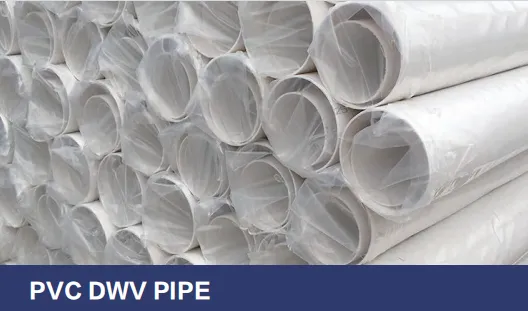
Imagine standing on a construction site, surrounded by the hum of machinery and the buzz of workers. You're a project manager, and today, the plumbing team is installing the drainage system for a new residential complex. The PVC DWV (Drain-Waste-Vent) pipes arrive, and as you inspect them, you notice something off—thin walls, uneven coloring, and a faint chemical smell. You brush it off, assuming it's just a minor batch issue. Six months later, the building is occupied, and complaints pour in: leaks in the walls, slow drainage, even mold growth. An investigation reveals the culprit: those low-quality PVC DWV pipes, which cracked under pressure and failed to withstand everyday use. The cost? Thousands in repairs, delayed handovers, and a damaged reputation.
This scenario isn't just a nightmare—it's a reality for many contractors, architects, and developers who overlook the critical step of verifying their PVC DWV pipe supplier's product quality. PVC DWV pipes are the unsung heroes of any building's plumbing system, responsible for carrying wastewater and venting gases safely away. When they fail, the consequences ripple through construction timelines, budgets, and even occupant health. That's why choosing a reliable supplier isn't just about comparing prices—it's about ensuring every pipe, fitting, and connection meets the highest standards of durability, safety, and performance.
In this guide, we'll walk you through the step-by-step process of vetting a PVC DWV pipe supplier, from checking certifications to evaluating manufacturing practices and beyond. Whether you're a seasoned contractor in Saudi Arabia or a developer sourcing materials for a hospital project, these insights will help you avoid costly mistakes and build with confidence.
Certifications are the first line of defense against subpar products. A reputable PVC DWV pipe supplier won't just claim their products are "high quality"—they'll back it up with third-party certifications that prove compliance with industry standards. For PVC DWV pipes, the gold standard is ASTM International's ASTM D2665, which specifies requirements for polyvinyl chloride (PVC) pipe, fittings, and couplings for drainage, waste, and vent (DWV) applications. This standard covers everything from wall thickness and dimensional stability to impact resistance and chemical compatibility—critical factors for long-term performance.
While ASTM D2665 is universal, regional regulations matter too. If you're sourcing for a project in Saudi Arabia, for example, ensure the supplier's products meet the Kingdom's national standards, such as SASO (Saudi Arabian Standards Organization) certifications. SASO enforces strict guidelines for building materials to ensure they can withstand local climate conditions—like high temperatures and humidity—and adhere to safety codes. A supplier that ignores regional certifications may be cutting corners, putting your project at risk of failed inspections or, worse, in-field failures.
Additionally, look for ISO 9001 certification, which indicates the supplier has a robust quality management system (QMS) in place. ISO 9001-certified suppliers follow documented processes for everything from raw material sourcing to production and testing, reducing the likelihood of inconsistencies. For specialized projects, such as hospitals or schools, you might also encounter requirements for fire safety—though PVC DWV pipes are not typically used in fire-rated systems, suppliers who also offer Class A fireproof materials (like CPL inorganic boards) may demonstrate a broader commitment to safety standards.
Beware of suppliers who hesitate to share certification documents or claim "proprietary standards" that replace recognized benchmarks. If a supplier says, "We don't need ASTM certification because our pipes are 'stronger,'" that's a major warning sign. Certifications aren't just paperwork—they're independent validation that the product has been tested and proven to perform. Without them, you're gambling with untested materials.
Certifications tell you a product should meet standards, but the raw materials used to make the pipes determine if it will meet them. PVC DWV pipes are made from polyvinyl chloride resin, but not all resins are created equal. High-quality pipes use virgin PVC resin, which is pure, consistent, and free from contaminants. Lower-quality suppliers, however, may cut costs by mixing in recycled plastic, fillers, or even toxic additives—compromising strength and safety.
A trustworthy supplier will be transparent about their raw material sources. Ask for details: Where do they source their PVC resin? Do they use recycled content, and if so, what percentage? Reputable suppliers often partner with well-known resin manufacturers, such as Formosa Plastics or Shin-Etsu, and can provide certificates of analysis (CoA) for each batch of resin. These CoAs verify the resin's purity, molecular weight, and absence of harmful substances like lead or phthalates—critical for projects in sensitive environments like schools or hospitals.
Another red flag is a supplier that refuses to disclose their raw material sources or claims "confidentiality." In an industry where material quality directly impacts performance, secrecy is rarely a good sign. For example, recycled plastic may contain impurities that weaken the pipe's structure, making it prone to cracking under temperature fluctuations or pressure. Even small amounts of contaminants can reduce a pipe's lifespan by years.
PVC DWV pipes aren't just resin—they also contain additives that enhance performance. Stabilizers, for instance, protect the pipe from degradation due to heat and UV exposure, while impact modifiers improve toughness. A low-quality supplier might skimp on these additives to save money, resulting in pipes that become brittle over time or warp in hot weather. Ask the supplier to explain their additive package: What stabilizers do they use? Are they lead-free? How do they ensure consistent additive mixing during production? A supplier that can't answer these questions likely hasn't invested in quality control.
A supplier's manufacturing facility is a window into their commitment to quality. Even if you can't visit in person (thanks to distance or time constraints), a virtual tour or detailed facility report can reveal volumes about their production practices. Here's what to look for:
PVC DWV pipe production relies on extrusion lines that melt resin, shape it into pipes, and cool it uniformly. Older, poorly maintained machines often produce pipes with inconsistent wall thickness, uneven diameters, or surface defects like pitting or warping. Modern lines, by contrast, use computerized controls to monitor parameters like temperature, pressure, and speed in real time, ensuring each pipe meets exact specifications. Ask the supplier about their extrusion equipment: How old are their lines? Do they use automated diameter and wall thickness gauges? A supplier with state-of-the-art machinery is more likely to deliver consistent, high-quality products.
Quality control shouldn't start after production—it should happen at every stage. During your tour, observe whether operators are checking pipes as they come off the line. Are they measuring diameters with calipers? Testing wall thickness with ultrasonic gauges? Inspecting for surface defects under lights? A rigorous in-process QC system catches issues like thin spots or air bubbles early, preventing defective pipes from reaching customers. Some suppliers even use vision systems—cameras that scan pipes for imperfections at high speeds—ensuring no defect goes unnoticed.
Also, look for separate areas for raw material storage and finished goods. Raw resin should be stored in dry, covered facilities to prevent contamination, while finished pipes should be sorted, labeled, and stored on racks to avoid damage. A disorganized factory with resin bags piled on the floor or pipes stacked haphazardly is a red flag—quality starts with order.
Every manufacturing process produces waste, but how a supplier handles that waste speaks to their efficiency and quality standards. A high-quality operation will have minimal scrap, as their processes are tightly controlled. If the factory floor is littered with rejected pipes, it may indicate frequent production issues or poor QC. Ask about their scrap rate: What percentage of production is rejected? How do they analyze the root causes of defects? A supplier that tracks and addresses scrap trends is committed to continuous improvement—while one that ignores waste is likely cutting corners.
Even the most impressive certifications and shiny factories mean nothing if the final product fails under real-world conditions. That's why testing is non-negotiable. A reputable PVC DWV pipe supplier will conduct a battery of tests on every batch—and they'll happily share the results with you. Here are the key tests to request:
PVC DWV pipes may not carry pressurized water like supply lines, but they still need to withstand occasional surges (e.g., from a clogged drain) and the weight of backfilled soil in underground installations. Hydrostatic pressure testing involves filling pipes with water and subjecting them to pressure above their intended operating level for a set period (typically 1 hour at 50 psi for DWV pipes). A pipe that leaks or deforms during this test is unfit for use. Ask the supplier for hydrostatic test reports for the specific batch you're ordering—generic "sample" reports are a red flag.
Pipes are often transported, stored, and installed in less-than-gentle conditions—dropped, dragged, or bumped against hard surfaces. Impact resistance testing (per ASTM D2444) measures how well a pipe withstands sudden blows. Samples are cooled to 0°F (-18°C) (to simulate cold weather) and struck with a weighted pendulum. A quality pipe will crack only if hit with significantly more force than the standard requires. If a supplier's impact test results show frequent failures or marginal performance, their pipes may not hold up on the job site.
Inconsistent dimensions—like varying outer diameters or wall thickness—can make installation a nightmare. Pipes that are too small won't fit into fittings; those that are too large may crack when tightened. Dimensional testing ensures every pipe meets ASTM D2665's strict tolerances. Ask for reports on outer diameter, wall thickness, and length variation for your batch. A supplier that can't provide these is likely producing pipes with "close enough" dimensions—until they're not.
| Test Type | What It Measures | Acceptable Result (ASTM D2665) | Red Flag |
|---|---|---|---|
| Hydrostatic Pressure | Resistance to water pressure | No leakage after 1 hour at 50 psi | Leakage or deformation at <40 psi |
| Impact Resistance | Toughness under sudden blows | No cracking at 15 ft-lbs impact (0°F) | Cracks at <10 ft-lbs impact |
| Dimensional Stability | Consistency in size/wall thickness | Outer diameter ±0.03 inches; wall thickness ±5% | Variations >±0.05 inches or >±10% |
| Heat Distortion | Resistance to warping in high temps | No visible distortion at 140°F for 1 hour | Softening or bending at <120°F |
A supplier can tick all the certification and testing boxes, but if their customers are unhappy, it's a warning sign. Reputation is built over years of consistent performance, and the best way to gauge it is to talk to other clients. Here's how:
A confident supplier will readily provide references from customers in your industry (e.g., contractors, developers, or plumbing wholesalers). When you call these references, ask specific questions: How long have they worked with the supplier? Have they ever had quality issues? How did the supplier handle complaints? Did pipes arrive on time and as ordered? A reference that hesitates or gives vague answers ("They're okay, I guess") is better than no reference at all—but it's not a glowing endorsement.
For bonus points, look for case studies on the supplier's website or social media. A supplier that showcases successful projects (e.g., "Our PVC DWV pipes were used in Riyadh's XYZ Residential Tower") is proud of their work—and transparent about their track record. Avoid suppliers with no public case studies or testimonials; they may be hiding a history of poor performance.
In today's digital age, a quick Google search can uncover a wealth of unfiltered feedback. Look for reviews on platforms like Alibaba, Thomasnet, or even social media groups for contractors. While one or two negative reviews are normal (no supplier is perfect), a pattern of complaints—"pipes cracked after 6 months," "customer service ignored our calls," "delivered the wrong size"—is a dealbreaker. Pay special attention to how the supplier responds to negative reviews: Do they apologize and offer solutions, or get defensive? A supplier that takes responsibility for mistakes is more likely to prioritize customer satisfaction.
There's a reason why the phrase "been in business for 20 years" is a selling point: longevity often correlates with reliability. A PVC DWV pipe supplier that's weathered market fluctuations, regulatory changes, and customer demands for decades has likely refined their processes and built a loyal customer base. Newer suppliers can be excellent, of course—but they lack the proven track record of their established counterparts. If you're considering a newer supplier, ask about their leadership team's experience: Have they worked in the PVC pipe industry before? Do they have a history of launching successful manufacturing ventures? Experience at the top often trickles down to better products.
Even the best products occasionally have issues. When they do, you need a supplier that's responsive, helpful, and committed to making it right. Customer support is a critical—but often overlooked—factor in choosing a PVC DWV pipe supplier. Here's what to assess:
Every project has unique challenges: tight spaces, unusual layouts, or specialized requirements (e.g., noise reduction in hospitals). A good supplier will offer technical support to help you select the right pipes, fittings, and installation methods. Do they have in-house engineers or technical advisors? Can they provide CAD drawings or installation guides? Will they answer questions about compatibility with other materials (e.g., plastic valve systems or upvc pipes)? A supplier that treats technical support as an afterthought will leave you scrambling when problems arise.
A strong warranty is a sign of confidence in a product. Most reputable PVC DWV pipe suppliers offer warranties of 5–10 years, covering defects in materials and workmanship. Read the fine print: What does the warranty exclude? Is it transferable if the building is sold? How do you file a claim? A supplier with a vague or overly restrictive warranty ("Warranty void if installed in temperatures below 50°F") is more interested in avoiding liability than standing behind their products.
Returns are another area to clarify. What if you receive a damaged shipment or the wrong size? Does the supplier offer free returns or replacements? A supplier that makes returns a hassle—charging restocking fees or dragging their feet on approvals—will cost you time and money in the long run.
A pipe is only useful if it arrives when you need it. Ask the supplier about their lead times, inventory levels, and contingency plans for delays (e.g., raw material shortages or shipping disruptions). Do they have multiple manufacturing facilities to avoid bottlenecks? Can they guarantee delivery dates in writing? A supplier that regularly misses deadlines will throw your project schedule into chaos—costing you overtime pay, lost productivity, and potentially even penalties for late completion.
While PVC DWV pipes are your primary focus, don't overlook suppliers that offer complementary products—like pipes fittings, plastic valve systems, or even upvc pipes. A one-stop supplier can streamline your sourcing process, reduce logistics costs, and ensure compatibility between products. For example, if you're installing PVC DWV pipes, using fittings from the same supplier guarantees a perfect fit, minimizing leaks. Similarly, pairing PVC pipes with a plastic valve system from the same manufacturer ensures the materials work together seamlessly, reducing the risk of chemical incompatibility.
That said, don't sacrifice quality for convenience. A supplier that offers "everything under the sun" but cuts corners on PVC DWV pipes isn't worth the time. Use the same rigorous vetting process for their other products, and ask how they ensure consistency across their product line. Do they have separate quality control teams for pipes vs. fittings? Are all products tested to the same standards? A one-stop supplier with a reputation for excellence in every category is a rare find—but worth the effort to locate.
Verifying a PVC DWV pipe supplier's product quality isn't a quick task—but it's an investment that pays dividends in fewer repairs, smoother projects, and peace of mind. By checking certifications, evaluating materials, inspecting factories, demanding test reports, researching reputations, and assessing customer support, you'll separate the industry leaders from the fly-by-night operators.
Remember: The cheapest quote isn't always the best deal. A slightly higher price from a reputable supplier may save you thousands in future repairs and delays. So take the time to ask questions, tour facilities, and talk to references. Your project—and your reputation—depend on it.
At the end of the day, a reliable PVC DWV pipe supplier isn't just a vendor—they're a partner in building safe, durable, and successful projects. Choose wisely, and build with confidence.
Recommend Products












