
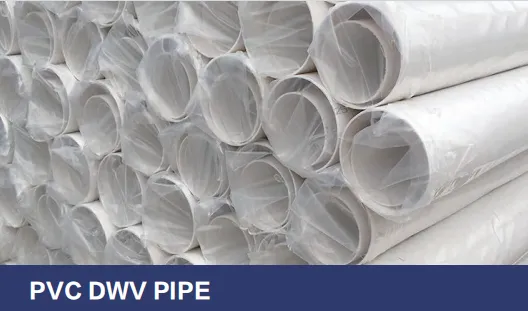
When you are planning a large commercial project, the plumbing and drainage network that runs through the building is easy to overlook and very hard to fix later. The PVC DWV pipe you install in an office tower, hotel, hospital, or shopping center must carry waste water steadily for decades, under constant use and strict code inspection. That is why choosing the right supplier matters just as much as choosing the right pipe. A reliable pvc dwv pipe supplier does more than sell product—it protects your timeline, your budget, and your reputation.
For those new to the term, DWV stands for drain, waste, and vent. Unlike pressure pipes that push water up, DWV piping relies on gravity to move waste downward while venting air to keep the flow smooth and trap seals intact. Because the stakes are high at commercial scale, this guide walks through the practical steps to shortlist, vet, and commit to a partner you can count on.
Before you compare suppliers, compare pipes. A large commercial project is not a plumbing fixture order—it is a volume purchase with exacting requirements. Start by writing down the nominal diameters, wall thickness, and schedule you need, and confirm that the supplier's product meets the dimensional and performance criteria your engineer has specified. For drainage and vent applications, check that the pipe complies with the relevant standard for DWV systems and, where the line carries potable water or sits in a fire-rated shaft, that it carries the appropriate certifications.
The type rarely changes for commercial DWV: thin-walled, low-pressure, gravity-flow pipe is the norm. But fittings matter just as much. Confirm that the supplier stocks the elbows, tees, couplings, and adapters that match your layout, because a project built from mismatched components is a leak waiting to happen.
A catalogue photo tells you nothing about how a pipe was made. For a large project, you need third-party evidence of consistent quality. Look for suppliers who run certified manufacturing processes—ISO 9001 for quality management is the baseline—and whose products carry the relevant product certifications for the region and application. A finished-pipe checklist is not enough; ask how the factory tests dimension, wall thickness, and impact resistance across production batches.
Consistency is the hidden risk in commercial procurement. A supplier that delivers one great truckload and then slips on the next will stall your project. Certified, controlled production is your best defence against that outcome.
Large commercial projects consume pipe by the truckload, and delay costs money. Ask the supplier directly about monthly output, current order load, and how much of your peak requirement they can guarantee in a single delivery window. Beware of a supplier who promises volume they cannot back up with facilities or contract terms.
Equally important is logistics. For international buyers, the distance from factory to port, the packing method, and the reliability of the shipping route all affect your job site. A pipes fittings supplier with export experience—and ideally a local agent or warehouse near your project—can remove a great deal of freight and customs risk.
There is no substitute for holding the product in your hands. Request samples of every diameter and fitting type you plan to use, then have them inspected by your team or a third-party lab. Check straightness, uniform wall thickness, a clean interior surface, and fittings that seat correctly together. A solvent-weld joint is only as good as the precision of the mating surfaces.
A large project does not end when the last pipe is laid. Confirm what the supplier offers after delivery: technical guidance on installation, clear warranty terms, and a point of contact who can answer questions when issues arise on site. Long-term buyers also benefit from suppliers who can consolidate adjacent materials under one relationship, reducing the number of vendors and contracts they must manage.
This is where a commercial building materials supplier earns its keep. When drainage, sanitary ware, and dozens of other categories come from one partner, your procurement gets simpler and your leverage grows.
Finding a partner who understands both the product and your market shortens the entire purchasing cycle. A supplier based in a major manufacturing hub gains from mature supply chains and competitive input costs, while a supplier with a local agent in your region provides faster support and smoother logistics. For buyers in the Middle East and beyond, for example, working with a manufacturer that keeps an overseas presence in Saudi Arabia can make the difference between a project that flows and one that stalls.
The piping under a large commercial building should be the last thing on your mind once construction starts, not the source of a crisis. By screening suppliers on specification fit, certification, capacity, logistics, and post-sale support, you build a foundation the project can rely on for years.
COLORIA GROUP is a commercial building materials supplier headquartered in Foshan, Guangdong, China, with an overseas agent in Saudi Arabia. It supplies PVC DWV pipes and a full range of pipe fittings alongside more than ten other building material categories, offering one-stop support for commercial and residential projects worldwide. Contact the team at +86-13630185350 (WhatsApp/WeChat) or visit www.coloriagroup.net.
Recommend Products












