
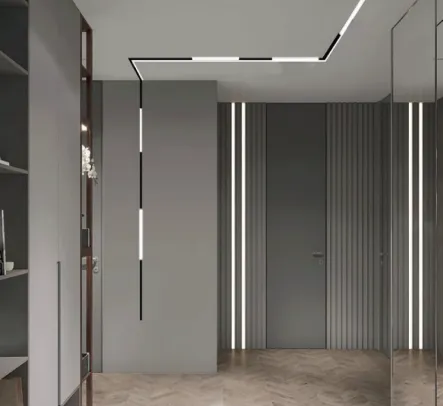
Magnetic track lighting has become a go-to solution for modern residential and commercial spaces, prized for its minimalist design, tool-free adjustability, and multi-scene flexibility. As demand grows, so does the number of suppliers claiming to offer patented track systems. For contractors, interior designers, and procurement managers, distinguishing genuine innovation from marketing claims is critical. This article walks through the practical steps to identify a reliable magnetic track lighting manufacturer with real patented track technology.
Before evaluating manufacturers, it helps to know what aspects of a magnetic track system can be patented. Common patent areas include the conductive rail design, magnetic coupling mechanism, modular connector architecture, and integrated dimming control circuitry. A manufacturer with genuine patents typically protects the bottom conductive technology, multi-circuit isolation design, or a unique mechanical locking structure that prevents fixtures from detaching.
When a supplier says they have patented systems, ask which specific component or technology is covered — and whether the patent is an invention patent, a utility model, or a design patent. The distinction matters because a design patent only covers appearance, while an invention patent protects the underlying technical innovation. Request to see the patent certificate number and verify it through official databases such as WIPO or the relevant national patent office.
A manufacturer serious about patented track systems runs its own R&D center and owns private tooling rather than sourcing generic molds from the open market. During evaluation, request documentation such as product development timelines, testing reports, and design iteration records. Visit the factory if possible, or ask for a video tour of the production line and tooling workshop.
Companies that invest in proprietary tooling, FR4 circuit boards with gold-plating processes, and 6063-grade aluminum extrusion tend to produce more reliable track systems than those that assemble from off-the-shelf components. The presence of in-house mold-making, SMT assembly lines, and aging test chambers are strong indicators of a manufacturer that controls quality at every stage rather than relying on third-party suppliers.
Patented technology is only valuable if the product meets the safety and performance standards of your target market. Look for certifications such as CE for European compliance, UL or ETL for North American safety, and RoHS for environmental compliance. A well-established magnetic track light supplier will also provide photometric test reports showing CRI ratings, lumen output, and flicker performance data.
The safe operating voltage — typically 24V for residential systems — should be clearly stated in the product specification sheet. Compatibility with dimming protocols like TRIAC, 0-10V, DALI, and smart control platforms such as Tuya, Zigbee, and Casambi is another indicator of a mature product line. A manufacturer that can provide third-party lab test reports for each certification demonstrates transparency and confidence in their engineering.
A strong manufacturer offers more than one track width. Look for suppliers that provide multiple track profiles: ultra-narrow 3.5mm tracks for near-invisible installations, 22mm 4-wire systems for independent multi-circuit control, and flexible or curved tracks for creative architectural layouts. The ability to customize track length, finish color, beam angle, and color temperature — typically ranging from 2700K to 6500K — signals that the manufacturer controls its own production rather than reselling standard catalog items.
Ask about minimum order quantities and lead times for custom configurations. A manufacturer with flexible MOQ policies and reasonable sample turnaround times is more likely to support your project through its design and prototyping phases. For comprehensive magnetic track light solutions, the supplier should also offer compatible accessories including power drivers, end caps, joiner connectors, and suspension kits.
A patented track system is a long-term investment, not a one-time purchase. Check whether the manufacturer maintains adequate inventory of drivers, connectors, and spare fixtures to support ongoing projects and future expansions. Ask about warranty terms — reputable manufacturers typically offer at least three to five years of coverage on their track systems — and whether technical support is available in your language and time zone.
A manufacturer with overseas project experience, particularly in markets like Saudi Arabia, the Middle East, Southeast Asia, and Africa, demonstrates proven logistics capability and familiarity with regional electrical standards and installation practices. Request case studies or project references from markets similar to yours to gauge their real-world delivery performance.
Working with a one-stop building materials supplier simplifies procurement significantly. When your project requires magnetic track lighting alongside ceiling systems, decorative profiles, electrical fixtures, and other interior materials, consolidating orders with a single partner reduces coordination overhead, shipping costs, and quality inconsistency risks. COLORIA GROUP supplies magnetic track lighting as part of a comprehensive LIGHTS category that also includes shop lighting, outdoor lighting, office lighting, hospitality lighting, and residential lighting — allowing buyers to source a complete lighting package plus complementary building materials from one reliable partner.
Once you have shortlisted potential manufacturers, compare them across several dimensions: patent authenticity and scope, production capability and in-house tooling, certification coverage for your target markets, customization flexibility and MOQ terms, and supply chain reliability with after-sales support. Request physical samples of the magnetic track system and test the magnetic coupling strength, track conductivity under load, and fixture interchangeability across different positions on the rail.
A reliable magnetic track lighting manufacturer will be transparent about their technology, responsive to technical inquiries, and willing to support your project from specification through delivery. They will share patent documentation when asked, explain their manufacturing process in detail, and provide references from completed projects. The effort spent on thorough evaluation upfront pays off in reliable product performance and fewer headaches during installation and long-term operation.
Recommend Products












