
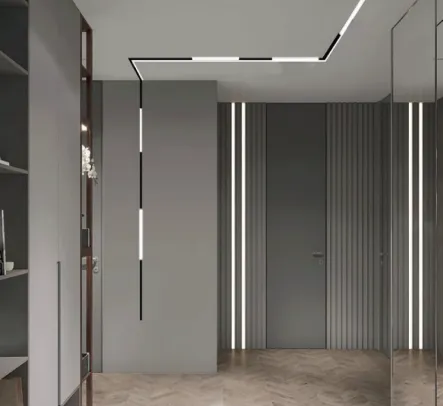
Design flexibility is one of the most critical factors when selecting a magnetic track lighting manufacturer. A system that can adapt to various architectural layouts, aesthetic preferences, and functional demands ensures that your lighting investment remains valuable as spaces evolve. This guide walks through the key dimensions to evaluate when assessing a manufacturer's design flexibility capabilities.
A manufacturer with genuine design flexibility will offer a comprehensive product range that covers multiple track types, fixture styles, and accessory options. When evaluating a supplier, examine whether their catalog includes:
A narrow catalog with only a few fixture types often signals limited manufacturing capability and restricts the design possibilities for your project. In contrast, a manufacturer with a broad portfolio demonstrates the engineering depth to support diverse design requirements across residential, retail, hospitality, and office environments.
True design flexibility goes beyond off-the-shelf products. The ability to customize track lengths, fixture configurations, and finishes is what separates a commodity supplier from a design-oriented manufacturer. Key customization indicators include:
| Customization Dimension | What to Look For | Why It Matters |
|---|---|---|
| Track Length | Custom-cut tracks to exact millimeter specifications | Eliminates awkward gaps or unnecessary joints in installation |
| Track Bending | Curved and angled track sections for non-linear layouts | Enables creative ceiling designs beyond straight lines |
| Fixture Finishes | Custom RAL color matching for fixtures and tracks | Ensures lighting blends seamlessly with interior design palette |
| Connector Design | L-type, T-type, cross-type, and flexible connectors | Supports complex layout geometries for large spaces |
When discussing your project with a potential manufacturer, ask whether they can accommodate non-standard requests. Manufacturers that respond with "we can develop that" rather than "we only offer standard sizes" are the ones that truly support design flexibility. A reliable magnetic track light solutions provider should be able to tailor their offerings to your specific project needs.
The hallmark of a flexible lighting system is modularity — the ability to add, remove, or reposition lighting fixtures without rewiring or structural changes. When evaluating a manufacturer, assess the following modular design features:
All fixtures — regardless of type — should be compatible with the same track system. A spotlight, linear light, and pendant should all be mountable and movable on the same track, allowing users to reconfigure lighting layouts as space usage changes. This is especially valuable in retail environments where display layouts shift seasonally, or in offices where team configurations evolve.
The magnetic connection mechanism should allow fixtures to be repositioned by hand without tools. A strong magnetic hold (typically rated at 3–5 kg retention force) ensures fixtures stay securely in place while still being easy to move during layout changes. Ask manufacturers about their magnetic retention testing standards and whether they perform cycle-life testing on their magnetic connectors.
The track system should support daisy-chaining and extension. For large commercial spaces, the ability to connect multiple track segments into continuous runs of 15 meters or more is essential. Verify that the manufacturer's connectors and power feed points are designed to handle extended track configurations without voltage drop or connection instability.
Key Question to Ask: "If I need to change my lighting layout two years from now, can I reuse the same track infrastructure and simply reposition or swap fixtures?" A manufacturer that can answer "yes" with confidence demonstrates genuine commitment to design flexibility.
Design flexibility in modern lighting extends beyond physical configuration to include intelligent control capabilities. A forward-thinking manufacturer should offer compatibility with mainstream control protocols:
The ability to tune color temperature (from warm 2700K to cool 5000K) and adjust brightness per fixture adds another layer of design flexibility. A single track can simultaneously serve as accent lighting for a display area (narrow beam, high brightness), ambient lighting for a lounge zone (wide beam, warm tone), and task lighting for a workstation (medium beam, neutral white) — all controlled independently.
A manufacturer's design flexibility is only as useful as the support resources that accompany it. Before committing to a supplier, evaluate the quality of their technical documentation:
| Support Resource | What to Expect |
|---|---|
| IES/LDT Photometric Files | Standard lighting data files for accurate Dialux or Relux simulations, allowing designers to model lighting performance before installation |
| CAD/BIM Components | Ready-to-use 2D and 3D blocks for AutoCAD and Revit, streamlining the design integration process |
| Installation Guides | Detailed step-by-step manuals with diagrams covering track mounting, fixture installation, and electrical connection |
| Design Consultation | Access to in-house lighting designers who can recommend fixture quantities, placements, and beam angle combinations for your specific project |
A manufacturer that provides comprehensive design support documentation demonstrates that they understand the full project lifecycle — from initial specification through installation and future reconfiguration.
The best way to gauge a manufacturer's design flexibility is to examine their project portfolio. Look for evidence of successful deployments across diverse application types:
A manufacturer that has delivered projects across multiple verticals brings cross-domain insights that benefit your specific project. They have likely encountered and solved the design challenges you are facing.
Design flexibility means little if the system degrades in performance over time. When evaluating a manufacturer, verify their quality assurance processes:
A system that allows flexible reconfiguration is only valuable if the components remain reliable through years of use. The magnetic connections should maintain their holding force, the LED modules should retain consistent color and brightness, and the drivers should perform without flickering or failure.
Making the Right Choice
Evaluating a magnetic track lighting manufacturer for design flexibility requires looking beyond the product catalog to assess the manufacturer's engineering depth, customization willingness, modular system design, control integration, and project experience. The right manufacturer will not only supply quality products but also serve as a design partner who understands your project's unique requirements.
As a one-stop building materials and lighting solutions provider, COLORIA GROUP offers a comprehensive magnetic track light solutions portfolio alongside 12 other product categories — from walls and flooring to sanitary fixtures and home appliances. This integrated approach means your lighting specification can be coordinated with broader interior design elements through a single supplier, reducing complexity and ensuring cohesive project delivery. When evaluating manufacturers, prioritize those who demonstrate not just product flexibility, but a genuine commitment to supporting your design vision from concept to completion.
Recommend Products












