
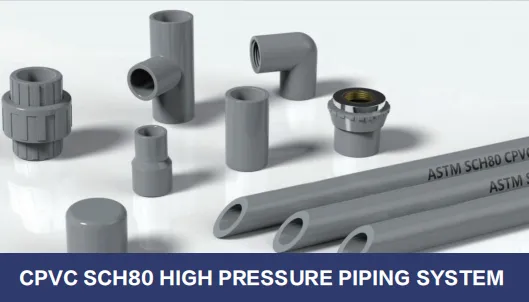
Choosing a CPVC SCH80 high pressure piping system supplier is one of those decisions that looks straightforward on paper but carries real consequences. The pipe network you install today is expected to carry hot water, chemicals, or fire-suppression fluid under pressure for decades, and a weak batch of pipe or a poorly made fitting can surface as a leak years after the project is handed over. The good news is that quality and reliability are not mysterious. Both leave traces you can check before you commit, and this article walks through the practical points that separate a dependable CPVC SCH80 high pressure piping system supplier from one that is simply quoting a low price.
CPVC, or chlorinated polyvinyl chloride, is PVC that has been further chlorinated. That extra step raises the material's maximum service temperature and improves its resistance to a wider range of chemicals, which is why it shows up in hot water distribution, chemical processing lines, and fire sprinkler systems where the fluid is hot, aggressive, or both. The SCH80 designation refers to the wall thickness schedule, giving the pipe a higher pressure rating than SCH40 at the same nominal size. Because the stakes are higher than a typical drain line, the supplier evaluation has to be correspondingly stricter.
The fastest way to narrow the field is to check which standards the supplier builds to. For CPVC SCH80 pressure piping, the references that matter include ASTM D2846, which covers CPVC plastic hot- and cold-water distribution systems, ASTM F441 for CPVC pipe and fittings, and ISO 15877 for CPVC piping systems used for hot and cold water. If the piping will carry drinking water, look for NSF/ANSI 61 certification or the local equivalent, and for fire-suppression applications, UL listings are the relevant mark.
A supplier that can produce these certificates on request, rather than promising to email them later, is usually a supplier that actually manufactures to those standards. Ask to see the certificate, note the certificate number and the issuing body, and check that the product name on the certificate matches the product you are buying. It takes two minutes and tells you a great deal about how the company operates.
Certifications are a starting point, but they are only as good as the process behind them. Ask how the supplier controls quality on the production line. Do they test every batch or only random samples? Do they keep batch records that let a specific roll of pipe be traced back to the raw material and the production date? Dimensional accuracy matters more than most buyers realize: an outer diameter or wall thickness that drifts outside tolerance produces loose joints, and loose joints fail under pressure.
A reliable CPVC SCH80 high pressure piping system supplier will be able to explain their in-process checks, show you their test equipment, and tell you how they handle a batch that fails inspection. If the answers are vague, treat that as a red flag rather than a detail to chase later.
Pressure piping is about long-term performance, not just how the pipe looks on day one. The tests that matter fall into a few groups:
You do not need to run these tests yourself. What you need is a supplier who can show you the results for the specific product you are buying, not a generic brochure claim that applies to the whole catalogue.
A pressure piping system is only as strong as its weakest component. Pipe, fittings, valves, and solvent cement all have to be compatible, and the safest arrangement is to buy them as a matched system from one source. Mixing pipe from one manufacturer with fittings from another is where joint failures usually begin. When you evaluate a supplier, ask whether they supply the complete CPVC SCH80 system, including pipe, fittings, valves, and joining materials, and whether the components are designed to work together. A supplier that offers the whole system also simplifies your procurement, because you deal with one point of contact instead of coordinating several.
The relationship with a piping supplier is a long one, and service quality shows up early if you know where to look. Send a technical question and see how quickly and how competently they respond. Ask about lead times and how they handle urgent orders. Check whether they provide documentation such as material certificates and test reports with each shipment. A supplier who answers questions clearly before you buy is far more likely to support you after the sale, when a project issue needs a fast answer.
When you sit down to compare candidates, run through this list and score each supplier against it:
Evaluating a CPVC SCH80 high pressure piping system supplier does not require you to become a polymer engineer. It requires you to ask the right questions and to insist on evidence instead of assurances. Standards and certifications establish the baseline, factory quality control and test records prove the performance, a complete product system removes compatibility risk, and responsive service protects you after the sale. Suppliers who can satisfy all of these points are the ones worth building a long-term relationship with. When you are ready to compare options, a CPVC SCH80 high pressure piping system supplier that manufactures the full range of pipes fittings and can back its products with test documentation is a strong place to start.
Recommend Products












