
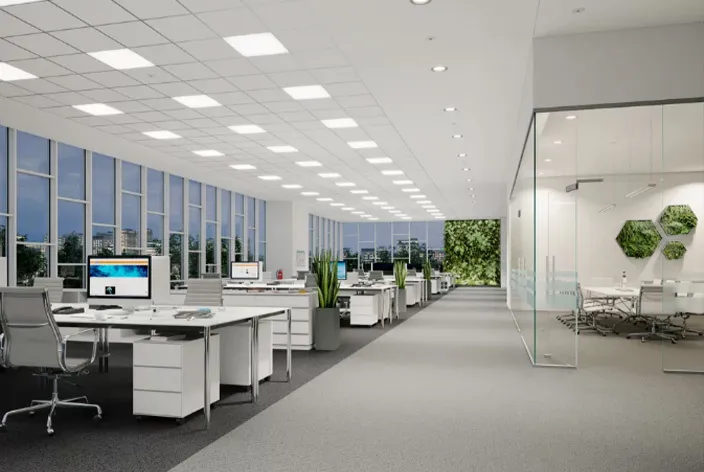
Lighting is not just about visibility — it shapes how people work, focus, and feel throughout the day.
Walking into a poorly lit office is an experience nobody forgets. The harsh glare from overhead tubes, the shadowy corners where desk lamps become mandatory, the collective afternoon fatigue that hits harder than it should. These are not minor annoyances — they are signs that the workspace lighting was chosen without enough thought. For project managers, facility directors, and procurement teams, finding the right office lighting supplier is not just a line item in a budget. It is a decision that affects energy bills, employee well-being, and the long-term maintenance load of a building.
The challenge is that the market is saturated with options. Walk into any trade show or browse any B2B platform, and you will find hundreds of suppliers claiming to offer the best LED panels, the most efficient troffers, the sleekest linear fixtures. So how do you cut through the noise and pick a supplier who actually delivers?
Before evaluating any supplier, you need to be clear about what kind of office lighting you actually need. A corporate headquarters with open-plan workstations has different requirements than a small consultancy with private offices, which in turn differs from a co-working space that operates 16 hours a day.
Most commercial office projects require a mix of the following:
Panel lights — Recessed or surface-mounted LED panels are the backbone of general office illumination. They provide even, glare-free light across large areas and are the most common choice for open-plan floors.
Linear suspended fixtures — These work well above workstations and in corridors. They offer directional lighting and can be arranged in continuous runs for a clean architectural look.
Track lights and spotlights — Useful for accent lighting in reception areas, meeting rooms, and executive offices where visual hierarchy matters.
Task lighting — Desk lamps and under-cabinet lights give employees control over their immediate environment, which has been shown to improve comfort and reduce eye strain.
A capable supplier should be able to provide all of these categories, not just one or two. This is where working with a commercial building materials supplier that covers multiple product lines becomes a practical advantage — you avoid the coordination headache of dealing with separate vendors for different fixture types.
Once you have defined your lighting requirements, the supplier evaluation begins. Here are the factors that matter most in real-world procurement:
A supplier that only offers one or two types of office lighting may not be a long-term partner. Look for a supplier whose catalog covers panel lights, linear fixtures, track systems, and task lighting under one roof. This consistency matters when you need matching color temperatures, uniform driver specifications, and cohesive aesthetics across a multi-floor project.
Office lighting operates for 10 to 12 hours a day, sometimes longer. The fixtures need to meet international safety and performance standards. Ask about CE, RoHS, and relevant local certifications. A supplier that cannot produce compliance documentation on request is a risk you do not need to take.
Not every office fits a standard ceiling grid. Some projects require custom lengths for linear fixtures, specific color temperatures (warm 3000K for breakout areas, cool 4000K-5000K for workspaces), or dimming protocols compatible with existing building management systems. A supplier with in-house engineering support can handle these requests without outsourcing to a third party.
A beautiful catalog means nothing if the delivery schedule is unreliable. Ask for clear lead times, shipping terms, and a track record of on-time delivery. For large commercial projects, even a two-week delay in lighting can cascade into costly downtime for other trades on site.
A practical tip: request a sample order before committing to a bulk purchase. A single LED panel or linear fixture sent to your site lets you verify build quality, packaging, color accuracy, and actual light output before the full shipment arrives.
Commercial construction and renovation projects rarely involve just lighting. A typical office fit-out also requires flooring, ceiling systems, wall panels, sanitary fixtures, doors and windows, and electrical components. Coordinating five or six different suppliers for these categories creates layers of administrative overhead — multiple invoices, multiple shipping timelines, multiple points of contact when something goes wrong.
This is the logic behind working with a one-stop architectural solution provider. Instead of sourcing lighting from one vendor, flooring from another, and ceiling materials from a third, a single coordinated supplier streamlines procurement, reduces freight costs through consolidated shipping, and gives you one accountable relationship to manage. For project managers juggling tight schedules, that consolidation is not a luxury — it is a practical necessity.
Before finalizing your office lighting supplier, run through these three questions:
1. Can they show me completed projects similar to mine? A supplier with experience in commercial office projects should be able to provide case studies or references. If they have only done residential work, the jump to commercial scale may introduce risks you do not want to own.
2. What is their warranty and after-sales process? LED fixtures have long lifespans, but driver failures and manufacturing defects do happen. A clear warranty policy and a responsive after-sales team are worth more than a slightly lower unit price.
3. Can they handle the full scope, or will I need multiple suppliers? If your project also needs ceiling panels, flooring, or electrical fixtures, ask whether the supplier can cover those categories as well. The fewer vendors you manage, the fewer opportunities for miscommunication and delay.
Office lighting is not something you replace every year. The fixtures you install today will shape the workspace experience for the next five to ten years. A well-lit office keeps employees alert through the afternoon slump, reduces the strain that leads to headaches, and creates a space that people actually want to work in. These outcomes are not accidental — they come from choosing the right products and the right supplier.
When you treat lighting procurement as a strategic decision rather than a commodity purchase, the criteria shift. Price per unit still matters, but so does product consistency, delivery reliability, customization capability, and the supplier's ability to support the broader scope of your project. In a market full of options, the suppliers that stand out are the ones that make procurement simpler, not more complicated.
COLORIA GROUP provides a comprehensive range of office lighting fixtures — including LED panel lights, linear suspended systems, track lights, and task lighting — as part of a full building materials catalog covering walls, flooring, ceilings, sanitary ware, doors, windows, and electrical components. If you are sourcing for a commercial project and want to consolidate suppliers, explore the product range or reach out to discuss your requirements.
Visit the office lighting page or browse the full product catalog.
Recommend Products












