
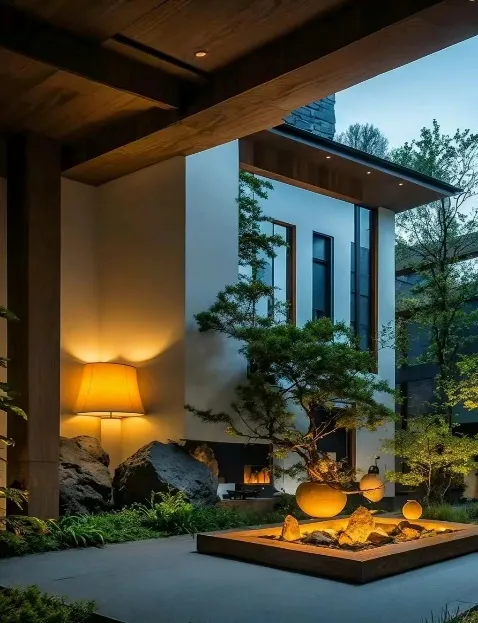
Outdoor lighting plays a vital role in enhancing safety, security, and aesthetics for residential gardens, commercial parking lots, pathway illumination, and public infrastructure. However, the effectiveness of any solar-powered outdoor lighting system depends almost entirely on one critical component: the solar panel. Choosing a solar panel with sufficient charging capacity ensures that your lights stay on through the night—even after cloudy days or during winter months when daylight hours are limited. This guide walks you through the key factors to consider when selecting solar panels for outdoor lighting, helping you make an informed decision that balances performance, durability, and cost.
A solar panel serves as the energy heart of an outdoor lighting system. During daylight hours, it converts sunlight into direct current electricity and stores it in a rechargeable battery. At night, the stored energy powers the LED light fixture. The panel's wattage, conversion efficiency, and exposure to sunlight collectively determine whether the battery receives enough charge to sustain illumination throughout the entire night.
When the solar panel is undersized, the battery never reaches full charge, leading to dim or short-lived lighting. Over time, chronic undercharging degrades the battery, shortening the entire system's lifespan. Conversely, an oversized panel adds unnecessary cost. The goal is to match the panel's charging capacity precisely to the lighting system's energy demands.
Before selecting a solar panel, you must first determine how much energy your outdoor lighting system consumes each day. The calculation is straightforward:
Daily Energy Consumption (Wh) = Light Wattage (W) × Operating Hours per Night (h)
For example, a 30W outdoor LED garden light running for 10 hours each night consumes 300Wh of energy. A 50W pathway light running for 8 hours consumes 400Wh. Accurate energy estimation is the foundation of proper solar panel sizing.
Solar panel performance is highly dependent on the availability of peak sunlight hours at the installation site. Industry guidelines recommend a minimum of 4 to 5 hours of effective peak sunlight daily for reliable charging. In regions with frequent overcast skies, heavy tree cover, or buildings that cast shadows, you must increase the panel's wattage to compensate for reduced solar exposure.
Before installing, carefully inspect the site for obstructions such as tall trees, neighboring buildings, or signage. Even partial shading on a single panel cell can sharply reduce the overall output. If unavoidable shading exists, consider a split-system configuration where the solar panel is mounted separately from the light fixture in an unobstructed location.
With the daily energy demand and peak sunlight hours in hand, use the industry-standard formula to calculate the required panel wattage:
Solar Panel Power (W) = (Daily Energy Consumption ÷ Peak Sunlight Hours ÷ System Conversion Efficiency) × Safety Factor
System conversion efficiency typically ranges from 0.7 to 0.8, accounting for losses in wiring, the charge controller, and battery charging. The safety factor is recommended at 1.2 to 1.3, reserving 20% to 30% extra capacity to handle cloudy days, seasonal sunlight variation, and long-term panel degradation.
A practical example: for a 30W outdoor light running 10 hours (300Wh daily), with 4 peak sunlight hours, 0.7 conversion efficiency, and a 1.3 safety factor, the required panel power is (300 ÷ 4 ÷ 0.7) × 1.3 ≈ 139W. The nearest standard size would be a 150W panel. For areas with only 3 hours of peak sunlight, the same calculation yields approximately 186W, calling for a 200W panel.
The two most common types of solar panels for outdoor lighting applications are monocrystalline and polycrystalline silicon panels. Each has distinct characteristics that affect performance and cost.
| Parameter | Monocrystalline | Polycrystalline |
|---|---|---|
| Conversion Efficiency | 20%–23%+, excellent low-light performance | 15%–18%, average low-light performance |
| Service Life | 25+ years, slow degradation | 20–25 years, slightly faster degradation |
| Space Efficiency | Higher (smaller panel for same wattage) | Lower (larger panel needed) |
| Best Use Case | Limited space, cloudy regions, long-term projects | Sunny regions, budget-conscious large-scale installations |
For most outdoor lighting applications—especially those in partially shaded areas, regions with inconsistent sunlight, or projects where long-term reliability is paramount—monocrystalline panels are the recommended choice. Their higher efficiency means they can generate more power from the same surface area, and they perform better during overcast conditions and at dawn and dusk.
The solar panel and battery must work together as a matched pair. An undersized battery cannot store the energy the panel generates, while an oversized battery paired with a weak panel will never reach full charge and may suffer permanent damage from chronic undercharging.
For outdoor lighting, lithium iron phosphate (LiFePO4) batteries are the preferred choice due to their long cycle life (2,000–3,000+ cycles), excellent thermal stability, and deep discharge capability. As a rule of thumb, the battery capacity should be sufficient to power the light for at least 2 to 3 consecutive rainy days. In high-rainfall or high-latitude regions, consider extending this to 3–5 days of autonomy.
Outdoor solar panels face constant exposure to rain, dust, UV radiation, and temperature extremes. Selecting panels with robust weather resistance is essential for long-term reliability. The minimum recommended ingress protection rating is IP65, which ensures the panel is dust-tight and protected against water jets from any direction. For coastal or high-humidity environments, look for panels with IP67 certification and corrosion-resistant aluminum alloy frames.
Additionally, verify that the panel glass is tempered and high-transparency, as this protects against hail impact and surface scratches while maintaining excellent light transmission over years of service. Reputable solar panel china supplier manufacturers provide panels that meet international certification standards such as IEC 61215 (performance) and IEC 61730 (safety), giving you confidence in the product's quality.
Modern outdoor lighting systems equipped with intelligent controls can significantly reduce the required solar panel size. Features like motion sensors (PIR or radar), dusk-to-dawn light sensors, and programmable time-based dimming can cut nighttime energy consumption by 30% to 50%. This reduction directly translates to smaller panel wattage requirements and lower upfront investment.
For example, a pathway light that operates at full brightness only when motion is detected—and dims to 20%–30% brightness otherwise—may reduce its effective daily energy consumption from 300Wh to as low as 150Wh. This can halve the required panel size, making the system both more affordable and more compact.
Different outdoor lighting applications have different energy requirements. The table below provides general guidance on matching solar panel wattage to common outdoor lighting scenarios:
| Application | Typical Light Wattage | Recommended Panel Size |
|---|---|---|
| Garden & pathway lights | 10W–20W | 50W–100W |
| Driveway & courtyard lights | 20W–40W | 100W–200W |
| Parking lot & security lights | 40W–80W | 200W–400W |
| Street & road lighting | 60W–120W | 300W–600W |
These values assume 4 peak sunlight hours and a standard safety margin. Always adjust based on your specific location's sunlight conditions and the desired autonomy days.
When building or upgrading an outdoor lighting system, working with a comprehensive supplier offers significant advantages. A one-stop building materials provider like COLORIA GROUP simplifies procurement by supplying both solar panels and a wide range of outdoor lighting solutions under one roof. This means you benefit from:
Even the best solar panel will underperform if installed incorrectly. Follow these practical tips to maximize charging efficiency:
Selecting solar panels with sufficient charging capacity for outdoor lighting is a process that balances careful calculation, environmental awareness, and quality component selection. Start by accurately assessing your lighting energy demand, then factor in your local sunlight conditions, apply the sizing formula with appropriate safety margins, and choose high-efficiency monocrystalline panels with robust weatherproofing. Pair the panel with a properly sized LiFePO4 battery and consider smart control features to optimize energy usage.
By sourcing from a reputable supplier that offers both solar panels and complementary outdoor lighting solutions, you ensure system compatibility and streamline your project from procurement to installation. A well-chosen solar panel is the foundation of reliable, sustainable outdoor illumination that serves your property for decades.
Recommend Products












