
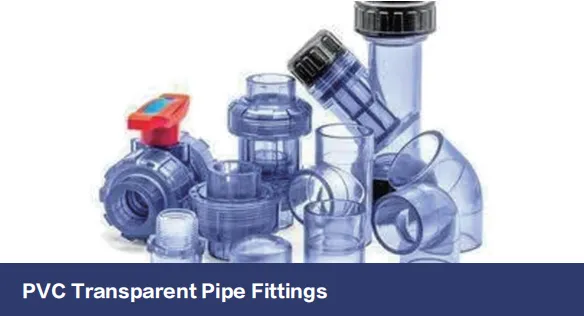
Ever wonder how industries monitor fluid flows without interrupting operations? The secret lies in clear PVC pipe fittings. These see-through components act as industrial windows, allowing you to literally keep an eye on your processes. Let's dive into how this transparent innovation revolutionizes monitoring across industries!
Picture this: You're managing a chemical processing line and need to monitor fluid consistency. Traditional pipes leave you guessing, but clear PVC fittings? They're like having X-ray vision for your operations. Unlike their opaque cousins, these fittings are manufactured through a specialized process that maintains optical clarity while delivering polyvinyl chloride's signature durability.
The transparency trick comes from carefully controlled additives. Manufacturers combine PVC resin with specific plasticizers and stabilizers, heated precisely between 155-160°C during extrusion. Add rapid cooling into the mix, and voilà – you get crystal-clear piping that maintains structural integrity.
These aren't just pretty pipes! Clear PVC maintains excellent chemical resistance while being lightweight enough for easy installation. Imagine spotting a blockage before it becomes a crisis or monitoring chemical reactions in real-time – that's the advantage transparent pipe fittings bring to the table.
| Fitting Type | Perfect For | Monitoring Advantage |
|---|---|---|
| 90° Elbows | Tight spaces needing sharp turns | See inside right-angle transitions where particles collect |
| 45° Elbows | Gradual flow direction changes | Monitor fluid dynamics with minimal turbulence |
| Clear Couplers | Extending pipeline length | Continuous visual access across connection points |
| Transparent Tees | Splitting or merging flows | Simultaneously monitor multiple flow directions |
"In our brewery, clear PVC elbows became our early warning system. We spotted sediment buildup in elbow joints during routine checks, preventing what would've been a production-stopping clog." - James R., Process Engineer
If you're working in compact spaces like laboratory setups or cramped equipment rooms, 90° elbows are your best friend. They execute sharp turns efficiently while letting you check for crystallization or particulate accumulation at critical angles. Perfect for chemical drainage systems where space is premium.
When dealing with viscous fluids or applications demanding flow efficiency, 45° elbows minimize resistance. In aquaculture systems or recirculating fountains, their gentle curve lets you track particle movement without disruptive turbulence. Less pressure drop means easier flow monitoring.
Watch reactions unfold as they happen through transparent pipes. Spot crystallization early during compound transfers and immediately identify contamination - no more guessing games about what's happening inside your pipes.
From tracking syrup consistency in bottling plants to monitoring dairy flows for curd formation, clear PVC turns quality control visual. See when filters need changing before flow reduction occurs and maintain sanitation standards visually.
Visually confirm filter effectiveness as water passes through clear sections. Immediately spot algae growth or sediment accumulation in elbow joints before it impacts system pressure. Transparency delivers peace of mind.
Demonstrate fluid dynamics principles with working transparent models. Educational institutions love using clear PVC assemblies as teaching tools where students can observe laminar vs turbulent flow firsthand.
Yes, even superheroes have weaknesses, and clear PVC is no exception. But smart monitoring design can overcome these challenges:
Sunlight can yellow your pipes over time. Solution? Use UV-resistant coatings for outdoor applications or route transparent sections indoors. Some manufacturers now offer UV-stabilized formulations that maintain clarity longer. For monitoring critical outdoor points, consider protective enclosures.
Clear PVC performs best between 0°C to 60°C. Beyond this range? Monitor high-heat applications with strategic transparent sections at critical points rather than entire runs. Insulate nearby pipes to maintain temperature stability around viewing areas.
Maximize your monitoring capabilities with proper setup:
Place transparent elbows strategically at critical monitoring points. Position clear sections after filters to verify performance or before sensitive equipment to protect them. Install at natural rest points where particles tend to accumulate for easy inspection.
You can't monitor what you can't see! Install focused LED lighting near transparent sections to backlight flowing media. Use different color temperatures to enhance visibility: cool white for water systems, warm white for oils.
Keep your visual access crystal clear with regular maintenance. For food applications, use food-grade cleaners monthly. Chemical systems benefit from dedicated flush ports near viewing fittings. Microfiber cloths prevent scratching during cleaning.
Implement routine monitoring checks: weekly visual inspections for critical processes, monthly for standard systems. Document findings directly on pipe surfaces with temporary markers. Create inspection checkpoints at key clear fittings during audits.
Clear PVC pipe fittings transform monitoring from educated guesswork to visual certainty. Whether you're preventing clogs in lab drainage systems or perfecting craft beverage clarity, these transparent components offer immediate process insight. By strategically implementing 90° and 45° elbows at critical points, your maintenance team gains superpowers - spotting issues before they escalate and verifying operations at a glance.
The future of process monitoring is transparent. Industries implementing clear PVC fittings consistently report reduced downtime, improved quality control, and more efficient maintenance operations. Remember, when it comes to process visualization, seeing truly is controlling.
Recommend Products












