
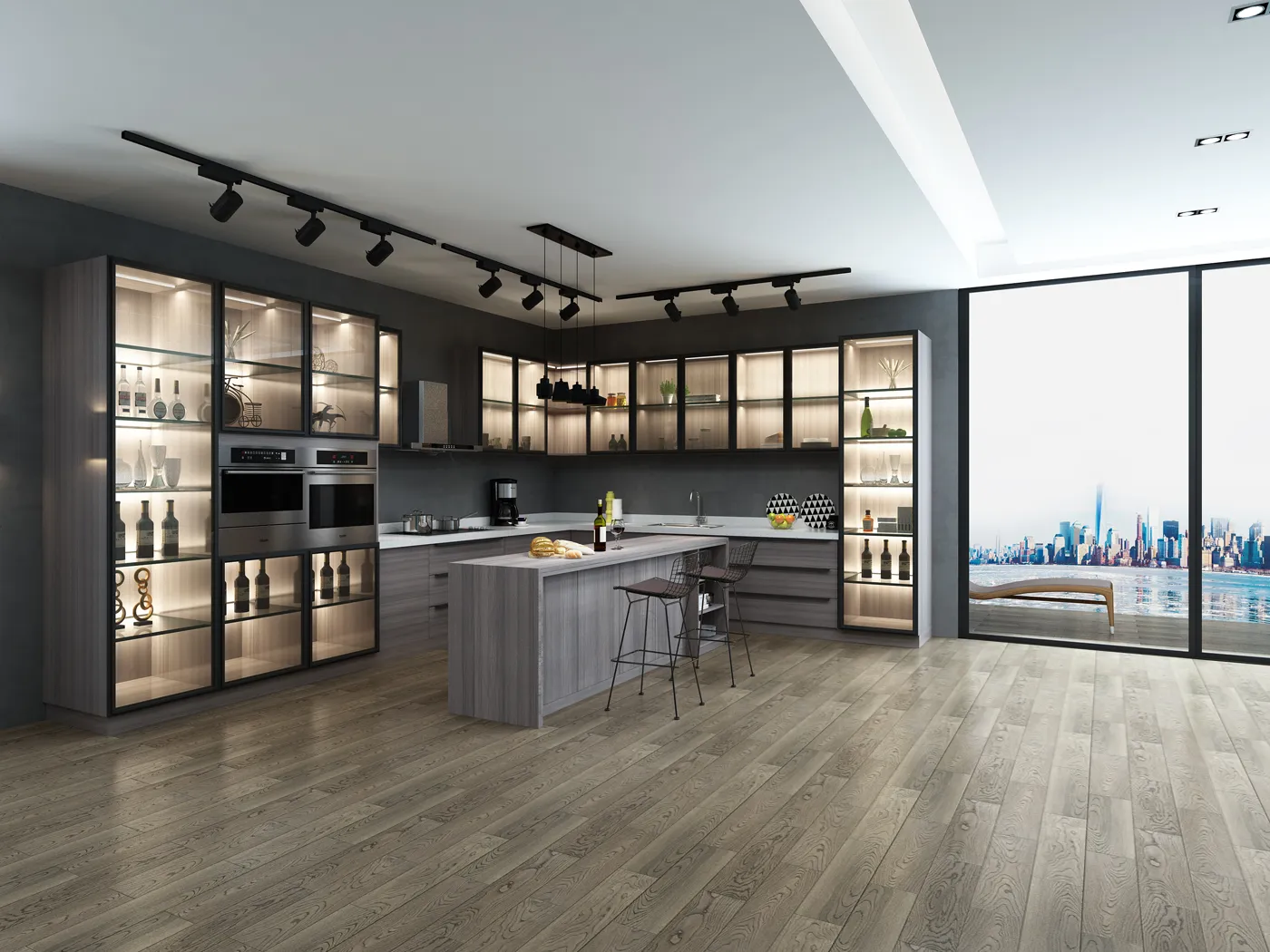
For decades, kitchen cabinets were functional storage solutions – boxes made of wood or particleboard, hidden behind monotonous doors. But the kitchen is transforming from a purely utilitarian space into the heart of our homes – a hub for connection, creativity, and wellness. This evolution is driving a revolution in kitchen cabinet design, fueled by astonishing advancements in materials science and digital technologies.
We're witnessing the convergence of multiple technological frontiers: smart materials with self-healing or antimicrobial properties, sustainable composites that outperform traditional wood, autonomous sensing systems for energy efficiency and food preservation, and advanced manufacturing techniques enabling unprecedented personalization. Together, these innovations are fundamentally reimagining what a cabinet is and does.
The kitchen cabinet industry is undergoing a seismic shift in material selection driven by environmental concerns and technological breakthroughs. Traditional materials like virgin hardwoods and formaldehyde-based particleboards are giving way to a new generation of engineered composites and bio-sourced alternatives.
Imagine cabinets constructed from bamboo charcoal composites – light, durable, and naturally antibacterial. Or surfaces made from nanocellulose derived from agricultural waste, offering incredible strength with negligible environmental footprint.
These innovations aren't just eco-friendly; they enhance functionality too. A notable leap forward comes from structural battery composites (SBCs) , previously spotlighted by the World Economic Forum as a Top 10 Emerging Technology for 2025. Though initially conceived for electric vehicles and aerospace, their potential in kitchen design is profound.
"Think beyond a cabinet that simply holds plates," explains Dr. Elena Rodriguez, a materials scientist at MIT. "SBCs enable us to build cabinetry that is the energy storage system itself – a structural element providing power for integrated lighting, charging stations, or even small appliances. The weight savings and efficiency gains could fundamentally change kitchen layouts."
Meanwhile, breakthroughs in inorganic decorative panels offer stunning aesthetics rivaling natural stone or wood grains, while providing unprecedented fire resistance, moisture tolerance, and ease of cleaning – perfect for the high-demand kitchen environment.
The passive cabinet is becoming obsolete. Future kitchens will feature intelligent cabinetry embedded with sensors, processing units, and micro-actuators, creating a responsive ecosystem that anticipates needs and enhances usability.
Powered by collaborative sensing technology, cabinets will communicate with each other, appliances, and home networks. Sensors embedded within cabinet doors and interiors will monitor:
This interconnected system forms part of a broader whole-house customization trend, where cabinetry acts as an intelligent node in the home automation ecosystem. Your cabinets could sense when you're preparing a complex meal based on ingredients accessed and automatically adjust task lighting or ventilation.
Kitchen cabinets endure significant wear and tear – spills, scratches, steam, and impacts. Emerging materials science promises surfaces that repair themselves and repel dirt without harsh chemicals.
Innovations in nanozymes – lab-created nanomaterials mimicking the catalytic functions of natural enzymes – are particularly promising:
"The dream of truly maintenance-free surfaces is becoming a reality," says Dr. Arjun Patel, head of materials innovation at a leading design institute. "We're moving from finishes you have to actively protect to surfaces that actively protect themselves and their environment through embedded nanotechnology."
Mass customization will define the future of kitchen cabinets. Technologies enabling bespoke design and on-demand manufacturing are eliminating the trade-offs between personalization, cost, and lead times.
Generative AI Design Assistants: Platforms leveraging generative watermarking for responsible AI (as highlighted in emerging technology forecasts) allow homeowners to co-create cabinet layouts. Describe your style ("Mid-century modern with a Japanese minimalism influence, warm wood tones, hidden smart storage"), and the AI generates detailed designs optimized for your space.
Advanced Additive Manufacturing (3D Printing): Moving beyond prototyping, industrial 3D printers using composite polymers or bio-sourced resins can produce intricate cabinet components, door fronts, and organizers tailored to exact dimensions and aesthetic preferences. This enables complex geometries impossible with traditional methods.
Robotic Precision Assembly: Collaborative robots equipped with vision systems handle intricate assembly tasks for custom cabinet configurations with perfect precision, increasing efficiency while reducing waste.
This shift toward digital manufacturing minimizes waste, reduces reliance on overseas production, and empowers local workshops to offer highly personalized solutions without massive inventory. It transforms the cabinet from a commodity into a crafted expression of individual style.
As homes become smarter and energy demands grow, kitchen cabinets are poised to play an unexpected role in power generation and management, contributing to integrated energy systems .
Osmotic Power Systems: While primarily large-scale infrastructure, the fundamental principle – generating power from salinity gradients – inspires potential for micro-scale applications. Conceivable future scenarios include cabinet surfaces in moist environments (near sinks or dishwashers) coated with specialized membranes, capturing minute amounts of energy to power integrated LED lighting or sensors.
Smart Surfaces: Cabinets featuring integrated photovoltaic materials could harvest ambient light, converting it into electricity for low-power applications like under-cabinet lighting or sensor networks.
Distributed Sensor Networks: Cabinets themselves become part of the home's energy monitoring system. Autonomous biochemical sensing for environmental control (temperature, humidity) provides granular data to optimize HVAC usage, reducing energy waste. Sensors embedded in cabinets can detect when heat appliances are in use (oven, stovetop) and automatically adjust ventilation efficiency.
While kitchen cabinetry won't replace solar panels, its strategic location throughout kitchens positions it as a key participant in home energy optimization networks, contributing to greener households.
The kitchen's role in family wellness is paramount, and future cabinets will actively contribute to healthier living environments. Innovations focus on improving indoor air quality and supporting user well-being.
Advanced Ventilation Integration: Cabinets above stoves will incorporate seamless, intelligent ventilation systems far superior to current hoods. Using optimized airflow algorithms and advanced filters (potentially leveraging nanozymes), they will quietly and efficiently capture pollutants at the source, improving indoor air quality.
Air-Purifying Materials: Surfaces incorporating activated bamboo charcoal or specialized catalytic agents actively absorb and break down volatile organic compounds (VOCs) released from cleaning supplies, off-gassing plastics, and cooking processes, creating a cleaner breathing environment.
Ergonomic Intelligence: Smart cabinets using weight and proximity sensors can automatically adjust shelf heights or slide-out trays to optimal positions for different users, reducing strain and enhancing accessibility.
"The kitchen cabinet is evolving from a storage unit into a wellness enabler," states nutritionist Maria Chen. "The ability to seamlessly manage food freshness through intelligent sensing reduces waste and promotes healthier eating habits. Active air purification and ergonomic intelligence further integrate health directly into the kitchen's fabric."
The environmental impact of manufacturing and discarding kitchen cabinets is immense. The future lies in designing for disassembly, reuse, and integration with wider circular economy principles.
Materials Innovation: Advances in lightweight building decorative panels made from rapidly renewable resources or recycled content dramatically reduce the carbon footprint compared to virgin wood or particleboard.
Designed for Disassembly (DfD): Cabinets will be constructed using mechanical fasteners and reversible adhesives instead of permanent bonding. Standardized interfaces for doors, frames, and hardware will make component replacement or upgrading simple, extending lifespan significantly.
Circular Logistics: Manufacturers will increasingly embrace take-back programs. End-of-life cabinets will be disassembled efficiently. Materials like advanced composites, metals, and specialized polymers will be separated and reprocessed for use in new cabinets or other products, minimizing landfill waste.
Green Nitrogen Fixation Inspiration: While a large-scale industrial process, the concept of producing essential components locally and sustainably resonates. Imagine modular cabinet systems manufactured locally on-demand using bio-based or recycled materials, drastically cutting transport emissions and packaging waste.
Sustainability is shifting from an add-on feature to the core operating principle. Future kitchens won't just use less energy; they'll be made from materials designed for multiple lives within a restorative industrial ecosystem.
This exciting future isn't without hurdles. Significant challenges need addressing:
The journey requires collaboration between material scientists, software engineers, traditional cabinet makers, and appliance manufacturers to create cohesive systems that truly enhance the user experience without becoming technological burdens.
The future kitchen cabinet is far more than a box. It will be a dynamic, intelligent participant in the home ecosystem, crafted from revolutionary sustainable materials. It will manage our food intelligently, conserve energy, contribute to cleaner air, adapt to our bodies, and self-maintain to a remarkable degree.
We are witnessing the convergence of materials science, sensor technology, AI, and sustainable design principles, transforming the most functional element of the kitchen into a platform for personalized, healthy, and sustainable living. The era of the passive cabinet is ending, ushering in an exciting future where our kitchens not only serve us but actively enhance our lives.
"This isn't just about redesigning cabinets," reflects futurist architect Thomas Vale. "It's about reimagining the entire kitchen environment. The boundaries between appliance, structure, storage, and interface are dissolving. The result will be spaces that are profoundly more intuitive, efficient, healthy, and responsive to human needs than we can easily envision today."
Recommend Products












