
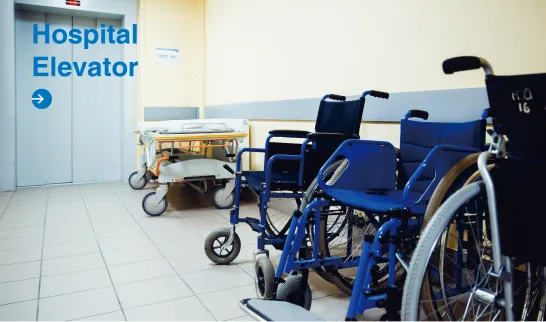
In hospital environments, not all elevators are created equal. While both stretcher elevators and standard hospital elevators serve vertical transportation needs within medical facilities, their design specifications differ substantially in ways that directly affect patient care, operational efficiency, and regulatory compliance. Understanding these differences is essential for architects, hospital administrators, and procurement professionals who need to make informed infrastructure decisions. This article examines the key design distinctions between stretcher elevators and standard hospital elevators across seven critical dimensions.
The most immediate design difference lies in cabin dimensions. A hospital elevator designed for stretcher transport must accommodate a standard stretcher measuring approximately 600mm by 2000mm, plus a medical team and portable equipment. The minimum recommended interior dimensions for stretcher elevators are 1400mm in width and 2400mm in depth. For ICU and surgical floor applications, cabins of 1600mm by 2700mm or larger are recommended. Standard hospital passenger elevators, by contrast, feature smaller cabins designed for standing passengers and wheelchair users, with typical dimensions closer to 1100mm by 1400mm — clearly insufficient for bed transport.
Stretcher elevators require wider door openings — typically at least 1100mm clear width — to allow smooth, unobstructed loading and unloading of beds and stretchers. Center-opening doors are the preferred configuration because they maximize the clear opening and minimize the risk of door contact with patients, IV poles, or monitoring equipment. Standard hospital passenger elevators may use narrower doors of around 900mm and can employ side-opening mechanisms, which are adequate for wheelchair access but wholly insufficient for stretcher transport.
Stretcher elevators are engineered for significantly higher load capacities, typically ranging from 1600kg to 2500kg. This accounts for the combined weight of the patient, the hospital bed or stretcher, accompanying medical staff (usually two to three attendants), and life-support or monitoring equipment. Standard hospital passenger elevators generally operate at lower capacities of 1000kg to 1350kg, which is sufficient for staff and visitor circulation but cannot safely handle bed transport scenarios.
Floor-leveling accuracy is a critical design parameter that distinguishes stretcher elevators from standard models. High-quality stretcher elevators achieve leveling precision within ±2mm to ±5mm, ensuring there is no jarring bump or gap at the threshold that could disrupt sensitive medical equipment or cause discomfort — and potential injury — to patients on stretchers. The ride smoothness is also calibrated to prevent vibration and sudden acceleration that could agitate patients or interfere with IV lines. Standard hospital elevators, while still requiring smooth operation, may have slightly more relaxed tolerances since they do not transport bed-bound patients.
Stretcher elevators incorporate antimicrobial surfaces and easy-to-clean materials throughout the cabin — typically stainless steel with antibacterial coatings — because infection control is paramount when transporting patients between wards, operating theatres, and intensive care units. Some advanced designs feature copper alloy touch surfaces on handrails and control buttons, which have proven antimicrobial properties that actively reduce hospital-acquired infection risks. Standard hospital elevators also prioritize cleanliness, but they may not require the same comprehensive level of antimicrobial surface treatment across the entire cabin interior.
Both elevator types include essential safety features, but stretcher elevators carry additional mandatory requirements. An Automatic Rescue Device (ARD) that moves the elevator to the nearest floor and opens the doors automatically during a power failure is non-negotiable for stretcher elevators, as patient entrapment during an outage can have life-threatening consequences. Emergency power backup via generator or battery systems ensures uninterrupted operation. Additional features such as seismic sensors, firefighter service mode, and two-way intercom systems are standard in stretcher elevator specifications. Standard hospital elevators include emergency features as well, but the redundancy and fail-safe requirements for stretcher units are typically more stringent.
Stretcher elevators are equipped with priority call systems that allow medical staff to override normal elevator operation during emergencies. These systems ensure the elevator is immediately available when a patient requires urgent transport between floors, such as from the emergency room to an operating theatre. Standard hospital elevators typically operate on conventional dispatching algorithms without the same level of emergency priority integration. In well-designed hospital facilities, stretcher elevators are also part of a separated traffic plan where patient, visitor, and service flows use dedicated elevator banks to minimize cross-contamination and congestion.
The design differences between stretcher elevators and standard hospital elevators are driven by fundamentally different operational requirements. Stretcher elevators prioritize cabin depth, door width, load capacity, leveling precision, infection control, and emergency redundancy to a degree that standard hospital passenger elevators do not require. For medical facilities planning new construction or renovation, selecting the right elevator for each application is a critical infrastructure decision. As a leading elevator manufacturer in China, COLORIA GROUP provides a comprehensive range of hospital elevators designed to meet the specific demands of modern healthcare environments, from stretcher lifts to freight elevators for medical logistics.
Recommend Products












