
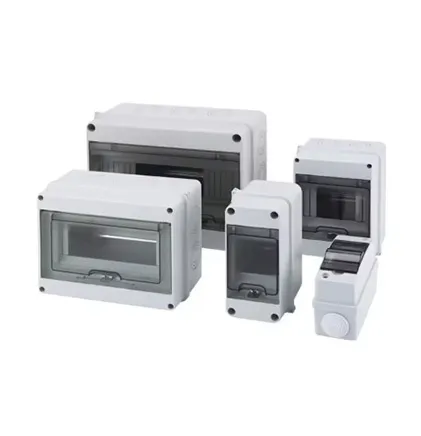
In electrical infrastructure projects, distribution boxes serve as the central hub for power routing and circuit protection. For contractors, project managers, and procurement specialists, the consistency of these units across large orders is just as important as their individual performance. A single substandard unit can compromise an entire installation. So how does a professional distribution box factory ensure that every unit leaving the production line meets the same high standard?
Product consistency begins long before materials enter the workshop. A reliable factory establishes detailed engineering specifications for every distribution box model. These specifications cover enclosure dimensions, material thickness, busbar configuration, circuit breaker mounting positions, and wiring layouts. By locking down design parameters in CAD and 3D modeling software, the factory eliminates variability that could arise from ad-hoc adjustments on the production floor.
Once a design is approved and type-tested, it becomes the immutable reference for all production batches. Any modification to the design must go through a formal engineering change process that includes re-validation and documentation updates. This discipline ensures that the 100th unit produced is functionally identical to the first.
The quality and consistency of finished distribution boxes are directly tied to the materials used. A reputable distribution box supplier implements strict incoming material inspection protocols. Each batch of steel sheets, copper busbars, insulating materials, and protective coatings is tested for thickness, tensile strength, conductivity, and flame resistance before being accepted into inventory.
Material traceability is equally important. Factories that maintain batch-level records can trace every component in a distribution box back to its raw material lot. If a quality issue is ever detected in the field, the traceability system allows the factory to quickly identify the affected batch range and take corrective action, preventing a small problem from becoming a widespread concern.
Consistency at scale requires advanced manufacturing equipment. CNC laser cutting machines, automated punching systems, and robotic welding cells produce components with repeatable accuracy that manual operations cannot match. When a distribution box enclosure is cut and formed by CNC equipment, the dimensional tolerance is maintained within fractions of a millimeter across thousands of units.
Automated powder coating lines further enhance consistency by applying uniform surface finishes with controlled thickness and curing parameters. The result is a product that not only looks identical from unit to unit but also delivers consistent corrosion resistance and electrical insulation properties.
Quality control in a professional electrical distribution box manufacturers facility is not a single checkpoint at the end of the line. It is a series of inspections embedded throughout the production process:
Key Consistency Factors
The most effective factories combine automated precision equipment with documented standard operating procedures and a culture of quality accountability. When machinery, methods, and mindset all align, product consistency becomes a natural outcome rather than a constant struggle.
Even the most advanced machinery requires skilled operators and well-defined procedures. Leading factories invest in workforce training programs that ensure every technician understands not just what to do, but why each step matters for product quality. Standard operating procedures are documented in detail, with photographic references showing correct assembly at each stage.
Regular competency assessments and refresher training keep the workforce aligned with evolving standards and new equipment. When procedures are standardized and personnel are consistently trained, the variability introduced by human factors is minimized while the benefits of human judgment in quality decisions are preserved.
International certification frameworks provide an external benchmark for consistency. Factories that hold ISO 9001 quality management certification have demonstrated their ability to consistently deliver products that meet customer and regulatory requirements. Product-specific certifications such as IEC 61439 for low-voltage switchgear assemblies further validate that the factory's production processes yield compliant results batch after batch.
Regular third-party audits and type-testing reinforce this discipline. A factory that voluntarily submits its products to independent testing organizations signals confidence in its manufacturing consistency and provides buyers with objective assurance.
Conclusion
Product consistency in distribution box manufacturing is the result of a systematic approach that spans design, materials, equipment, inspection, workforce training, and certification. Each element reinforces the others, creating a production environment where quality is built into the process rather than inspected in at the end. For buyers seeking a reliable partner, evaluating a factory's approach to consistency across these dimensions provides a clearer picture than price alone.
COLORIA GROUP, as a one-stop building materials supplier, offers a comprehensive range of electrical fixtures including distribution boxes, switches and sockets, and cables for residential, commercial, and industrial projects. With a commitment to quality and global customer satisfaction, COLORIA GROUP connects buyers with reliable manufacturing solutions that meet international standards.
Recommend Products












