
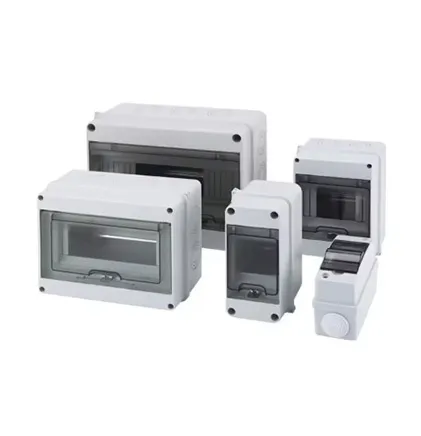
When procurement managers evaluate a china power distribution box against locally sourced alternatives, the sticker price is only the beginning of the story. A Chinese-made distribution box typically arrives at a unit cost that is 30% to 50% lower than equivalent products manufactured in Western markets. However, the real comparison must account for shipping, customs duties, lead times, after-sales support, and compliance with local electrical codes. Understanding these layers helps buyers make informed decisions rather than reacting to price tags alone.
China's electrical manufacturing sector benefits from deeply integrated supply chains. The Yangtze River Delta and Pearl River Delta regions host dense clusters of component suppliers, metal fabricators, and assembly facilities, all within a short radius. This proximity eliminates the multi-tier supplier markups common in fragmented Western supply chains. Raw materials such as copper busbars, steel enclosures, and insulation plastics are sourced directly from nearby mills and chemical plants, cutting intermediary costs.
Labor costs also play a significant role. Skilled assembly line workers in China's electrical manufacturing hubs operate at wage levels substantially below those in North America or Europe, yet productivity remains high due to standardized workflows and extensive automation. Robotic welding stations and automated testing lines reduce defect rates while keeping throughput costs competitive.
Economies of scale further widen the gap. Chinese factories serving the domestic market — the world's largest construction sector — run production lines at volumes that amortize tooling, mold, and setup costs across vastly larger quantities. A local manufacturer producing for a regional market simply cannot match this per-unit cost dilution.
Local sourcing does offer genuine advantages that translate into cost savings in specific scenarios. The most obvious is logistics: a domestically manufactured distribution box avoids ocean freight, port handling fees, and import duties. For small-quantity orders, these add-on costs can erase the unit price advantage of an overseas purchase. Lead times are also shorter, which matters when a project is running on a tight construction schedule and cannot afford four to six weeks of shipping and customs clearance.
Compliance and certification can be another pain point. Local manufacturers typically pre-certify their products to the electrical standards enforced in their home market — UL in the United States, CE in Europe, or AS/NZS in Australia. A Chinese supplier must voluntarily pursue these certifications, and not all do. Buyers who fail to verify certifications may face costly rework or rejection at the inspection stage. Therefore, working with an experienced exporter that understands target-market requirements is essential.
A complete cost comparison should use a total cost of ownership (TCO) model rather than looking at invoice prices alone. TCO includes the purchase price, freight and insurance, customs duties and brokerage fees, warehousing, quality inspection costs, warranty service, and the cost of any delays. For large-scale projects ordering hundreds of units, the freight and duty costs are spread thin enough that the Chinese unit-price advantage usually dominates the equation. For a small contractor buying five or ten units, local sourcing may come out ahead once freight minimums and customs brokerage fees are factored in.
Quality is another dimension of TCO. A poorly made distribution box — regardless of origin — creates costs far beyond its purchase price: downtime, replacement labor, potential safety incidents, and reputational damage. This is why buyers should evaluate suppliers on their quality assurance systems, not just their quoted price. Reputable Chinese manufacturers now operate ISO 9001-certified facilities with automated testing that rivals any Western factory.
COLORIA GROUP operates as a one-stop building materials supplier headquartered in Foshan, China — the heart of the country's building materials industry. The company's electrical fixtures & cables category includes distribution boxes, switches and sockets, and a full range of cables, offering project buyers a consolidated procurement channel. Instead of managing separate suppliers for enclosures, breakers, wiring, and accessories, a single purchase order with COLORIA GROUP covers the entire electrical package.
This consolidation reduces administrative overhead, simplifies logistics, and often unlocks volume discounts that would be unavailable when splitting orders across multiple vendors. The company ships to markets worldwide, with an established agent network in Saudi Arabia and experience navigating the documentation requirements of different regions. For buyers who want the cost advantage of Chinese manufacturing without the complexity of dealing with multiple unfamiliar factories, a partner like COLORIA GROUP provides a practical middle path.
When weighing a Chinese-made distribution box against a local option, buyers should evaluate several practical factors beyond price. First, verify that the supplier can provide the exact certifications required by the local authority having jurisdiction — this is non-negotiable. Second, request a sample order to assess build quality, packaging, and documentation before committing to a container load. Third, calculate the all-in landed cost using a realistic freight quote and the correct harmonized tariff code. Fourth, consider the warranty terms and how after-sales service will be handled across time zones. Finally, assess the supplier's communication responsiveness and English proficiency, as these directly affect how smoothly issues are resolved.
For many projects, the arithmetic favors importing from China once order volumes exceed a modest threshold. The key is to choose a supplier that combines competitive pricing with demonstrable quality control and reliable export logistics — precisely the value proposition that experienced exporters like COLORIA GROUP deliver.
Recommend Products












