
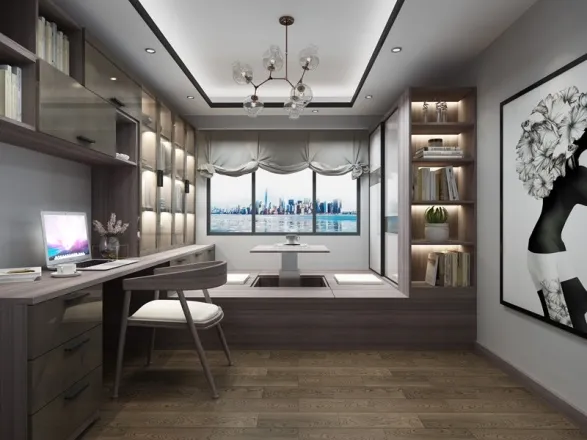
You know that frustrating moment when you walk into your bedroom and feel like you're navigating an obstacle course? Traditional beds with their bulky frames and mattress foundations dominate spaces, leaving little room for anything else. But what if I told you there's a centuries-old Japanese solution that completely reimagines how we use bedroom space?
Tatami bed systems have been quietly transforming small Japanese homes for generations, and now they're gaining global popularity as the ultimate space-saving sleep solution. Unlike conventional beds that permanently claim 30-40 square feet, tatami systems disappear during the day, transforming bedrooms into multipurpose spaces for yoga, work, play, or whatever you need.
The magic formula: Minimal nighttime footprint + Maximum daytime utility = Revolutionary space efficiency
Traditional Japanese tatami starts with a 2-inch thick base mat (about half the height of a standard mattress). But the real genius lies in its layered approach:
"Tatami creates a natural boundary between activity zones without physical barriers," explains Tokyo interior designer Kenji Tanaka. "The mats themselves signal functional transformation – when bedding is out, it's sleep time; when stored, the room breathes with new purpose."
| Space Factor | Tatami System | Traditional Bed | Space Saved |
|---|---|---|---|
| Daytime Footprint | 0 ft² (stored completely) | 30-40 ft² (permanent) | 100% |
| Vertical Clearance | Clears entire wall space | Blocks 60% of wall height | Storage wall potential |
| Room Circulation | Unobstructed walking paths | "Bed island" creates bottlenecks | 25% more usable floor |
| Multifunction Capability | 5+ functions per room | Typically 2 functions max | 150% utility gain |
Consider New York artist Marco's 400 sq ft studio: "Before tatami, my bedroom corner was wasted space 16 hours a day. Now, my sleep setup stashes in a wall cabinet and the same area becomes my painting studio, saving me $400/month in rental costs I'd otherwise need for separate workspace."
Beyond physical measurements, tatami beds dramatically affect how we experience space:
"My clients report feeling like they gained 200 square feet after switching," notes San Francisco organizer Lisa Chen. "That's not physical space – it's the relief of finally having room to breathe mentally without bedroom clutter dominating their view 24/7."
Contemporary designers have supercharged traditional tatami concepts:
Melbourne's Float Furniture merges Japanese principles with Scandinavian minimalism – tatami platforms that discreetly lift 6 inches, revealing storage cavities that swallow entire bedding sets in seconds.
Tokyo's Muji offers sensor-equipped tatami that track sleep patterns while auto-folding bedding at preset morning hours. Their climate-control layer even adjusts floor temperature seasonally.
The latest innovation? Transformable tatami walls. Berlin startup Raumkraft developed partition panels that slide from wall storage to instantly configure as room dividers or sleep platforms – turning studios into one-bedroom apartments at sunset.
Maria K., 280 sq ft Barcelona micro-loft: "Start with weekend naps before committing full-time. Use a padded shikibuton if your floor isn't perfectly level. Rotate mattress storage positions weekly to prevent permanent creases."
Beyond square footage, tatami's greatest gift might be temporal space:
"My morning routine shrunk from 45 minutes to 15," shares London consultant Amir. "Instead of making an elaborate bed, I simply roll my futon into its tatami compartment. That reclaims 30 precious minutes daily – 182 hours yearly!"
This philosophy of effortless transformation creates psychological breathing room too. Tokyo psychologist Dr. Sato observes: "The tactile ritual of laying bedding becomes meditation bookending the day – an actionable start/stop boundary increasingly lost in modern life."
The most innovative implementations borrow tatami principles throughout homes:
Integrating bespoke furniture designs allows seamless blending of functional tatami elements with Western decor aesthetics. Customizable tatami modules can transform awkward alcoves or underused corners into multi-functional zones.
Vancouver architect Elena Petrova designs homes around "tatami cores" – centralized service walls housing all sleep components that distribute to different rooms as needed. "It's about fluid space rather than designated rooms," she explains.
As urban dwellings shrink globally, tatami principles point toward sustainable solutions:
At its heart, tatami represents more than space efficiency – it's a philosophy of dynamic living space that adapts to our changing needs moment-to-moment. As Paris designer Luc Blanchet puts it: "We're not designing smaller homes, we're designing smarter relationships with space. Your bedroom shouldn't sleep all day while you're living."
Recommend Products












