
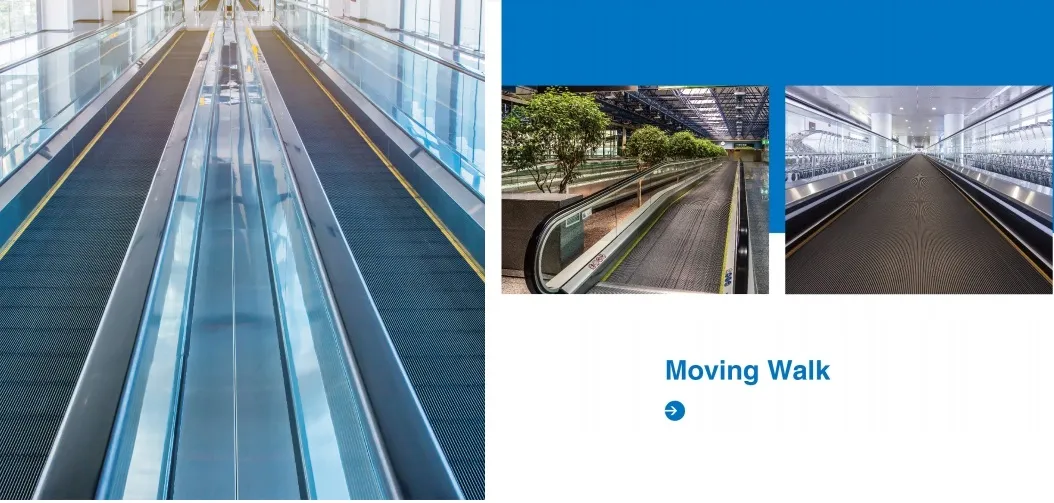
A moving walk — also known as an autowalk or travelator — is essentially a flat conveyor belt that transports people across horizontal or gently inclined surfaces. There are no steps; passengers stand or walk on a continuous belt. An escalator, by contrast, is a moving staircase with rotating steps that carries people between different floor levels. The key distinction is simple: escalators move people vertically, while moving walks cover horizontal distances.
Airports are the dominant application for moving walks. Long concourses connecting terminals, corridors stretching over 300 meters, and passenger transfer tunnels all benefit from moving walks. They reduce walking fatigue and speed up passenger flow without requiring floor-height changes. Transit hubs like metro stations and railway terminals, on the other hand, depend heavily on escalators. The vertical drop from street level to underground platforms — often 5 to 15 meters — demands a steep, step-based system. Many modern transportation hubs deploy both: escalators for vertical transitions and moving walks for horizontal passenger distribution.
The incline angle is a fundamental technical difference. Moving walks operate between 0° and 12° — any steeper makes the ride unsafe. Escalators run at 30° to 35°, which is steep enough to save floor space while remaining comfortable for standing passengers. In terms of speed, both systems typically run at 0.5 meters per second for standard applications, though high-traffic escalators can reach 0.75 m/s. Passenger capacity differs significantly: a standard escalator handles 6,000 to 9,000 passengers per hour, while a moving walk accommodates roughly 4,000 to 5,000 per hour. However, moving walks allow passengers to walk alongside the belt, effectively doubling their travel speed — something not recommended on escalators due to safety risks.
Modern moving walks and escalators both incorporate energy-saving technologies such as variable frequency drives and automatic slow-down modes during idle periods. Escalators generally consume more power due to the mechanical complexity of the step chain system and the greater height they must overcome. Moving walks, with their simpler belt-driven mechanism, are often more energy-efficient on a per-meter basis. Maintenance requirements also vary: escalators have more moving parts — steps, step chains, and handrail drives — and require more frequent inspection. Moving walks have fewer wear components, potentially reducing long-term maintenance costs.
The decision ultimately depends on the specific layout and passenger flow pattern of your facility. If your project involves long horizontal corridors — such as airport terminal connectors or convention center walkways — a moving walk is the clear choice. If you need to move passengers between floors in a shopping mall, metro station, or office tower, a commercial escalator is the right solution. For large-scale projects, working with a one-stop architectural solution provider can simplify procurement by offering both systems under a single supply chain, ensuring consistent quality and coordinated delivery schedules.
Moving walk solutions and escalators are complementary rather than competing technologies. Moving walks excel at covering long horizontal distances with minimal passenger fatigue, while escalators are indispensable for vertical transportation in multi-level facilities. Airports and transit hubs typically benefit from a thoughtful combination of both. By carefully evaluating passenger flow, spatial constraints, and long-term operating costs, project planners can make informed decisions that enhance both efficiency and traveler experience.
Recommend Products












