
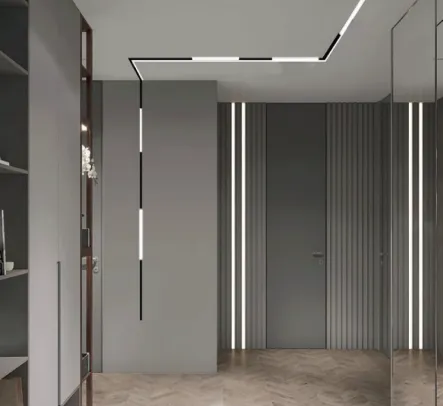
Track lighting has long been a staple in residential, commercial, and retail spaces, offering directional illumination that can highlight specific areas or architectural features. In recent years, however, magnetic track light solutions have emerged as a modern alternative to conventional 220V track lighting systems, prompting buyers, contractors, and project managers to reconsider which option best suits their needs. This article provides a detailed comparison of the two systems across key dimensions including safety, flexibility, lighting quality, installation, and long-term value.
Traditional track lighting operates on high-voltage AC power (typically 220V or 110V depending on the region). The system consists of a metal or plastic track rail with exposed copper conductors that carry mains voltage directly to the fixtures. Light heads are inserted into the track and twisted to lock into position, completing the electrical circuit through a mechanical connection.
The most common fixture types are spotlights fitted with standard GU10 or E27 bulb sockets. The key advantage of this approach is simplicity: bulbs are widely available, inexpensive to replace, and interchangeable across different brands. For basic illumination needs in warehouses, retail aisles, and utility spaces, traditional track lights remain a functional and budget-friendly choice.
However, traditional systems have notable limitations. The high-voltage design poses a safety risk during installation and maintenance, requiring professional electricians for any modification. Fixture positions are fixed once installed, making it difficult to adapt the lighting layout as space usage changes. The track profiles are also bulkier and more visually obtrusive, which can clash with modern minimalist interior designs.
Magnetic track lighting represents a fundamentally different approach. The system uses a slim aluminum rail with embedded copper conductors that carry low-voltage DC power — typically 48V. A driver converts mains AC power to safe low-voltage DC. Inside the track, steel strips provide a magnetic attachment surface, while strong neodymium magnets in the fixture bases snap onto the rail, locking the light into place and powering it instantly.
This magnetic attachment mechanism is the defining feature of the system. Fixtures can be slid freely along the track, repositioned, added, or removed in seconds — no tools, no electrician, and no rewiring required. The system supports a wide variety of fixture types beyond simple spotlights, including linear bar lights, grille lights, wall washers, flood lights, and pendant drops, all on a single track run.
| Aspect | Magnetic Track Lighting | Traditional Track Lighting |
|---|---|---|
| Voltage & Safety | Low-voltage 48V DC (SELV). Safe to touch, minimal shock risk. Ideal for homes, children's rooms, retail displays, and damp environments. | High-voltage 220V/110V AC. Shock hazard during installation and maintenance. Requires professional handling. |
| Fixture Attachment | Magnetic snap-on, tool-free. Fixtures slide freely and can be repositioned in seconds. | Mechanical twist-lock. Fixed positions, difficult to adjust without tools. |
| Fixture Variety | Spotlights, linear bars, grille lights, wall washers, pendants, flood lights — all on one track. | Primarily spotlights with GU10 or E27 bulbs. |
| Aesthetics | Ultra-slim aluminum profiles, nearly invisible when installed. Clean, modern look. | Bulkier track with visible hardware. Suits industrial or utility aesthetics. |
| Color Rendering | High CRI (typically ≥90, up to Ra97). Accurately renders colors of wood, fabric, leather, and artwork. | Often lower CRI. Colors may appear dull or washed out under cheaper fixtures. |
| Smart Control | Supports DALI, 0-10V, Zigbee, Bluetooth, Wi-Fi dimming and scene control. Compatible with smart home systems. | Limited to TRIAC dimmers or individual smart bulbs. No system-level smart control. |
| Maintenance | Integrated LED modules (50,000+ hour lifespan). Entire fixture replaced when LED reaches end of life. | Replaceable standard bulbs. Low per-bulb cost but more frequent replacements. |
| Upfront Cost | Higher initial investment (track, driver, fixtures). | Lower upfront cost. Affordable track rails and bulbs. |
For living rooms, bedrooms, and open-plan homes, magnetic track lighting provides a sleek, modern aesthetic with the flexibility to create layered lighting effects. You can combine warm spotlights over artwork with linear bars for ambient illumination, then adjust the layout as furniture arrangements change. The 48V low-voltage design also makes it a safer choice for homes with children.
Furniture showrooms, clothing stores, and galleries demand high color rendering to present products accurately. Magnetic track lights with CRI≥95 restore the true colors of wood grain, fabric textures, and leather finishes. The tool-free repositioning capability allows store managers to reconfigure lighting whenever merchandise displays are rearranged — a critical advantage in dynamic retail environments.
Hotels, restaurants, and office spaces benefit from the smart control capabilities of magnetic track systems. DALI or Zigbee integration enables scene presets — bright for daytime work, warm and dimmed for evening dining, accent lighting for lobby art displays — all controlled through a central system or mobile app. Traditional track lights, while adequate for basic corridor or back-office lighting, lack this level of control.
For warehouses, storage areas, or temporary installations where lighting flexibility and aesthetics are not priorities, traditional track lighting remains a practical choice. The lower upfront cost and widely available replacement bulbs make it suitable for spaces where the lighting layout is unlikely to change.
Both systems require a licensed electrician for the initial track installation and wiring. The difference lies in what happens afterward. With magnetic track systems, all subsequent fixture changes — adding, removing, or repositioning light heads — can be done by anyone without tools or electrical knowledge. Traditional systems require an electrician for any modification to the lighting layout.
Magnetic tracks can be installed as surface-mounted, recessed (requiring a false ceiling with 5-7 cm of clearance), or suspended. Surface mounting is the most straightforward option and works on bare concrete ceilings, making it suitable for both new construction and renovation projects.
The decision between magnetic and traditional track lighting ultimately depends on your project's priorities. If you value safety, design flexibility, high-quality light output, and smart home integration, magnetic track lighting is the clear winner for modern residential and commercial projects. If your primary concern is minimizing upfront cost for a space where the lighting layout will remain static, traditional track lighting may suffice.
For large-scale construction and renovation projects, working with a reliable magnetic track lighting manufacturer is essential to ensure consistent quality, compatibility across fixture types, and reliable after-sales support. As a one-stop architectural solution provider, COLORIA GROUP offers a comprehensive range of lighting products — including magnetic track lights, spotlights, chandeliers, wall lamps, and outdoor lighting — alongside 12 other building material categories, enabling project buyers to source multiple product lines from a single supplier and streamline the procurement process.
Magnetic track lighting represents a significant advancement over traditional track lighting systems. The combination of low-voltage safety, tool-free flexibility, high color rendering, smart control compatibility, and a sleek aesthetic profile makes it the preferred choice for modern homes, retail showrooms, hotels, and offices. While traditional track lights still serve a purpose in budget-sensitive or utility applications, the long-term benefits of magnetic systems — including energy efficiency, reduced maintenance hassle, and adaptability to changing space layouts — make them a worthwhile investment for most projects. When sourcing magnetic track lighting for your next project, choosing an experienced supplier with a broad product range ensures you get a system that performs reliably and looks exceptional for years to come.
Recommend Products












