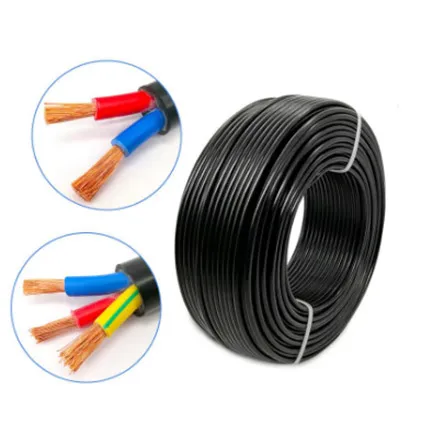
Every electrical installation, from a single wall socket to a full commercial building, depends on one quiet workhorse: the cable. Yet not all cables are created equal. Two properties decide how well a cable does its job — conductivity, which governs how efficiently electricity travels along the conductor, and insulation, which keeps that current safely contained. Understanding how different types of cables compare on both fronts is the first step toward choosing the right one for any project.
The conductor: what carries the current
Conductivity measures how easily a material lets electric current flow. The lower the electrical resistance, the less energy is wasted as heat and the better the cable performs. Silver is the best natural conductor, but its cost rules it out for everyday wiring. That leaves two practical choices for almost every real-world installation.
Copper — the benchmark. With a conductivity of around 100% IACS, copper offers the best practical balance of electrical performance, mechanical strength, and workability. It solders easily, resists corrosion at connection points, and handles repeated bending well. That is why copper remains the default conductor for building wiring, appliance cords, and most fixed installations.
Aluminum — the lightweight alternative. Aluminum conducts roughly 61% as well as copper but weighs only about a third as much and costs significantly less per meter. It is the standard choice for overhead transmission lines and large cross-section distribution cables, where weight and material cost matter more than raw conductivity.
Tinned copper — the corrosion-resistant option. A thin tin coating shields the copper from oxidation and corrosion, making tinned conductors a sensible choice in humid or chemically aggressive environments.
The practical takeaway is simple: if you want maximum conductivity in a given space, copper wins. If you are running long, heavy circuits and want to control cost and weight, aluminum earns its place.
The insulation: what keeps the current in its lane
Insulation is the material wrapped around the conductor. Its job is to stop current from leaking out, protect people from accidental contact, and survive the heat the conductor generates under load. Different insulation materials trade off temperature rating, flexibility, fire behavior, and cost.
PVC (polyvinyl chloride) — the everyday standard. PVC is cheap, tough, moisture-resistant, and easy to process, which is why it insulates the majority of low-voltage cables worldwide. Its continuous temperature rating is around 70°C. The catch is fire behavior: when PVC burns, it releases hydrogen chloride gas and dense smoke, which is why it is being phased out of high-occupancy buildings in many markets.
XLPE (cross-linked polyethylene) — the higher-performance upgrade. Cross-linking turns polyethylene into a thermoset that does not soften as temperatures rise, lifting the continuous rating to around 90°C. At the same conductor size, an XLPE-insulated cable can carry noticeably more current than a PVC equivalent. XLPE also has excellent dielectric properties, which makes it the standard insulation for medium- and high-voltage cables. It costs more than PVC, and because cross-linking is irreversible, offcuts cannot be recycled by simple remelting.
LSZH (low smoke zero halogen) — the safety-first choice. LSZH compounds release very little smoke and no halogen acid gases when exposed to fire. In tunnels, airports, data centers, and other enclosed or high-occupancy spaces, LSZH cables are often required by code because they dramatically improve the chances of safe evacuation.
Rubber and EPR — the flexible workhorses. Synthetic rubber insulation stays flexible across a wide temperature range and shrugs off ozone, UV, and weathering. Cables insulated with EPR are favored for mining, marine, welding, and other harsh environments where repeated flexing and outdoor exposure are the norm.
Silicone — the extreme-temperature specialist. Silicone insulation remains flexible from roughly −60°C to +180°C, which makes it the go-to for furnace wiring, heating elements, and aerospace applications. It is softer than most insulations and needs careful handling, but in high-heat settings it is often the only practical option.
PTFE — the chemical champion. PTFE resists essentially every acid, base, and solvent up to about 260°C. It is expensive and hard to process, so it is reserved for laboratory instruments, chemical plants, and other specialist uses.
Bringing the two together: how cable types are built
A cable is really a pairing decision: pick a conductor for how much current you need to move, then pick an insulation for the environment it will live in. For ordinary building wiring, a copper conductor with PVC insulation covers most needs at a sensible price. Where circuits are heavily loaded or run in warm spaces, switching to XLPE insulation buys extra current capacity without upsizing the conductor.
For direct burial or industrial sites where a cable may be crushed or gnawed, armored constructions add a layer of steel or aluminum wire protection. For life-safety circuits such as fire alarms and emergency lighting, mineral-insulated cables with magnesium oxide insulation keep working even in a fire. Flexible cables use finely stranded conductors so they can bend and flex thousands of times without breaking, which is why appliance cords and portable tool leads are built this way. Medium- and high-voltage cables add semiconducting screens to smooth out electric field stress, which is essential for reliable long-term performance above 1 kV.
How to choose the right cable
There is no single "best" cable — only the right cable for the job. Start with the current the circuit must carry and the voltage it must withstand, then factor in the environment: indoor or outdoor, wet or dry, hot or cold, exposed to chemicals or mechanical damage, and whether fire safety regulations apply. Those answers point you to the right conductor, the right insulation, and the right construction.
Conclusion
Conductivity and insulation are two sides of the same decision. Copper and aluminum define how efficiently a cable carries current; PVC, XLPE, LSZH, rubber, silicone, and PTFE define how safely and durably it contains that current in its environment. Understanding these trade-offs lets you specify cables with confidence — whether you are wiring a single room or equipping an entire building.
For builders, contractors, and project teams sourcing reliable wiring for residential and commercial projects, working with a trusted
cables supplier makes the process far simpler. COLORIA GROUP, a one-stop building materials supplier based in Foshan, China, supplies a full range of
electrical fixtures & cables alongside its broader portfolio of interior and exterior building materials. Their team can help you match the right
different types of cables to your project's conductivity and insulation requirements.